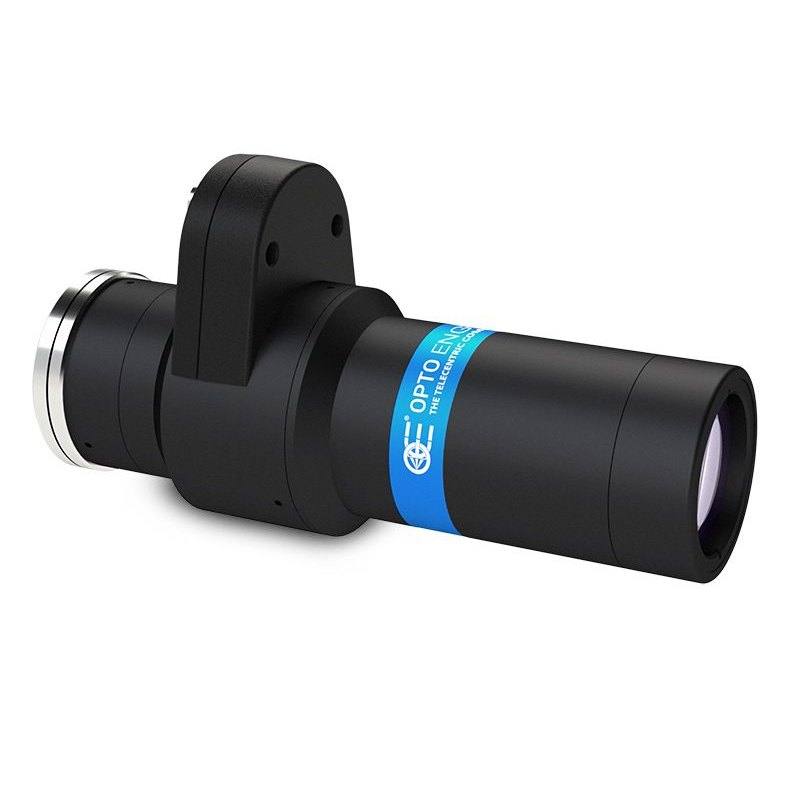
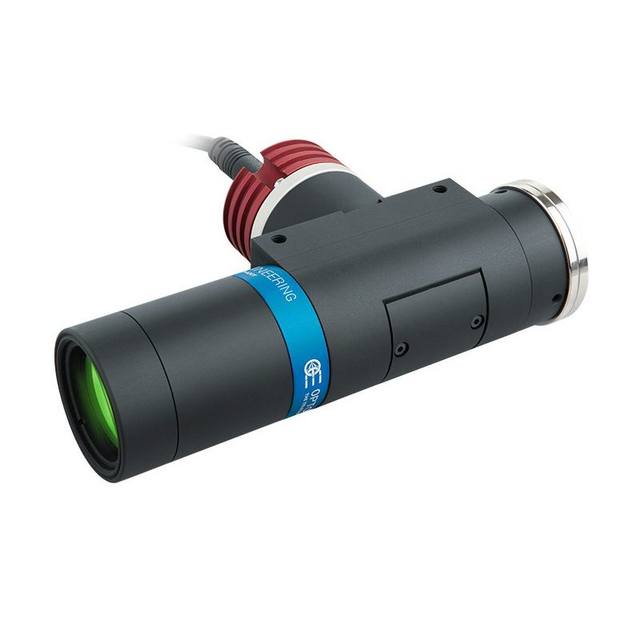
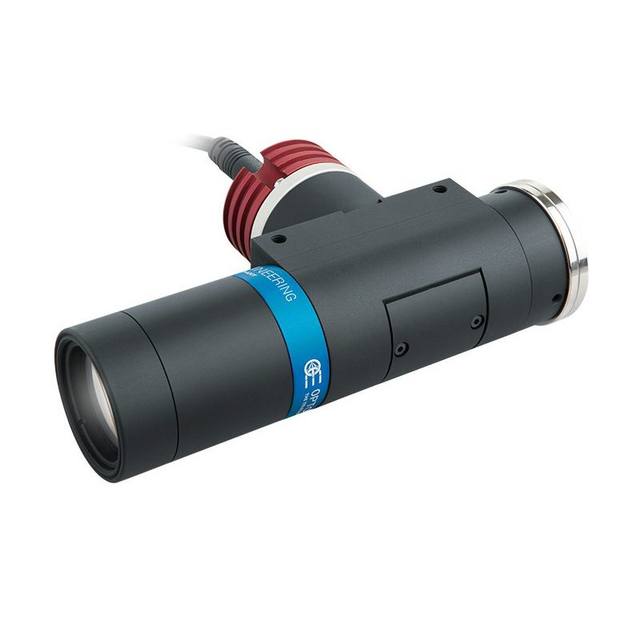
The Opto Engineering TCEL050 is a telecentric lens for 2/3″ sensors with an integrated liquid lens, set at 0.500× magnification. Its Ø 11.0 mm image circle covers sensors up to 2/3″, and the 132.3 mm working distance gives the camera room to stand off from the part. The TCEL series uses telecentric optics with liquid lens technology, so the liquid lens is built into the optical design itself.
Telecentricity is listed as < 0.04 (0.08) deg typ. (max) and distortion as < 0.1 (0.2) % typ. (max). A telecentric lens keeps the image scale nearly constant as the object moves within the depth of field, so these figures set how consistently a dimension reads from part to part. The wF/# 12 aperture sets the trade-off between depth of field and the light reaching the sensor.
The mount is C-mount, and the operating temperature is 0-40 °C. Because the optic has an integrated liquid lens, plan its integration as part of the system design, not only the mechanical mount. Account for the 0-40 °C range in the enclosure and ambient conditions, and confirm that the 132.3 mm working distance fits the machine geometry.
Best for
Gauging parts at 0.500× with a 132.3 mm working distance.
Telecentric inspection with a C-mount camera that has a sensor up to 2/3″.
Machine designs that specify a telecentric optic with integrated liquid lens technology.
Stations operating within a 0-40 °C ambient range.
Selection notes
Confirm that the object field at 0.500× covers the part features at the 132.3 mm working distance.
Set measurement tolerances on the maximum values, telecentricity of 0.08 deg and distortion of 0.2 %, and use the typical values as expected performance.
Plan the mechanical stand-off and enclosure around the 132.3 mm working distance and the 0-40 °C operating range.
Check the liquid lens control and wiring details in the manufacturer datasheet before designing the cabinet.
Specifications: General
Brand
Opto Engineering
Specifications: Optical
Lens mount
C-mount
Image circle / max sensor
Ø 11.0 mm (max sensor 2/3″)
Magnification
0.500×
Working distance
132.3 mm
Telecentric
Yes
Specifications: Environment
Operating temperature
0-40 °C
Applications this product is commonly selected for. Open one to see the full recommended hardware and approach.
Matched automatically by: camera mount fits the lens mount · camera sensor is covered by the lens image circle — this lens: C-mount · Ø 11.0 mm (max sensor 2/3″) image circle.