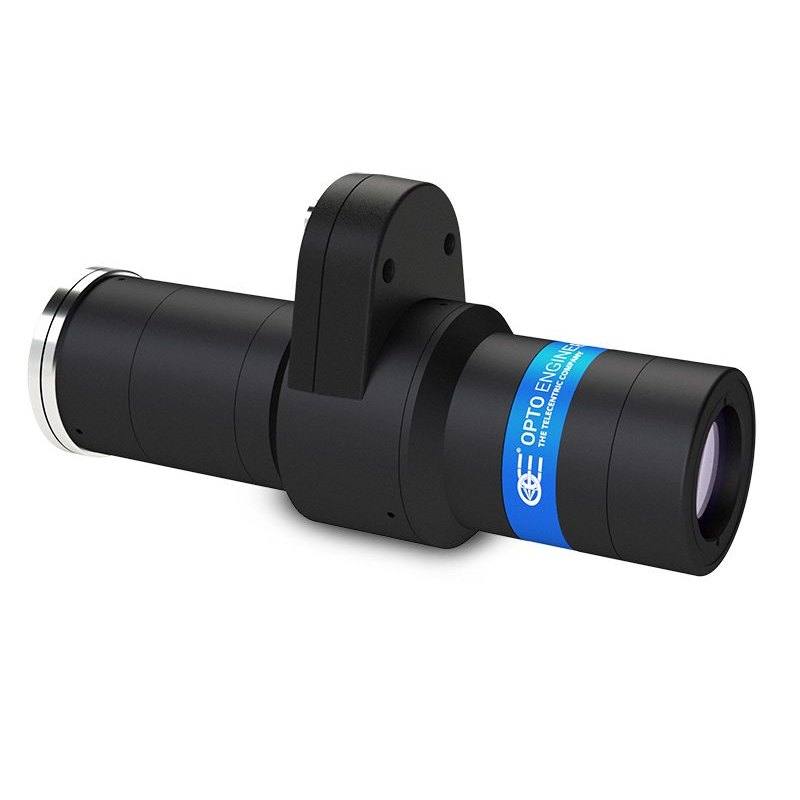
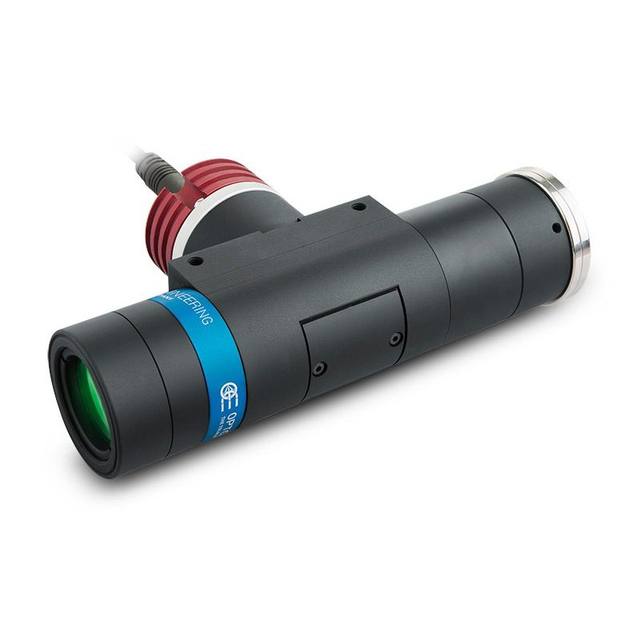
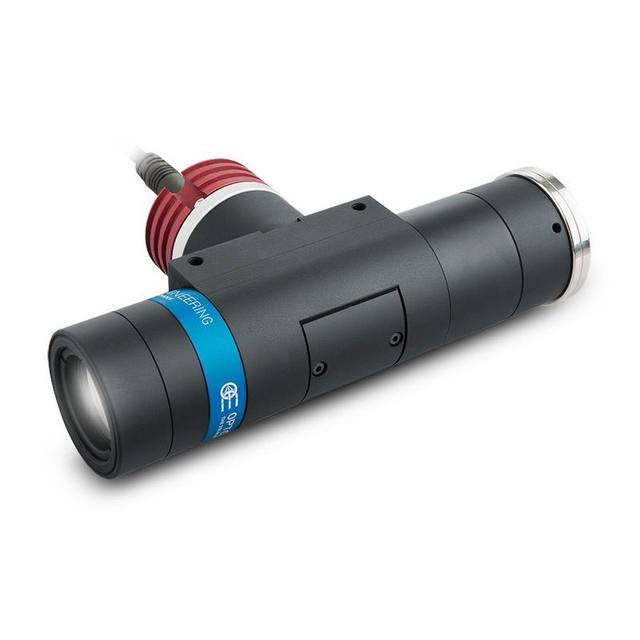
The Opto Engineering TCEL150 is a telecentric lens for 2/3″ sensors with an integrated liquid lens, set at 1.500× magnification. The object-side field follows from dividing the Ø 11.0 mm image circle by 1.500, so the lens images a small area of the part onto the sensor. The 132.3 mm working distance keeps the camera off the part, and the TCEL series uses telecentric optics with liquid lens technology.
Distortion is listed as < 0.05 (0.1) % typ. (max) and telecentricity as < 0.08 (0.1) deg typ. (max). Carry the typical and maximum figures into the tolerance budget, since they set how accurately a dimension can be read at this magnification. The wF/# 16 aperture is a small opening: it gives more depth of field but passes less light than a wider aperture, which makes the lighting plan more important.
The mount is C-mount, and the operating temperature is 0-40 °C. Because the lens has an integrated liquid lens, plan its integration alongside the mechanical design and the camera selection. At 1.500× the field is small, so repeatable part positioning within the 132.3 mm working distance matters for consistent results. Keep the 0-40 °C range in mind when laying out the bracket and enclosure.
Best for
Measuring small features at 1.500× magnification.
Telecentric gauging with 2/3″ C-mount camera systems.
Applications that need 1.500× magnification at a 132.3 mm working distance.
Setups that use a small aperture (wF/# 16) to extend depth of field across part height.
Selection notes
Confirm that the object field at 1.500× covers the feature before fixing the camera and lens positions.
Plan the lighting for wF/# 16, since this aperture passes less light than a wider aperture, and confirm the depth of field covers the part height variation.
Set tolerances on the maximum telecentricity of 0.1 deg and distortion of 0.1 %.
Check the liquid lens control and wiring details in the manufacturer datasheet before cabling the system.
Specifications: General
Brand
Opto Engineering
Specifications: Optical
Lens mount
C-mount
Image circle / max sensor
Ø 11.0 mm (max sensor 2/3″)
Magnification
1.500×
Working distance
132.3 mm
Telecentric
Yes
Specifications: Environment
Operating temperature
0-40 °C
Applications this product is commonly selected for. Open one to see the full recommended hardware and approach.
Matched automatically by: camera mount fits the lens mount · camera sensor is covered by the lens image circle — this lens: C-mount · Ø 11.0 mm (max sensor 2/3″) image circle.