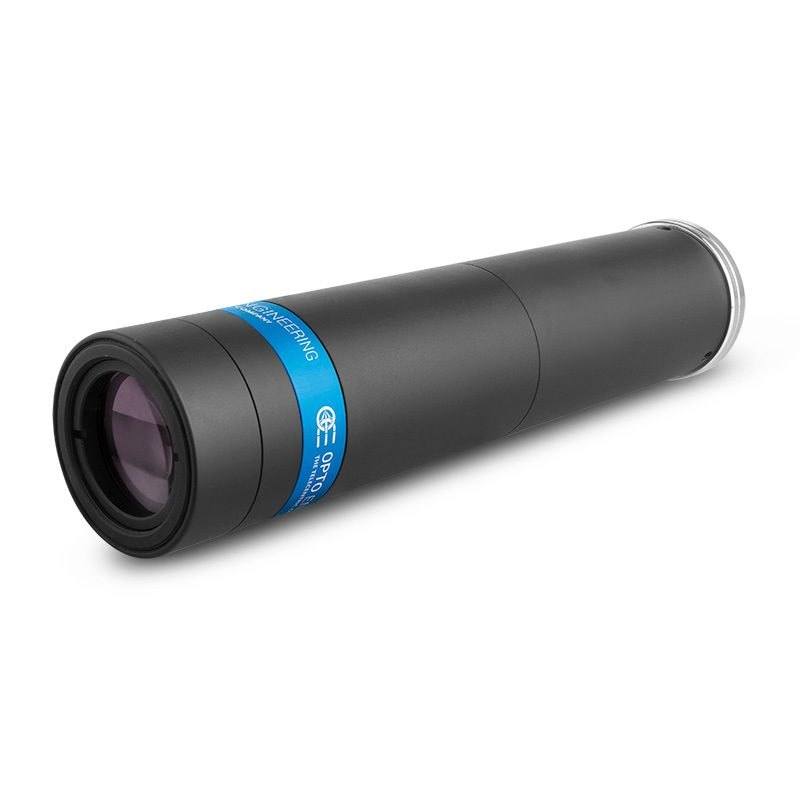
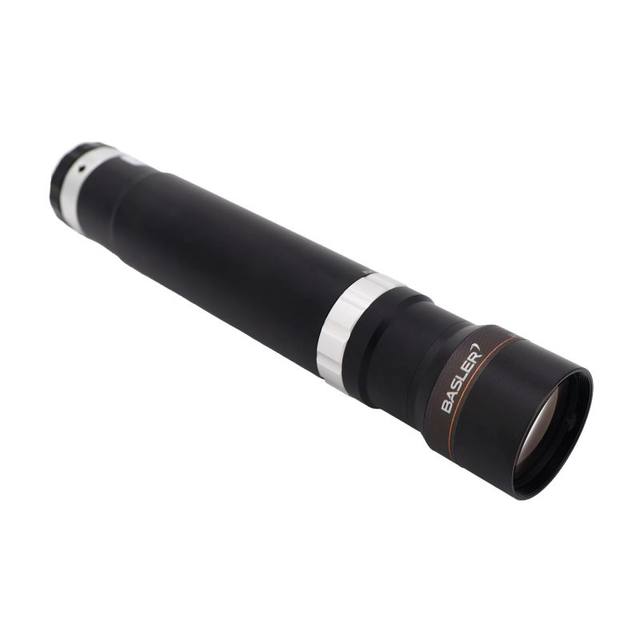
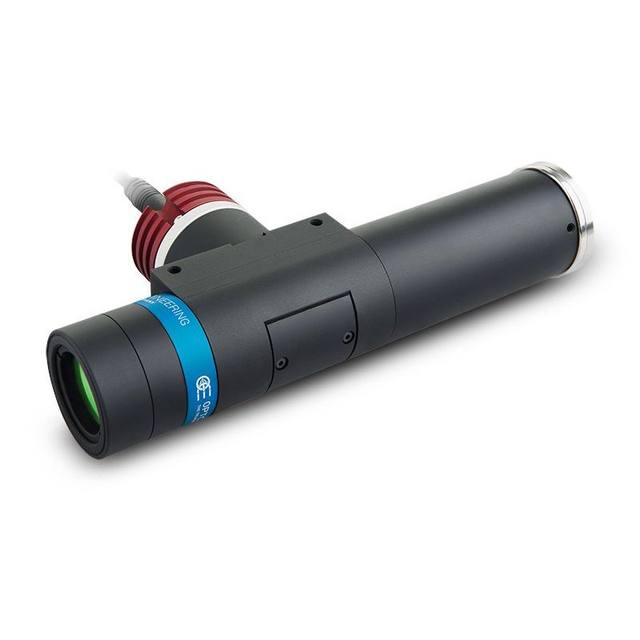
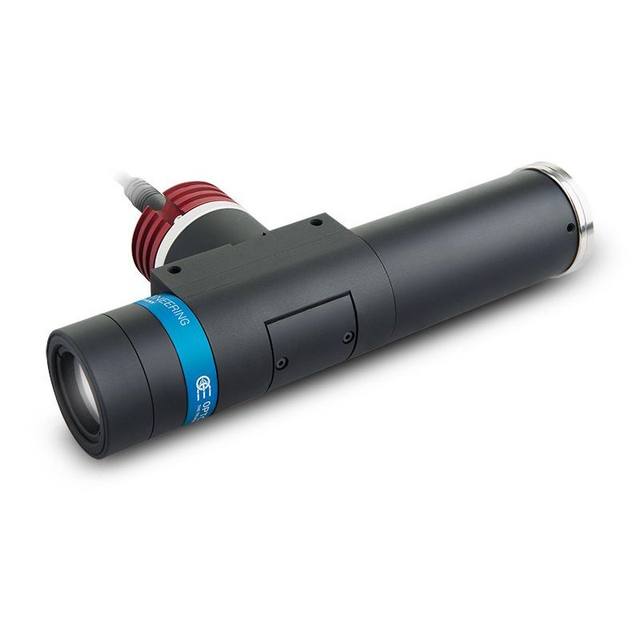
The TCLWD350 is a long working distance telecentric lens for 2/3″ sensors, part of the TCLWD series of 132 mm working distance telecentric lenses for sensors up to 2/3″. It provides 3.500× magnification on a Ø 11.0 mm image circle (max sensor 2/3″), with a working distance of 132.3 mm. The lens is C-mount and telecentric, so the camera needs a C-mount flange and a sensor no larger than 2/3″.
At 3.500× the sensor image is three and a half times the object size, so the sensor records a small area of the part and very fine features are enlarged onto the pixels. Distortion is given as < 0.05 (0.10) % typ. (max) and telecentricity as < 0.04 (0.06) deg typ. (max), meaning typical values below 0.05 % and 0.04 degrees, with maximums of 0.10 % and 0.06 degrees. These figures set the geometric accuracy of magnified measurements.
The wF/# 24 working aperture gives a deep depth of field and passes a limited amount of light. Illumination and exposure need to be planned around this, and the part should be held at 132.3 mm with a stable fixture so the magnified view remains in focus.
Best for
High-magnification inspection of very small features at 3.500× on 2/3″ sensors
Precision measurement at 132.3 mm where typical distortion below 0.05 % and telecentricity below 0.04 degrees matter
Imaging of parts with depth variation, supported by the deep depth of field from the wF/# 24 aperture
Dimensional checks of small parts magnified onto a 2/3″ sensor
Selection notes
Keep the sensor within 2/3″ and the Ø 11.0 mm image circle.
Calculate the object-side pixel size by dividing the sensor pixel pitch by 3.500 before setting the measurement tolerance.
Plan illumination and exposure for the wF/# 24 aperture, since it passes a limited amount of light.
Carry the distortion and telecentricity figures into the uncertainty budget, and confirm the C-mount on the camera.
Specifications: General
Brand
Opto Engineering
Specifications: Optical
Lens mount
C-mount
Image circle / max sensor
Ø 11.0 mm (max sensor 2/3″)
Magnification
3.500×
Working distance
132.3 mm
Telecentric
Yes
Applications this product is commonly selected for. Open one to see the full recommended hardware and approach.
Matched automatically by: camera mount fits the lens mount · camera sensor is covered by the lens image circle — this lens: C-mount · Ø 11.0 mm (max sensor 2/3″) image circle.