Skip to content
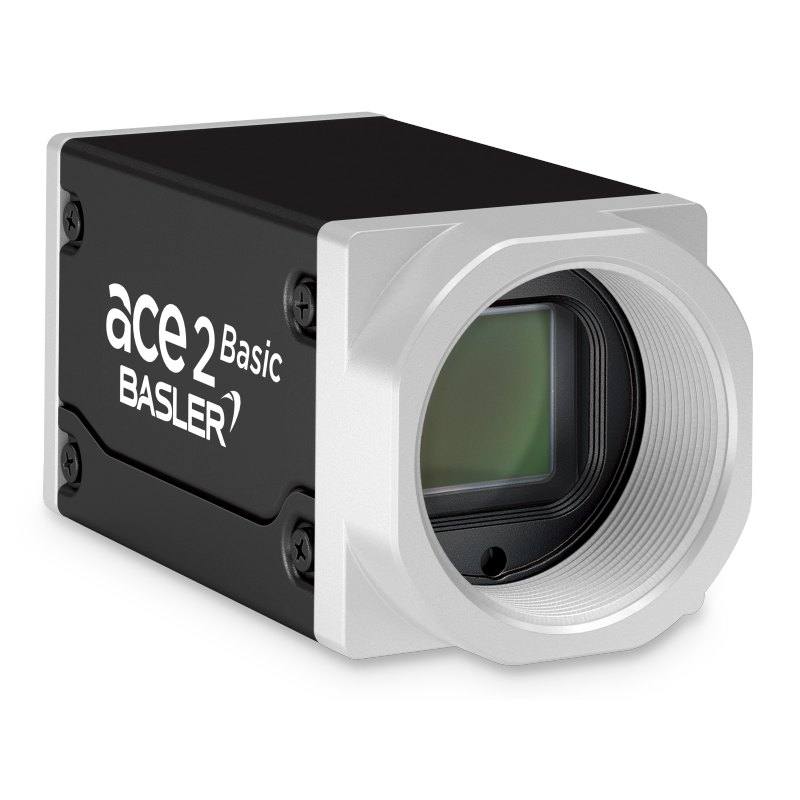
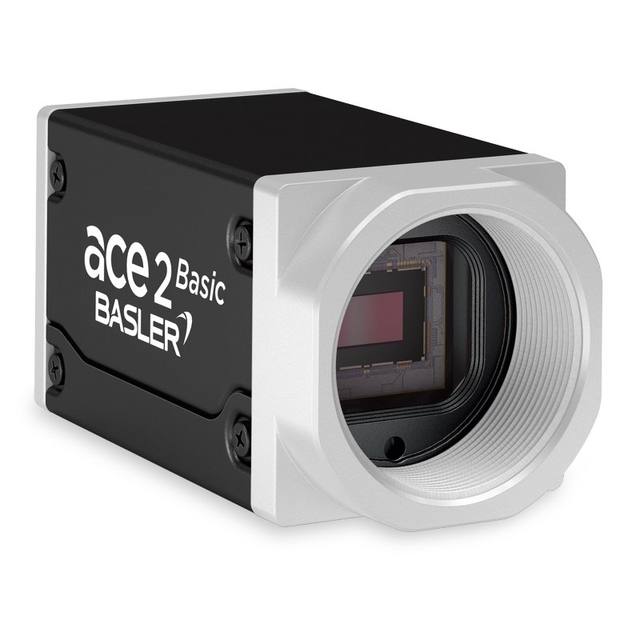
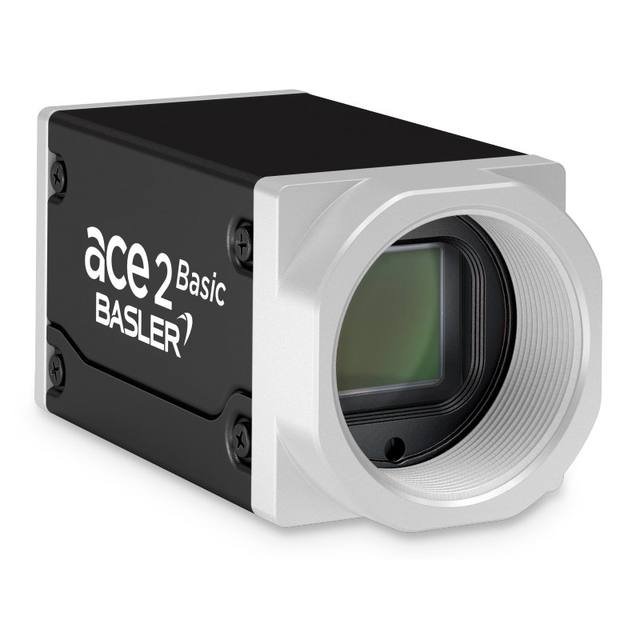
Basler a2A2840-14gm machine vision camera
  • Rosepetal compatible
  • Recommended by AIS Vision

Basler ace 2 a2A2840-14gmBAS

a2A2840-14gm

The Basler ace 2 a2A2840-14gm is an industrial area scan camera using a 2/3" Sony IMX546 global-shutter CMOS sensor with 2.74 µm pixels and 8 MP (2840 x 2840) resolution. It connects over Gigabit Ethernet (GigE Vision 2.0 / GenICam) and reaches roughly 14 fps at full resolution in mono. The camera has a C-mount, RJ45 data connector and M8 6-pin I/O connector, is powered via PoE (IEEE 802.3af) or 12-24 VDC, and consumes about 2.8 W typical. It is rated IP30 and weighs under 100 g.

Brand
Basler
Camera type
Area scan
Interface
GigE (Gigabit Ethernet, 1000 Mbit/s)
Resolution
8 MP
Horizontal resolution
2840 x 2840 px
Mono / color
Mono
Sensor manufacturer
Sony
Sensor model
Sony IMX546 (CMOS)
Shutter
Global shutter
FPS
Up to ~14 fps (12.7 fps default, 14.5 fps performance mode)
Mount
C-mount
Sensor size
7.78 mm x 7.78 mm (2/3", 11.1 mm diagonal)

Technical overview

The Basler ace 2 a2A2840-14gm is built around a 2/3-inch Sony IMX546 global-shutter CMOS sensor that delivers 8 MP at a square 2840 x 2840 px array. The square format is significant: with 7.78 mm on each side and an 11.1 mm diagonal, the field maps cleanly onto round, square, or radially symmetric parts (wafers, caps, lids, connectors) without wasting pixels on an unused aspect ratio. The 2.74 um pixels are small, so resolving power per millimetre is high; the trade-off is that they collect less light than larger pixels, which makes lighting design and exposure budget the central constraint rather than an afterthought.

The global shutter is the defining capability here. Every pixel is exposed at the same instant, so parts moving on a conveyor, a rotating turret, or an indexing stage are captured without the geometric skew and smearing a rolling shutter would introduce. Paired with the camera's ~14 fps at full resolution (12.7 fps default, up to 14.5 fps in performance mode), this suits steady-throughput inspection where every frame must be metrically trustworthy, rather than ultra-high-speed sorting. The monochrome sensor concentrates all 8 MP on luminance and contrast, which is exactly what defect detection, edge-based measurement, and code/text reading want; it also pairs naturally with narrow-band or structured lighting for contrast control.

On the integration side, the camera uses a C-mount, so the chosen lens must cover the 11.1 mm (2/3-inch) image circle and resolve 2.74 um pixels to actually deliver the rated 8 MP. Connectivity is GigE Vision 2.0 / GenICam over Gigabit Ethernet (1000 Mbit/s) via an RJ45 connector, giving the 100 m copper reach standard to Gigabit Ethernet and straightforward integration with any GenICam-compliant software. Power comes through PoE (IEEE 802.3af) on the same cable or via 12-24 VDC, with low draw (around 2.8 W typical), keeping wiring to a single run in PoE installations. A 6-pin M8 I/O connector handles hardware trigger-in and strobe/flash-out for synchronising exposure to part arrival and lighting. At 62.2 x 29 x 29 mm, under 100 g, and rated IP30 for -10 to 60 C, it fits tight enclosures but expects a reasonably clean, dust-protected environment rather than a washdown line.

Best for

  • Surface and defect inspection of square or round parts (wafers, lids, caps, connectors) where the square 8 MP sensor maps the part without wasted pixels
  • Dimensional measurement and gauging on moving or indexed parts, where the global shutter guarantees distortion-free, metrically accurate frames
  • Industrial OCR/OCV and 1D/2D code reading, where 8 MP of monochrome contrast resolves small characters and code modules
  • Packaging-line inspection at steady ~14 fps throughput with hardware-triggered, strobe-synchronised acquisition via the M8 I/O
  • PoE-powered single-cable installations on existing Gigabit Ethernet infrastructure needing up to 100 m camera-to-controller reach

Selection notes

  • Budget light carefully: 2.74 um pixels are small and the IMX546 is monochrome, so plan strong, controlled illumination (ideally narrow-band or structured) and validate exposure against your line speed, since exposure time competes with the 14 fps ceiling.
  • Specify a true 8 MP C-mount lens that covers the 11.1 mm (2/3-inch) image circle and resolves 2.74 um pixels; a lower-grade lens will silently throw away the sensor's resolution advantage.
  • Confirm Gigabit Ethernet bandwidth and configure jumbo frames / NIC settings: a full 8 MP mono frame at ~14 fps pushes a meaningful share of a 1000 Mbit/s link, and shared switches or under-provisioned NICs cause dropped frames.
  • If using PoE (802.3af), verify the switch or injector supplies adequate port budget for the camera (around 2.8 W typical); otherwise wire 12-24 VDC and reserve the M8 6-pin connector pins for trigger-in and strobe-out.
  • Check the environment against the IP30 rating and -10 to 60 C range: this is a panel/enclosure-grade camera, not a washdown unit, so add a housing for dusty, wet, or high-vibration locations.

Specifications: General
BrandBasler
Camera typeArea scan

Specifications: Sensor
Resolution8 MP
Horizontal resolution2840 x 2840 px
Mono / colorMono
Sensor manufacturerSony
Sensor modelSony IMX546 (CMOS)
ShutterGlobal shutter
Sensor size7.78 mm x 7.78 mm (2/3", 11.1 mm diagonal)
Pixel size2.74 x 2.74 µm

Specifications: Performance
FPSUp to ~14 fps (12.7 fps default, 14.5 fps performance mode)

Specifications: Interface
InterfaceGigE (Gigabit Ethernet, 1000 Mbit/s)
ProtocolsGigE Vision 2.0, GenICam

Specifications: Optics
MountC-mount

Specifications: Electrical
PowerPoE (IEEE 802.3af) or 12-24 VDC
Power consumption4 W

Specifications: Environment
IP ratingIP30
Operating temperature-10 to 60 °C

Specifications: Mechanical
Dimensions62.2 x 29 x 29 mm
Weight100 g

Frequently asked questions

Related technical guides

Rosepetal · AI

Test this camera with Rosepetal

Validate your visual inspection with AI: send us sample images and we evaluate the case on your hardware.

AIS Vision · Integration

We validate camera + lens + lighting

AIS Vision defines and tests the optimal combination of camera, optics and lighting for your application before you buy.