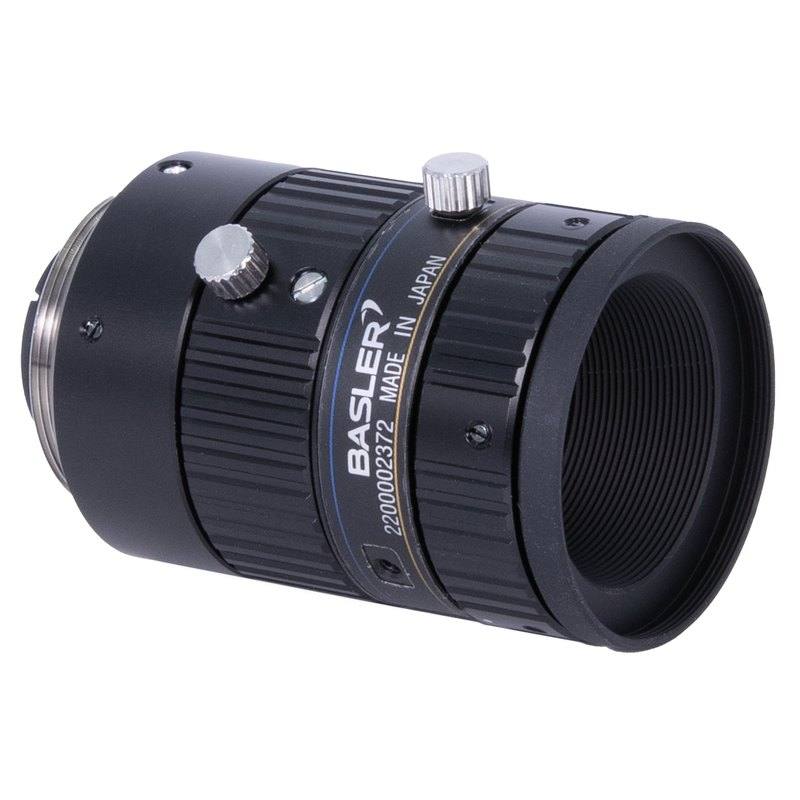
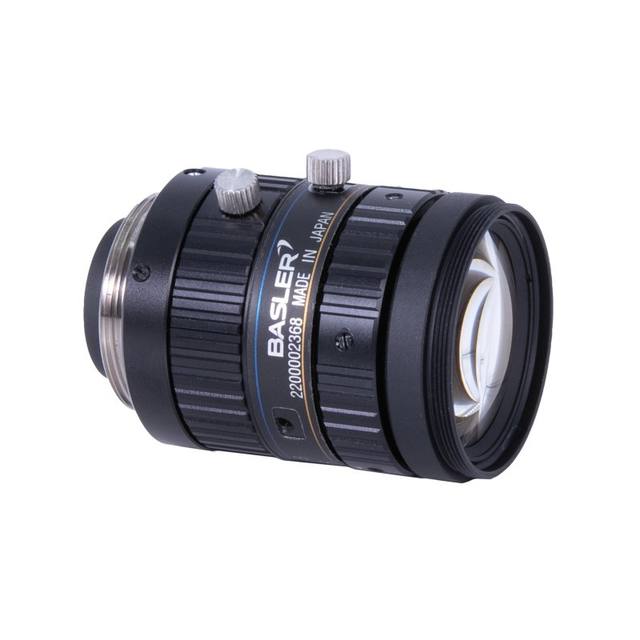
The Basler C23-3528-16M is a 35 mm fixed-focal-length C-mount lens optimized for 16 MP machine vision cameras with 2 µm pixel size and 2/3" sensor format. It provides an image circle of 11.8 mm, an aperture range of F2.8–F16, and is designed for a resolution of 250 LP/mm. The lens features a floating optical design for consistent image quality across the focus range (0.15 m to infinity), manual iris with click-stop mechanism for reproducible settings, and is vibration/shock resistant to 10 G for use in industrial environments.
The Basler C23-3528-16M is a 35 mm fixed-focal-length C-mount lens built specifically to keep pace with 16 MP sensors running a 2.0 µm pixel pitch. That pixel size imposes a demanding optical resolution requirement — the lens is rated to 250 LP/mm, meaning it resolves detail at the scale of a single pixel across the full 11.8 mm image circle without becoming the resolving bottleneck. At F2.8 the lens gathers enough light for short exposure times at high sensor gain settings, while stopping down to F16 gives the depth of field needed when components sit at varying heights on a conveyor or fixture. The manual iris includes a click-stop mechanism so an integrator can reproduce a calibrated aperture setting after a lens swap or during a line changeover without relying on a torque measurement.
The floating optical design maintains consistent image quality from the 150 mm minimum working distance through to infinity, which matters when the same lens configuration must handle both close-range part inspection and wider-field robot guidance without refocusing. At 150 mm working distance on a 2/3" sensor the field of view is compact, making the lens well suited to high-magnification surface or code reading work; moving the camera further away proportionally widens the field while the floating elements preserve sharpness at the edges of the 11.8 mm image circle. The 2/3" image circle format is fully covered, so there is no vignetting penalty when pairing with sensors up to that diagonal. The lens weighs 82 g and is rated to withstand 10 G vibration and shock, which allows mounting on robotic arms or inside machinery enclosures without additional damping hardware.
Non-telecentric geometry means the lens is not intended for high-accuracy dimensional gauging tasks where perspective error at the edges of the field would introduce measurable parallax — for those applications a telecentric design should be considered instead. For surface inspection, OCR/OCV, barcode and DPM reading, packaging verification, and robot guidance however, the perspective characteristic is normal and acceptable. The operating temperature range of -10 to 50 °C covers the majority of factory floor environments without requiring supplemental temperature management of the lens assembly itself.
Best for
High-resolution surface inspection on 16 MP cameras where a 35 mm focal length gives a compact field of view for detecting fine defects at 2 µm-scale detail
Industrial OCR and OCV on pharmaceutical or electronics packaging, where 250 LP/mm resolution supports clear character rendering on 16 MP sensors at close working distances
DPM and 2D barcode reading on PCBs or machined parts, exploiting the full 16 MP pixel budget to decode small or low-contrast marks without optical loss from the lens
Robot guidance and pick-and-place alignment tasks mounted on a robot arm, where 82 g weight and 10 G shock resistance keep the optical alignment stable during motion
Packaging and label inspection lines requiring reproducible aperture settings across multiple stations, where the click-stop iris enables consistent calibration after lens changes
Selection notes
Sensor format compatibility: the 11.8 mm image circle fully covers 2/3" sensors; pairing with a 1" or larger sensor will introduce corner vignetting and is not supported — verify your camera sensor diagonal before ordering
Pixel pitch matching: this lens is optimised for 2.0 µm pixels at 250 LP/mm; using it on a camera with a larger pixel pitch (e.g. 3.45 µm) gives optical headroom to spare, while a sensor with smaller pixels (sub-2 µm) may find the lens becomes the resolution limit
Working distance floor: the 150 mm minimum working distance sets a hard constraint on how close the camera can be to the subject — for applications requiring focus at 50–100 mm, a shorter-focal-length or macro-capable lens is needed
Non-telecentric design: for dimensional measurement tasks demanding sub-pixel accuracy at the image periphery, consider a telecentric lens instead; this lens is appropriate for inspection, reading, and guidance tasks where edge-of-field perspective distortion is tolerable
Aperture reproducibility: the click-stop iris is an advantage for multi-station lines where lenses may be swapped, but fine continuous aperture control between click stops is not available — factor this into the lighting design when exposure latitude is tight
Specifications: General
Brand
Basler
Specifications: Optical
Focal length
35 mm
Lens mount
C-mount
Aperture (f-number)
F2.8–F16
Image circle / max sensor
11.8 mm (2/3" format)
Optical resolution
16 MP (250 LP/mm, 2.0 µm pixel)
Telecentric
No
Working distance
150 mm to infinity
Specifications: Environment
Operating temperature
-10–50 °C
Specifications: Mechanical
Weight
82 g
Applications this camera is commonly selected for. Open one to see the full recommended hardware and approach.
Matched automatically by: camera mount fits the lens mount · camera sensor is covered by the lens image circle — this lens: C-mount · 11.8 mm (2/3" format) image circle.
By category
All 759Area scan cameras 622High-speed cameras 108High-resolution cameras 29
By brand
All 759Omron / Sentech 297Basler 242iRAYPLE 201Datalogic / Datasensing 19
Get a first image quickly with the pylon Viewer, then move into the pylon SDK for your application. These cameras are GenICam/GenTL-compliant, so any compliant vision software can drive them as well.
Download and install the pylon Camera Software Suite for your OS from Basler. This provides the pylon Viewer, the GenTL transport-layer producers and the pylon SDK (C/C++/.NET/Python). On Windows the installer adds the needed drivers; on Linux follow the included setup notes for USB and network permissions.
2. Connect the camera and check the link
Cable the camera to its matching interface: GigE Vision to a GigE port (use a quality cable and, ideally, a dedicated NIC with jumbo frames enabled), USB3 Vision to a USB 3.x port with the supplied cable, or CoaXPress to the frame grabber. Provide power where required (PoE, USB bus power, or PoCXP). Open the pylon Viewer and confirm the camera appears in the device list; for GigE, make sure the camera and NIC are on the same subnet.
3. Grab a first image and set exposure, gain and pixel format
Select the camera in the pylon Viewer and start a continuous grab. Adjust exposure time and gain until the image is well exposed (avoid clipped highlights), set the pixel format (e.g. Mono8 or a Bayer/RGB format), and focus the lens. Use a test pattern if the lens or scene is not ready yet.
4. Configure triggering and acquisition
Decide between free-run and triggered acquisition. For synchronized capture, set the trigger source (software or a hardware line on the I/O connector), trigger mode and any debounce or exposure mode, then verify timing. Note the parameter names you change in the Viewer feature tree, as you will reuse them in code.
5. Move to the SDK or a GenICam-compliant library
Recreate your settings in code with the pylon SDK (C, C++, .NET or Python) to open the device, apply the same features and pull frames into your pipeline; pylon vTools and pylon AI can add processing blocks. Because the cameras are GenICam/GenTL standard, third-party vision libraries work too. Once the image stream is stable, you can route frames to a deep-learning inspection such as Rosepetal for automated defect detection.
Frequently asked questions
The lens provides an 11.8 mm image circle, which fully covers 2/3" format sensors. Sensors larger than 2/3" will see vignetting at the corners and are not supported.
The specified minimum working distance is 150 mm. Below this distance the lens cannot achieve sharp focus; if your application requires closer inspection you will need a different optical design.
The lens is non-telecentric, meaning perspective projection applies and edge-of-field objects at different depths will exhibit parallax error. It is not recommended for high-accuracy dimensional gauging; a telecentric lens should be used for those tasks. It is well suited to inspection, code reading, and guidance applications.
F2.8 is the widest setting and maximises light throughput, enabling shorter exposure times or lower illumination power. F16 is the narrowest setting and maximises depth of field for components at varying heights. The click-stop mechanism means any selected aperture can be reliably reset after a lens change, which simplifies multi-station line calibration.
Yes. The lens is rated to 10 G vibration and shock resistance, and at 82 g it adds minimal moment load to a robot wrist. The operating temperature range of -10 to 50 °C covers most factory floor and robotic cell environments.