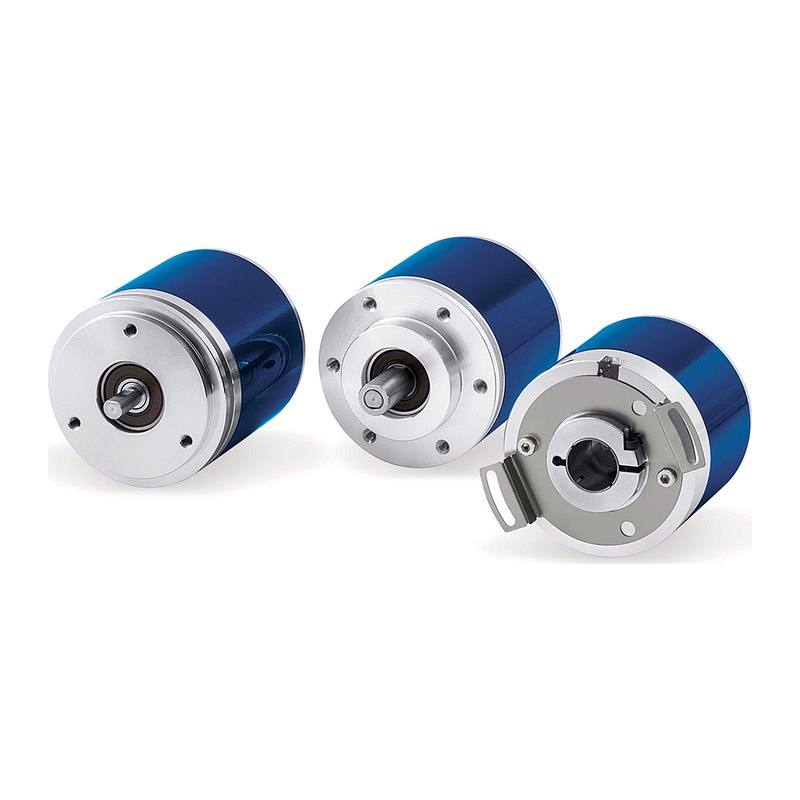
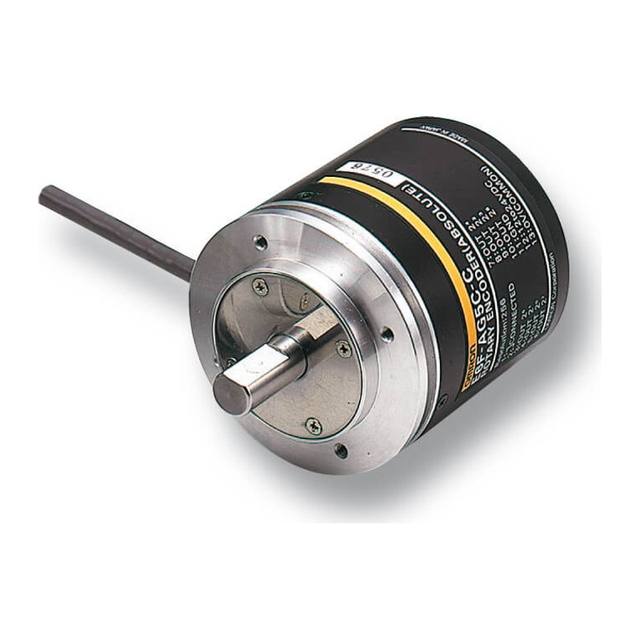
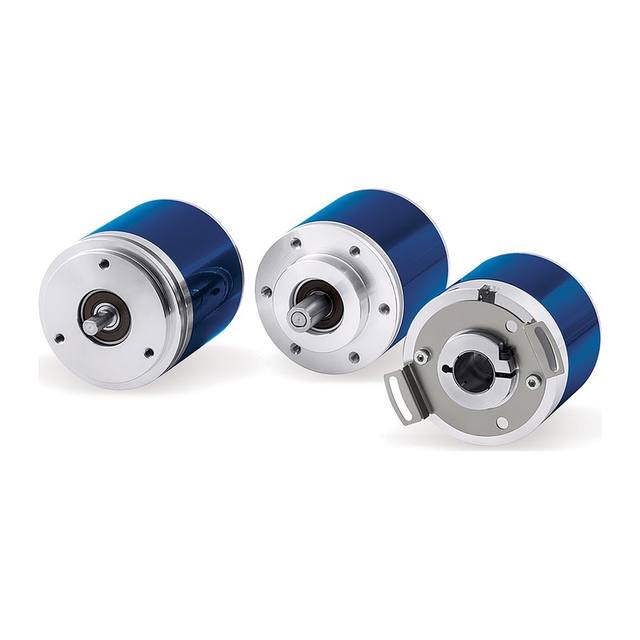
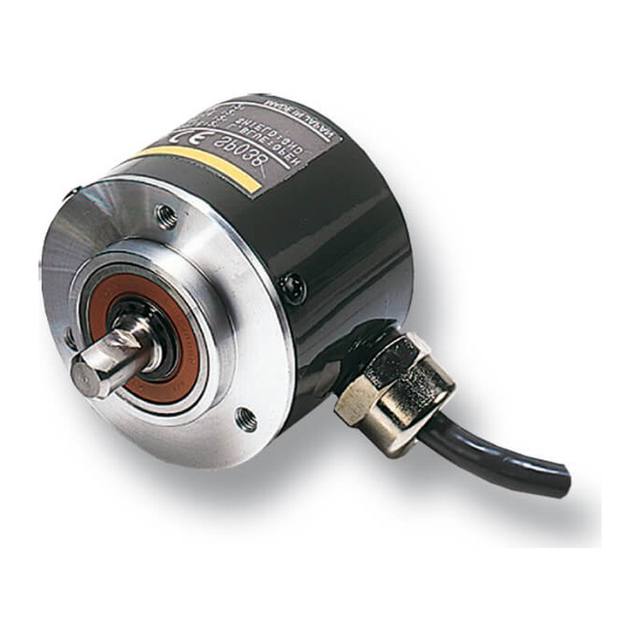
The Datalogic AST58-H is an absolute single-turn rotary encoder in a blind hollow-shaft version, with a Ø15 mm shaft/bore and a Ø58 mm aluminium housing (Ø58x49 mm). Its resolution is 13 bit (8192 cpr). Rather than delivering pulses to be counted, an absolute encoder reports the shaft position as a value, so the controller reads the angular position within one revolution directly.
The interface is SSI (Gray code, RS-422), with the output listed as Gray SSI, RS-422, so the receiving controller needs an SSI input with RS-422 signalling. The supply is 7.5-34 VDC. Connection is selected through the order code: the three order codes are a 1.5 m cable, an M12 connector and an M23 connector, so the exit style can be matched to the machine's wiring.
In a machine-vision installation an encoder like this plays the general role of position feedback on a rotating axis, such as a turntable or indexing stage, so that image capture or handling steps can be tied to a known angular position. Because the device is single-turn, the 8192 cpr value describes position within one shaft revolution, and multi-revolution travel has to be tracked by the controller.
Best for
Reading the angular position of a rotary stage or turntable where the controller takes an SSI position value
Rotary axes with a Ø15 mm shaft end that accept a blind hollow-shaft encoder
Controllers with an SSI (Gray code, RS-422) input that need a 13 bit (8192 cpr) position value
Installations that need a choice of 1.5 m cable, M12 connector or M23 connector
Selection notes
Check that the receiving controller has an SSI input using RS-422 signalling and Gray code; this is the interface of the encoder.
The shaft/bore is Ø15 mm and the housing is Ø58x49 mm; confirm the shaft end diameter and the available mounting space before ordering.
The connection is part of the order code: 1.5 m cable, M12 connector or M23 connector. Pick the one that matches the cabling already on the machine.
Compare the 7.5-34 VDC supply range with the supply available at the installation point.
Resolution is 13 bit (8192 cpr) over a single turn, so applications that travel through several revolutions need the controller to keep track of turns.
Specifications: General
Brand
Datalogic
Sensor type
Encoder
Encoder type
Absolute single-turn
Specifications: Performance
Absolute resolution
13 bit (8192 cpr)
Specifications: Interface
Communication
SSI (Gray code, RS-422)
Connection
1.5 m cable, M12 connector, M23 connector
Specifications: Electrical
Supply voltage
7.5-34 VDC
Specifications: Mechanical
Shaft
Blind hollow shaft
Shaft / bore diameter
Ø15 mm
Dimensions
Ø58x49 mm
Housing diameter
Ø58 mm
Housing material
Metal - Aluminium
Specifications: Output
Output type
Gray SSI, RS-422
This product groups every purchasable order code that shares the same sensing method, range and output. Cable length, connector type and operation mode (Light-ON/Dark-ON, NO/NC) vary by order code below.
Family variants with highlighted differences
Model
Connection ●
Shaft / bore diameter
Absolute resolution
Communication
Availability
Encoder Absolute singleturn - blind hollow 15 mm -SSI 13 bit - cable Base
1.5 m cable
Ø15 mm
13 bit
SSI
On request
Encoder Absolute singleturn - blind hollow 15 mm -SSI 13 bit - M12
M12 connector
Ø15 mm
13 bit
SSI
On request
Encoder Absolute singleturn - blind hollow 15 mm -SSI 13 bit - M23
M23 connector
Ø15 mm
13 bit
SSI
On request
Applications this product is commonly selected for. Open one to see the full recommended hardware and approach.
1. Install the IMPACT Software Suite and connect the camera
Install the IMPACT Software Suite on your PC, which provides both the configuration/viewer tools and the SDK. For a GigE Vision model (E100, M or U series), connect it to a dedicated NIC and, for USB3 models, use a certified USB3 cable and port. Power the camera and confirm it enumerates.
2. Bring the camera online and verify the link
For GigE Vision, put the camera and the host NIC on the same subnet (a static IP on the camera matching the NIC range is the most reliable starting point); for USB3, confirm the device is recognized. Open the IMPACT viewer/device tool, discover the camera, and verify a stable connection before streaming. Enabling jumbo frames on the NIC helps GigE throughput.
3. Set exposure, gain and trigger, then grab a first image
In the IMPACT tools, start a live stream and adjust exposure and gain until the image is well-lit without saturation; set white balance on color models. Begin in free-run (continuous) mode to confirm imaging, then switch to hardware or software trigger as your application requires. Capture and save a reference image once the scene looks correct.
4. Build a vision tool or move to the SDK/API
Use the IMPACT point-and-click vision tools to assemble an inspection, or use the IMPACT SDK to access the camera and results programmatically and feed them into your HMI/PLC application. As these are GenICam/GenTL-compliant devices, you can alternatively drive them from any GenICam-compliant third-party vision library if your pipeline standardizes on one.
5. Route the stable feed to deep-learning inspection (optional)
Once you have a stable, repeatable image, the feed can be sent to a deep-learning inspection platform such as Rosepetal for defect detection or classification tasks that go beyond rule-based tooling. Keep lighting, optics and trigger timing fixed so the images reaching the model stay consistent.
Frequently asked questions
The AST58-H uses SSI (Gray code, RS-422). Its output type is Gray SSI, RS-422.
It is an absolute single-turn encoder with a resolution of 13 bit (8192 cpr).
It has a blind hollow shaft with a Ø15 mm shaft/bore and runs from a 7.5-34 VDC supply.
There are three order codes: a 1.5 m cable version, an M12 connector version and an M23 connector version.