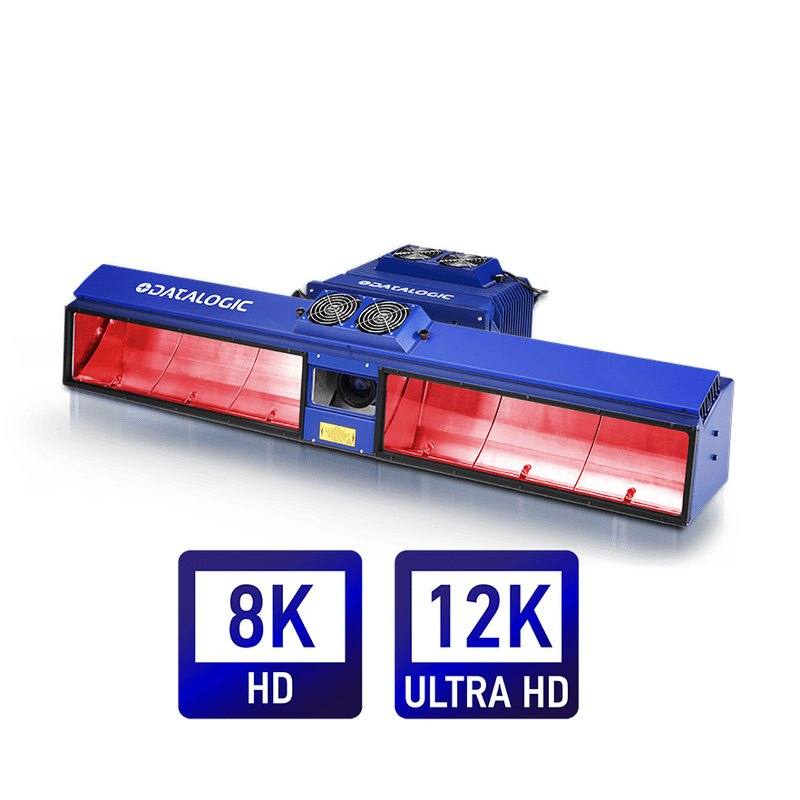
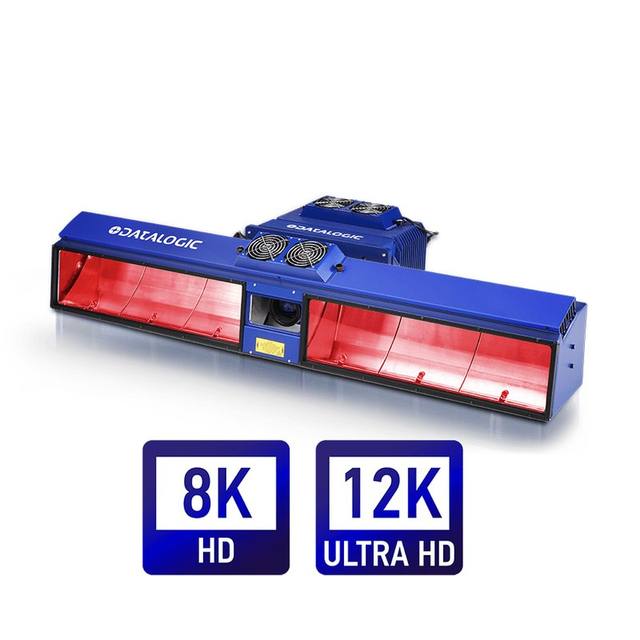
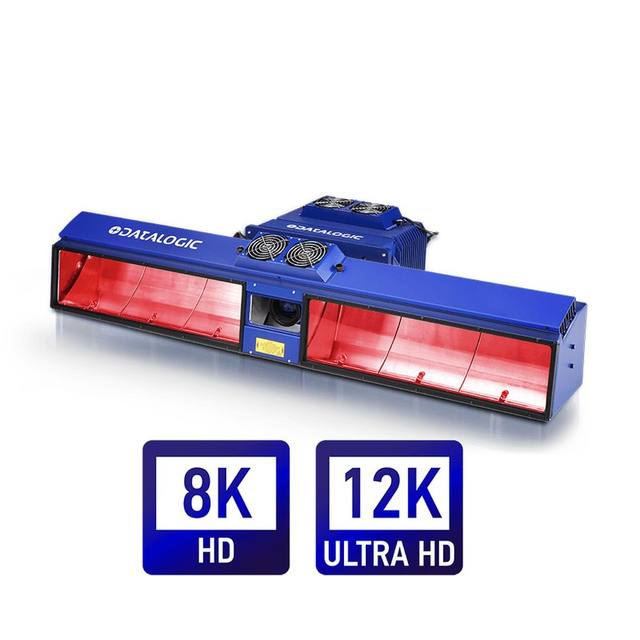
A line-scan reader lets the conveyor do the scanning: the 8192 px line is sampled at up to 33 kHz while the belt moves and the image builds row by row, so line triggering must follow belt travel from an encoder. Across the maximum 1400 mm field one pixel covers 1400 mm ÷ 8192 ≈ 0.171 mm; square pixels need a line rate of belt speed ÷ 0.171 mm, so the 33 kHz limit corresponds to 0.171 mm × 33,000 ≈ 5.6 m/s.
The 140 mm f/5.6 STD optic is the long, fast option among the 8K codes: from the same distance it covers about 80 ÷ 140 ≈ 0.57 of the field width of the 80 mm AV7000-1400, and f/5.6 passes about twice the light of an f/8 lens ((8 ÷ 5.6)² ≈ 2.0). That matters because at 33 kHz a line lasts at most 1 ÷ 33,000 ≈ 30 µs, which is why the AI7000 pulsed lighting system is part of the design; it is ordered separately in short, medium or long bars, red or white.
Best for
Parcel tunnels and conveyors up to 1200 mm wide, where one 8192 px line replaces several area-scan cameras and the stitching they need.
Mixed parcel heights: the patented autofocus extends the usable depth of field, so a small envelope and a tall carton can share a lane.
Sorters that cannot stop for a reader fault, since the architecture includes a double controller, tachometer, photo-eye and closed EBC loop for redundancy.
Selection notes
Order the lighting with the reader: AI7000-800, -1100 or -1500 bars, with a W suffix for white. With external fans the assembly is 845, 1150 or 1480 mm long (short, medium or long illumination) and the reader weighs 11 kg, so check the tunnel frame.
A long focal length means a high mount for a wide field, so confirm the reading window of this STD optic before fixing the gantry height.
The supply window at the illuminator connector is only 23–26 VDC, so a long cable run can drop below 23 V under load: check the voltage at the connector with the lighting running.
Specifications: General
Brand
Datalogic
Reader type
Code reader
Form factor
Fixed-mount linear camera (tunnel / conveyor reading station)
Specifications: Sensor
Horizontal resolution
8192 px (8K)
Specifications: Performance
Scan rate
33,000 scans/s (33 kHz line rate)
Specifications: Interface
Communication
2 x Gigabit Ethernet (decoding data / image transfer); main RS232/RS485 FD + aux RS232 (opto-isolated); SyncNet; 3 inputs (2 + encoder), 2 NPN outputs
Specifications: Optical
Focus
Patented autofocus system (extended depth of field)
Field of view
Up to 1400 mm (55.12 in); aperture angle 15° – 45° depending on model; conveyors up to 1200 mm wide (datalogic.com)
Focal length
140 mm f/5.6 STD
Specifications: Electrical
Supply voltage
23 – 26 VDC at illuminator connector
Specifications: Environment
Operating temperature
0 – 50 °C
IP rating
IP65
Specifications: Reading
Scan technology
High-speed CMOS line scan, 8192 px
Supported codes
All standard 1D and 2D symbologies
Specifications: Mechanical
Dimensions
With external fans: 845 x 416 x 237 mm (short illumination) / 1150 x 416 x 237 mm (medium) / 1480 x 416 x 237 mm (long)
Weight
11 kg
Housing material
Aluminum die-cast
This product groups every purchasable order code that shares the same sensing method, range and output. Cable length, connector type and operation mode (Light-ON/Dark-ON, NO/NC) vary by order code below.
Family variants with highlighted differences
Model
Availability
AV7000-1000 140mm f/5.6 STD Base
On request
Applications this product is commonly selected for. Open one to see the full recommended hardware and approach.
1. Install the IMPACT Software Suite and connect the camera
Install the IMPACT Software Suite on your PC, which provides both the configuration/viewer tools and the SDK. For a GigE Vision model (E100, M or U series), connect it to a dedicated NIC and, for USB3 models, use a certified USB3 cable and port. Power the camera and confirm it enumerates.
2. Bring the camera online and verify the link
For GigE Vision, put the camera and the host NIC on the same subnet (a static IP on the camera matching the NIC range is the most reliable starting point); for USB3, confirm the device is recognized. Open the IMPACT viewer/device tool, discover the camera, and verify a stable connection before streaming. Enabling jumbo frames on the NIC helps GigE throughput.
3. Set exposure, gain and trigger, then grab a first image
In the IMPACT tools, start a live stream and adjust exposure and gain until the image is well-lit without saturation; set white balance on color models. Begin in free-run (continuous) mode to confirm imaging, then switch to hardware or software trigger as your application requires. Capture and save a reference image once the scene looks correct.
4. Build a vision tool or move to the SDK/API
Use the IMPACT point-and-click vision tools to assemble an inspection, or use the IMPACT SDK to access the camera and results programmatically and feed them into your HMI/PLC application. As these are GenICam/GenTL-compliant devices, you can alternatively drive them from any GenICam-compliant third-party vision library if your pipeline standardizes on one.
5. Route the stable feed to deep-learning inspection (optional)
Once you have a stable, repeatable image, the feed can be sent to a deep-learning inspection platform such as Rosepetal for defect detection or classification tasks that go beyond rule-based tooling. Keep lighting, optics and trigger timing fixed so the images reaching the model stay consistent.
Frequently asked questions
An encoder on one of the 3 inputs (two general inputs plus the encoder), and a PLC that accepts the 2 NPN outputs, which switch to 0 V.
Not at full rate. At 33 kHz the line carries 8192 × 33,000 × 8 bit ≈ 2.2 Gbit/s (a typical 8 bit per pixel), more than its two Gigabit Ethernet ports combined, and at an example 2 m/s (2000 mm/s ÷ 0.171 mm ≈ 11.7 kHz) still ≈ 0.77 Gbit/s. Save selected images, such as no-reads.
Camera Housing: Basler Camera housing ace 2 GigE, Basler Camera housing ace 2 USB / CXP / GMSL, Basler Camera housing ace USB, Basler Camera housing ace GigE