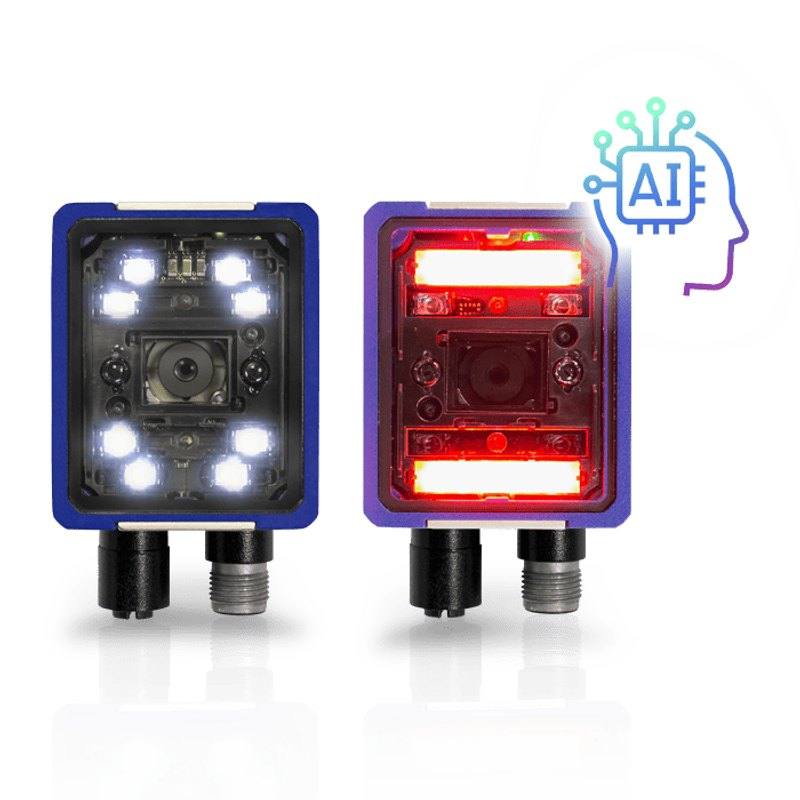
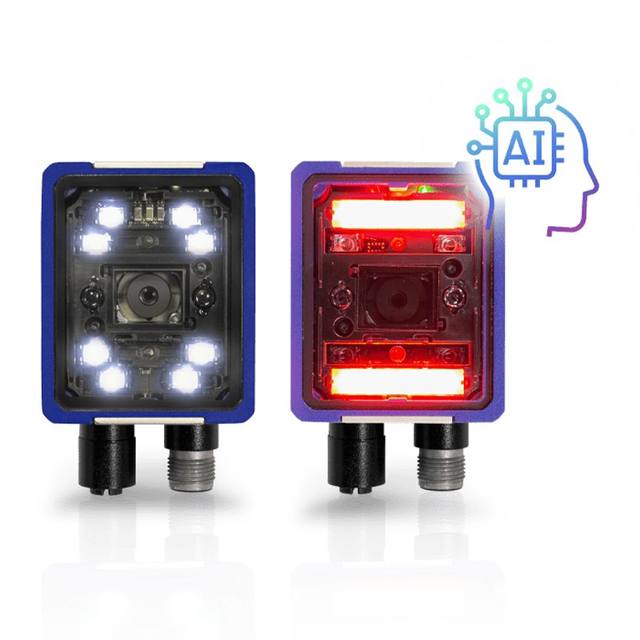
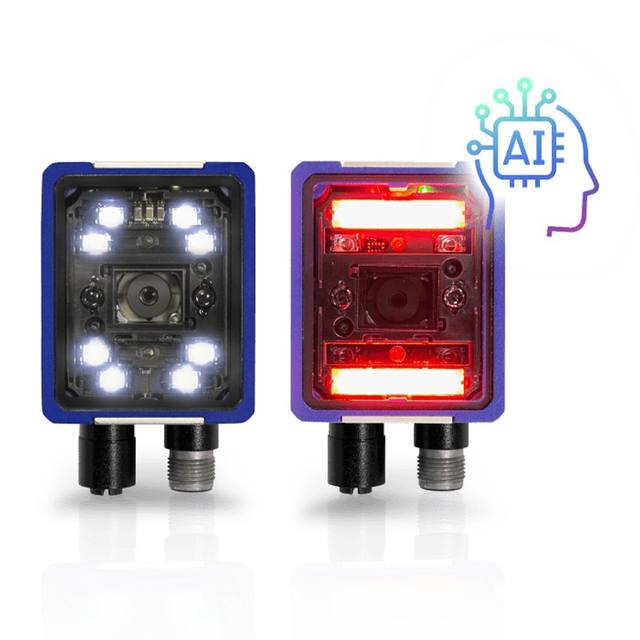
The 7 mm XAI pairs a 38.3° view, which tolerates parts that are not presented precisely, with DecodeX, AI-based decoding for DPM marks, quoted at up to 2.5× faster. It reads 40–300 mm with a 1280 × 960 px imager at 45 frames/s and a red or blue all-in-one illuminator with polarizer and diffuser. Taking the angle as horizontal, the field is about 0.69 × distance, or 208 mm wide at 300 mm. That is 208 ÷ 1280 ≈ 0.163 mm per pixel, which puts an example 0.5 mm module on 0.5 ÷ 0.163 ≈ 3.1 px.
Cycle time is the budget item: every DPM code is captured within 100 ms. On a station indexing an example 120 parts per minute, each part has 60 s ÷ 120 = 500 ms, so if the 100 ms covers the whole read it takes 100 ÷ 500 = 20 % of the cycle.
Best for
Parts that arrive with position scatter, where the wide 38.3° view absorbs the scatter and the AI decoder works to a 100 ms read budget.
Indexed stations with a short cycle, where a 100 ms capture time gives a fixed figure to plan the cycle around.
Stations that see several kinds of DPM mark on plastic, glass or metal parts with one reader setup, since the decoder is specified for any type of DPM.
Selection notes
Resolution is the price of the wide view: at 300 mm a pixel is about 0.16 mm (208 ÷ 1280), against about 0.10 mm for the 12 mm XAI (128 ÷ 1280), so tiny marks held far away need the 12 mm.
The up to 2.5× faster figure is relative to an unspecified baseline, so test the Matrix 220 DPM 7 mm on the same samples to see what the AI decoder adds.
Red or blue is fixed by the order code, so test sample parts under each colour before ordering.
Specifications: General
Brand
Datalogic
Reader type
Code reader
Form factor
Compact fixed-mount 2D imager
AI / deep learning
Yes — DecodeX, AI-based decoding (machine learning) for DPM codes; up to 2.5× faster decoding
78 x 47 x 38 mm (connector at 0°); 57 x 47 x 58 mm (connector at 90°)
Weight
173 g
Housing material
Aluminium case, plastic protective window cover
This product groups every purchasable order code that shares the same sensing method, range and output. Cable length, connector type and operation mode (Light-ON/Dark-ON, NO/NC) vary by order code below.
Family variants with highlighted differences
Model
Illumination colour ●
Availability
MATRIX 220 382-110 XAI DPM-R 7MM Base
Red (DPM)
On request
MATRIX 220 382-110 XAI DPM-R 7MM ESD
Red (DPM)
On request
MATRIX 220 392-110 XAI DPM-B 7MM ESD
Blue (DPM)
On request
Applications this product is commonly selected for. Open one to see the full recommended hardware and approach.
1. Install the IMPACT Software Suite and connect the camera
Install the IMPACT Software Suite on your PC, which provides both the configuration/viewer tools and the SDK. For a GigE Vision model (E100, M or U series), connect it to a dedicated NIC and, for USB3 models, use a certified USB3 cable and port. Power the camera and confirm it enumerates.
2. Bring the camera online and verify the link
For GigE Vision, put the camera and the host NIC on the same subnet (a static IP on the camera matching the NIC range is the most reliable starting point); for USB3, confirm the device is recognized. Open the IMPACT viewer/device tool, discover the camera, and verify a stable connection before streaming. Enabling jumbo frames on the NIC helps GigE throughput.
3. Set exposure, gain and trigger, then grab a first image
In the IMPACT tools, start a live stream and adjust exposure and gain until the image is well-lit without saturation; set white balance on color models. Begin in free-run (continuous) mode to confirm imaging, then switch to hardware or software trigger as your application requires. Capture and save a reference image once the scene looks correct.
4. Build a vision tool or move to the SDK/API
Use the IMPACT point-and-click vision tools to assemble an inspection, or use the IMPACT SDK to access the camera and results programmatically and feed them into your HMI/PLC application. As these are GenICam/GenTL-compliant devices, you can alternatively drive them from any GenICam-compliant third-party vision library if your pipeline standardizes on one.
5. Route the stable feed to deep-learning inspection (optional)
Once you have a stable, repeatable image, the feed can be sent to a deep-learning inspection platform such as Rosepetal for defect detection or classification tasks that go beyond rule-based tooling. Keep lighting, optics and trigger timing fixed so the images reaching the model stay consistent.
Frequently asked questions
382-110 in red, with a standard and an ESD version, and 392-110 in blue as an ESD version.
Yes. Over Ethernet 10/100 it offers OPC UA together with TCP/IP, UDP, FTP, PROFINET IO, EtherNet/IP and Modbus TCP, plus RS-232/RS-422 FD and ID-NET.
Camera Housing: Basler Camera housing ace 2 GigE, Basler Camera housing ace 2 USB / CXP / GMSL, Basler Camera housing ace USB, Basler Camera housing ace GigE