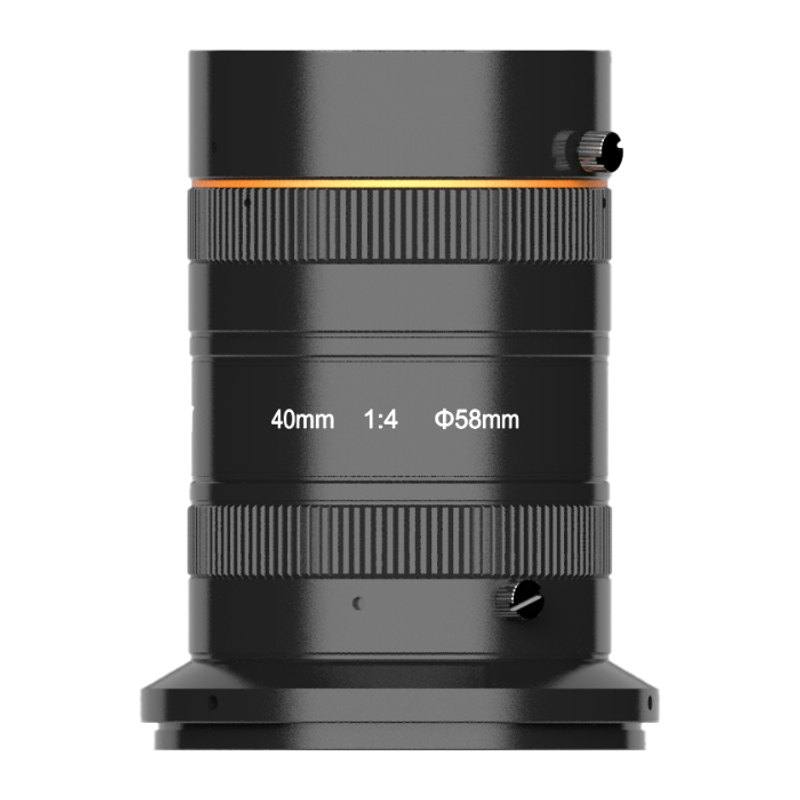
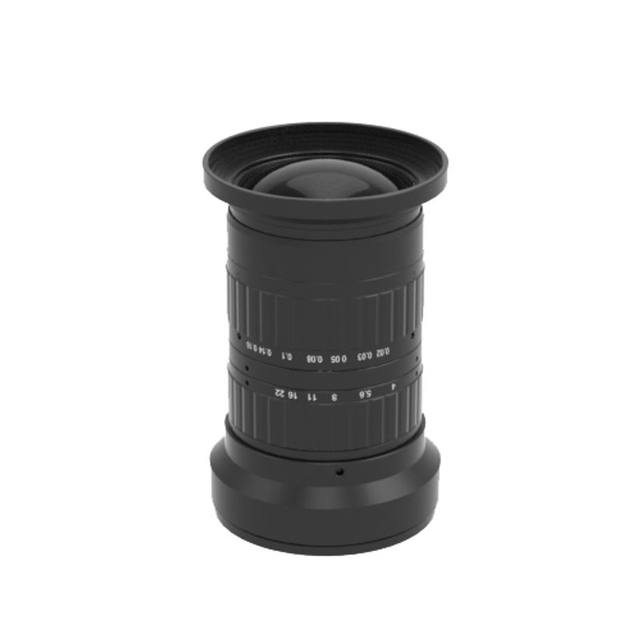
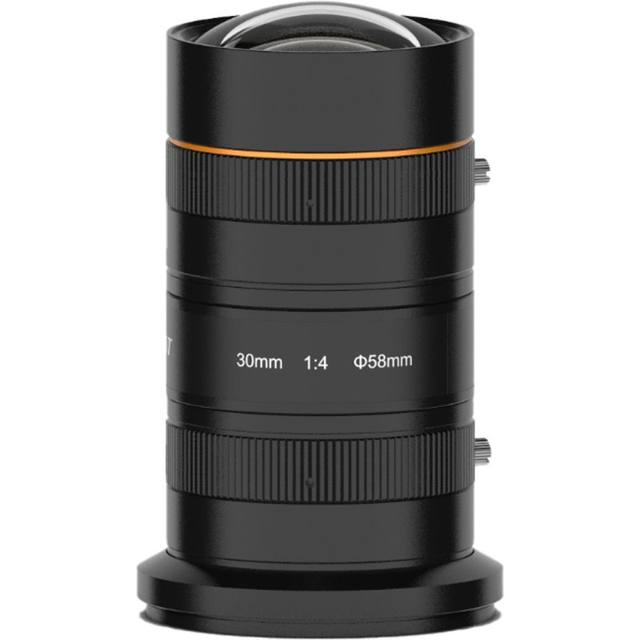
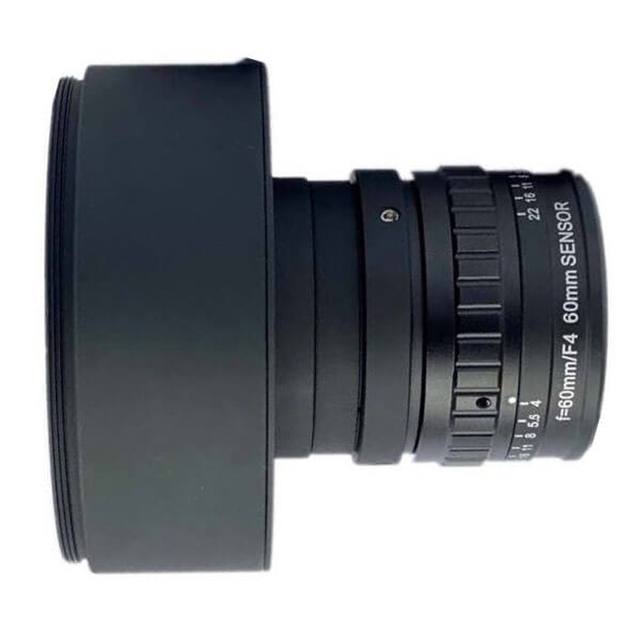
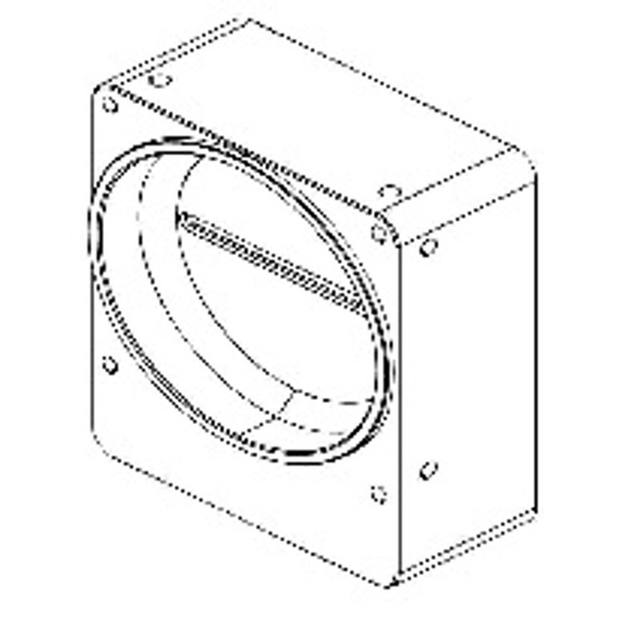
The MVL-LF4040M-01-M72 is a 40 mm lens with an aperture range of F4.0 to F22 and an image circle of Φ58 mm. Its mount is M72 × P0.75, so the camera side has to present that thread. The image circle sets the coverage limit: a sensor whose diagonal is larger than Φ58 mm will lose coverage at the corners, so the sensor format should be chosen to sit inside the circle.
The manufacturer gives a recommended magnification of 0.05-0.21x, and the working distance is listed as 200 mm to inf mm (tolerance: ±5 mm). For a given sensor and focal length, the working distance sets the image scale, so the two should be chosen together. Set the distance first, then read the field of view from the sensor size to confirm the image stays inside the intended magnification band. The aperture range of F4.0 to F22 gives control over exposure and depth of field at that distance.
The lens weighs 625 g, so the bracket and camera mount should carry the load, with the camera cable routed so it does not pull on the lens. Illumination should cover the Φ58 mm image circle evenly, and because the listed working distance runs from 200 mm to inf, the lighting geometry should be checked at the distance finally chosen.
Best for
Imaging within the recommended magnification range of 0.05-0.21x with a 40 mm focal length.
Systems with working distances from 200 mm to inf, within the ±5 mm tolerance.
Sensor formats whose diagonal fits within the Φ58 mm image circle on an M72 × P0.75 camera mount.
Setups that need an aperture range from F4.0 to F22 for exposure and depth-of-field control.
Selection notes
Check that the sensor diagonal fits inside the Φ58 mm image circle before choosing the camera.
Set the working distance at 200 mm or more and carry the ±5 mm tolerance into the mechanical layout.
Choose the working distance and sensor size together so the image scale stays within the 0.05-0.21x recommended magnification.
Use an M72 × P0.75 thread on the camera side and support the 625 g lens with a bracket.
Specifications: General
Brand
Hikrobot
Specifications: Optical
Lens mount
M72 × P0.75
Focal length
40 mm
Aperture (f-number)
F4.0 to F22
Image circle / max sensor
Φ58 mm
Working distance
200 mm to inf mm (tolerance: ±5 mm)
Specifications: Mechanical
Weight
625 g
Applications this product is commonly selected for. Open one to see the full recommended hardware and approach.
Matched automatically by: camera mount fits the lens mount · camera sensor is covered by the lens image circle — this lens: M72 × P0.75 · Φ58 mm image circle.