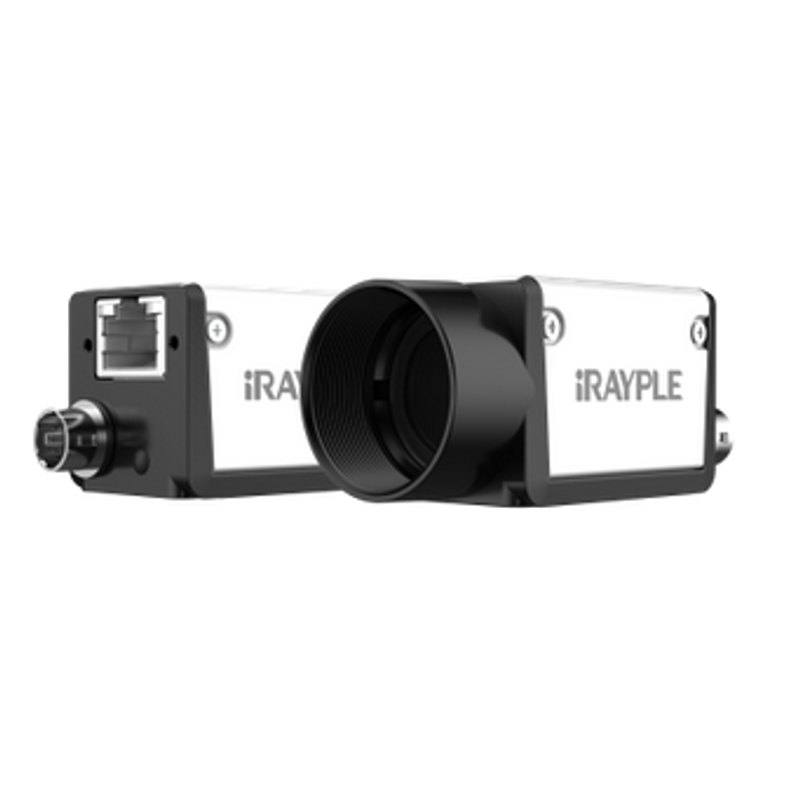
The iRAYPLE A3124MG100E (mono) and A3124CG100E (color) are A-series 3000 GigE industrial area-scan cameras using the 1/3" Onsemi AR0135 CMOS global-shutter sensor with 1280x960 resolution, 3.75 µm pixels and a 54 fps frame rate. They connect over a single Gigabit Ethernet interface (1 Gbps, up to 100 m) compliant with GigE Vision V2.0 and GenICam, with a 256 MB on-board cache for image buffering/resend. Power is via PoE or DC 9-24 V through a 6-pin Hirose connector that also carries one opto-isolated input, one opto-isolated output and one configurable I/O. The camera ships with a C-mount (CS-mount available on volume orders) and is backed by a 2-year warranty.
The iRAYPLE A3124MG100E (mono) and A3124CG100E (color) are A-series 3000 GigE area-scan cameras built around the 1/3" Onsemi AR0135 CMOS sensor, delivering 1.2 MP (1280 x 960) frames at 54 fps. The defining trait here is the global shutter: every pixel starts and stops integrating light simultaneously, so anything moving through the field of view, parts on a conveyor, products on an indexing table, a robot end-effector, is captured without the skew or smear that a rolling-shutter sensor introduces. Combined with the 54 fps frame rate, this makes the camera a natural fit for triggered inspection on lines that keep moving rather than stopping for each frame. The 3.75 µm pixel on a 1/3" optical format is a relatively large, sensitive photosite for this resolution class, which generally translates into clean images at short exposures, an advantage when you are freezing motion with strobed lighting.
Connectivity is a single Gigabit Ethernet link (1000BASE-T) running GigE Vision V2.0 and GenICam, which gives you up to 100 m of cable reach over standard Cat 5e/6 wiring, far beyond what USB3 allows, and lets you standardize on one driver and software stack across a multi-camera cell. A 256 MB on-board cache buffers frames and supports resend, smoothing over transient network hiccups so you do not drop images during a burst. Power and I/O share the deployment story: the camera runs on PoE (power and data on the one Ethernet cable) or on DC 9-24 V through a 6-pin Hirose connector that also carries one opto-isolated input, one opto-isolated output and one configurable I/O line. In practice that means you can hardware-trigger the camera from an encoder or photoelectric sensor and fire a strobe controller from the camera's output, keeping acquisition deterministically tied to the part rather than to a software poll.
On the optical side the camera ships with a C-mount (CS-mount available on volume orders), so it pairs with the broad ecosystem of C-mount machine-vision lenses; you size the lens from the 1/3" sensor format and 3.75 µm pixel against your required field of view and working distance. The 1280 x 960 resolution lands the camera in the general-purpose tier: enough detail for many guidance, presence/absence and code-reading tasks, but not a high-resolution metrology sensor, so plan field of view so that the smallest feature you need to resolve spans several pixels. The mono A3124MG100E maximizes sensitivity and per-pixel sharpness for measurement, edge-finding and code reading, while the color A3124CG100E trades some of that resolving power for color information where part discrimination or print color matters. Both rely on external lighting and a lens chosen to match, the sensor and interface are the fixed quantities; the lens, illumination geometry and trigger source are what you design around them.
Best for
Triggered inspection of parts moving on a conveyor or indexing table, where the global shutter freezes motion without skew at the 54 fps frame rate
Presence/absence and defect inspection in electronics, packaging and automotive assembly using the 1.2 MP mono sensor for edge and feature detection
Reading printed text and 1D/2D codes for OCR/OCV and traceability, where the sharp global-shutter mono image and 100 m GigE reach suit line-side placement
Robot guidance and pick stations, where deterministic hardware triggering via the opto-isolated input keeps acquisition synced to the cell
Multi-camera cells in logistics and semiconductor handling that benefit from PoE single-cable runs up to 100 m and a common GigE Vision/GenICam software stack
Selection notes
Choose the variant by task: the A3124MG100E (mono) gives maximum sensitivity and per-pixel sharpness for measurement, edge-finding and code reading, while the A3124CG100E (color) is for jobs that depend on color discrimination, at some cost in effective resolving power
At 1280 x 960 (1.2 MP) on a 1/3" sensor this is a general-purpose, not high-resolution, camera; size the field of view so your smallest critical feature spans several pixels, and step up in resolution if you need fine metrology
Budget your link: GigE delivers up to 100 m on Cat 5e/6 and one cable for PoE power, but 54 fps at 1.2 MP plus any multi-camera sharing must fit within the 1 Gbps interface; the 256 MB cache buffers bursts and supports resend if the network stutters
Power and triggering ride the same connectors, plan whether you will use PoE or the DC 9-24 V / 6-pin Hirose feed, and wire the opto-isolated input to your trigger source (encoder or sensor) and the output to a strobe controller for motion-frozen capture
Specify optics around the fixed sensor: it ships C-mount (CS-mount on volume orders), so select a C-mount lens matched to the 1/3" format and 3.75 µm pixel for your working distance and field of view, and pair with appropriate external lighting since the camera supplies neither lens nor illumination
Specifications: General
Brand
iRAYPLE
Camera type
Area scan
Specifications: Sensor
Resolution
1.2 MP
Horizontal resolution
1280 x 960 px
Mono / color
Mono (A3124MG100E) / Color (A3124CG100E)
Sensor manufacturer
Onsemi (AR0135)
Sensor model
Onsemi AR0135 CMOS
Shutter
Global shutter
Sensor size
1/3" CMOS
Pixel size
3.75 x 3.75 µm
Specifications: Performance
FPS
54 fps
Specifications: Interface
Interface
GigE (1000BASE-T, PoE), 1 Gbps up to 100 m
Protocols
GigE Vision V2.0, GenICam
Specifications: Optics
Mount
C-mount (CS-mount option on volume orders)
Specifications: Electrical
Power
PoE or DC 9-24 V (via 6-pin Hirose)
Applications this camera is commonly selected for. Open one to see the full recommended hardware and approach.
Matched automatically by: lens mount fits the camera mount · lens image circle covers the camera sensor — this camera: C-mount (CS-mount option on volume orders) · 1/3" CMOS sensor.
By category
All 244C-mount lenses 179Telecentric lenses 62F-mount / large-format lenses 3
By brand
All 244Omron / Sentech 81iRAYPLE 66Basler 65Datalogic / Datasensing 32
Follow these steps to bring up your iRAYPLE camera, capture a first image, and move from the viewer to your own application. The flow is the same across the A, AE, AX and L series; only the physical interface differs.
Download and install the iRAYPLE machine-vision SDK together with its viewer client for your operating system. The installer provides the camera drivers, the GenTL producer, and the viewer you will use for first light. For GigE Vision models, also install or enable the bundled filter/performance driver on the network adapter to maximize throughput.
2. Connect the camera to the correct interface
Wire the camera to its matching host interface: a dedicated Gigabit (or 10 GigE) NIC for GigE Vision models, a USB3 Vision port with a quality cable for USB3 models, or a frame grabber for CoaXPress models. Power the camera (PoE, USB bus power, or PoCXP / external supply as applicable). For GigE Vision, put the NIC and camera on the same subnet and, where supported, enable jumbo frames.
3. Detect and open the camera in the viewer
Launch the iRAYPLE viewer, run device enumeration, and select your camera from the discovered list. Open it to load the device feature tree (GenICam node map). If a GigE camera is found but cannot be opened, correct the IP configuration so the camera and NIC are in the same address range.
4. Set exposure, gain and trigger, then grab a first image
Start with continuous (free-run) acquisition under stable lighting. Adjust exposure time and gain for a well-exposed, low-noise image, set the pixel format (e.g. Mono8 or a Bayer/RGB format), and tune white balance on color models. Once the live image looks correct, switch trigger mode to hardware or software trigger to synchronize capture with your process, and verify a single triggered frame.
5. Move from the viewer to the SDK or a GenICam library
With imaging confirmed, reproduce the same settings in code using the SDK's C/C++ or Python API: enumerate, open, configure the relevant GenICam features, register a frame callback or grab loop, and convert frames to your pipeline's buffer format. Since the cameras are GenICam/GenTL-compliant, you can alternatively drive them from a third-party GenICam vision library. From here a stable image stream can feed a deep-learning inspection step such as Rosepetal for automated quality control.
Frequently asked questions
It is a global-shutter camera. The 1/3" Onsemi AR0135 CMOS sensor exposes all pixels simultaneously, so moving parts are captured without the skew or smear of a rolling shutter, which is why it suits triggered inspection of objects in motion.
The sensor is 1.2 MP at 1280 x 960 pixels and the camera runs at 54 fps. Pixel size is 3.75 x 3.75 µm on a 1/3" optical format.
It uses a single Gigabit Ethernet (1000BASE-T) interface at 1 Gbps with up to 100 m of cable reach, and it is compliant with GigE Vision V2.0 and GenICam. A 256 MB on-board cache handles image buffering and resend.
Power is via PoE (over the Ethernet cable) or DC 9-24 V through a 6-pin Hirose connector. That connector also provides one opto-isolated input, one opto-isolated output and one configurable I/O line, so you can hardware-trigger acquisition and drive a strobe output.
The camera ships with a C-mount (CS-mount is available on volume orders). It comes in two versions: monochrome (A3124MG100E) and color (A3124CG100E), both on the same AR0135 sensor. The camera is backed by a 2-year warranty.