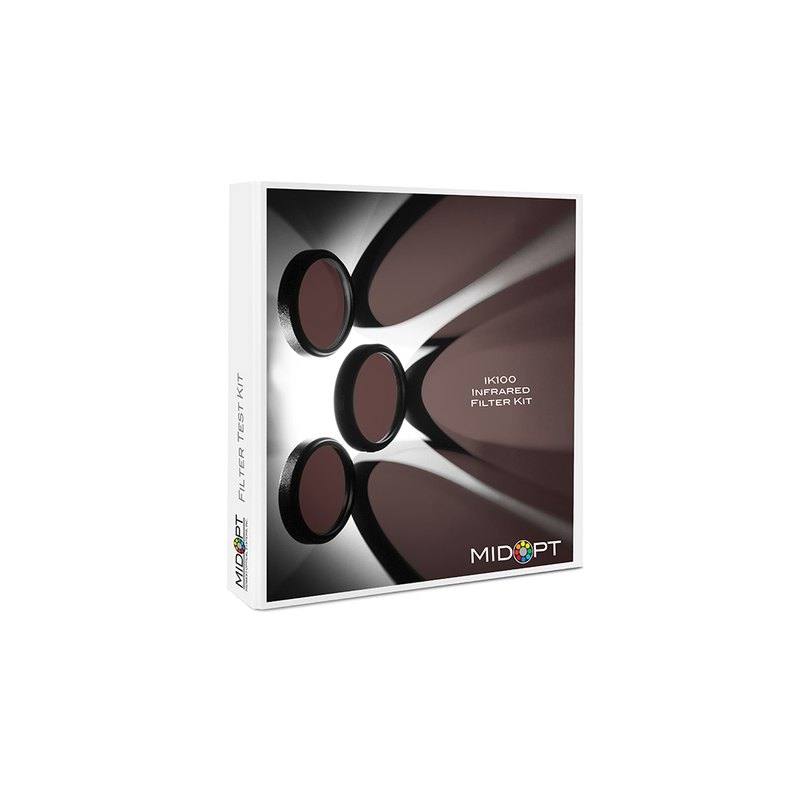
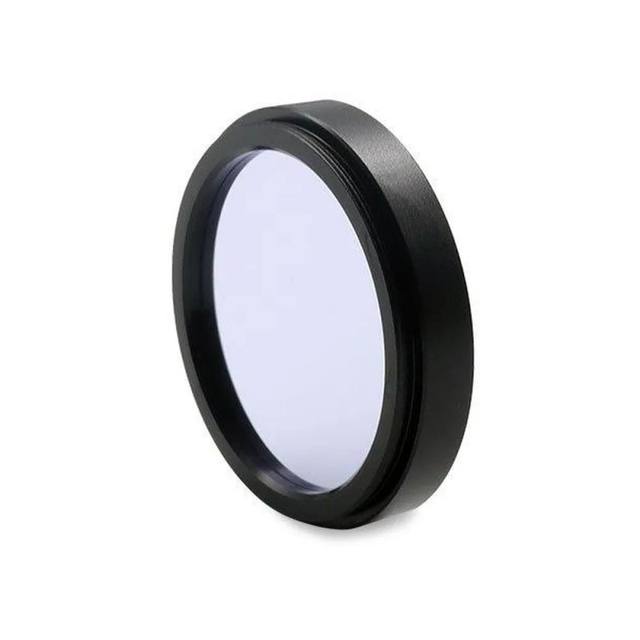
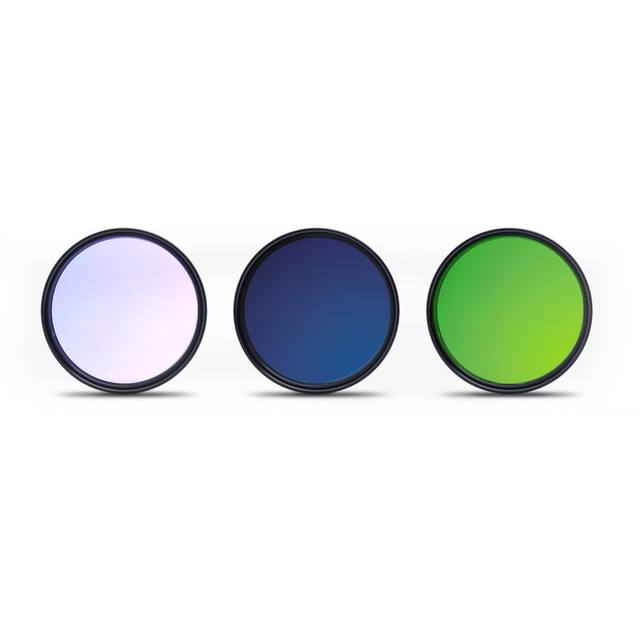
The IK100 is a near-infrared kit: six filters that show how far into the infrared an application needs to go. Four are longpass: LP695 (715–1100 nm), LP780 (800–1100 nm), LP920 (930–2300 nm) and the LP1000. Two are bandpass: BP800 (745–950 nm) and BP850 (820–910 nm).
Silicon sensors typically respond up to about 1100 nm, so the LP695 and LP780 ranges end where the sensor does. Run the longpass filters first to see whether any near-infrared band improves contrast, then the two bandpass filters to see how much a narrower window cuts ambient light.
Best for
Finding out whether near-infrared imaging helps at all, since inks, plastics and coatings that look opaque in visible light often change in the infrared.
Choosing between a wide and a narrow near-infrared window with BP800 (745–950 nm) and BP850 (820–910 nm) before buying lighting.
Setting the lowest useful cut-on wavelength, by stepping from LP695 up to LP920 and noting where the image starts to improve.
Selection notes
The IK100 is sold in 26 thread sizes, IK100-22.5 to IK100-105; choose the number equal to your lens's filter thread in mm. Step rings for M25.5 and M30.5 lenses come with the IK100-27.
Testing needs a near-infrared light that matches the band you want to test, such as an 850 nm LED.
Refocus under each filter, since focus typically shifts between visible and infrared wavelengths. Many colour cameras carry an IR-cut filter that would block these bands.
Specifications: General
Brand
MidOpt
Specifications: Mechanical
Thread / filter size
M22.5–M105 (26 threaded size options)
This product groups every purchasable order code that shares the same sensing method, range and output. Cable length, connector type and operation mode (Light-ON/Dark-ON, NO/NC) vary by order code below.
Family variants with highlighted differences
Model
Availability
Threaded mount M22.5 Base
On request
Threaded mount M25.4
On request
Threaded mount M25.5
On request
Threaded mount M27 — includes step-up & step-down adapter rings for M25.5 and M30.5 threaded lenses
That is the filter's useful range. A silicon sensor responds only up to about 1100 nm, so with a standard camera the useful band is roughly 930–1100 nm.
A longpass passes everything above its cut-on up to the sensor's limit, while a bandpass such as BP850 passes a band about 160 nm wide at half maximum.