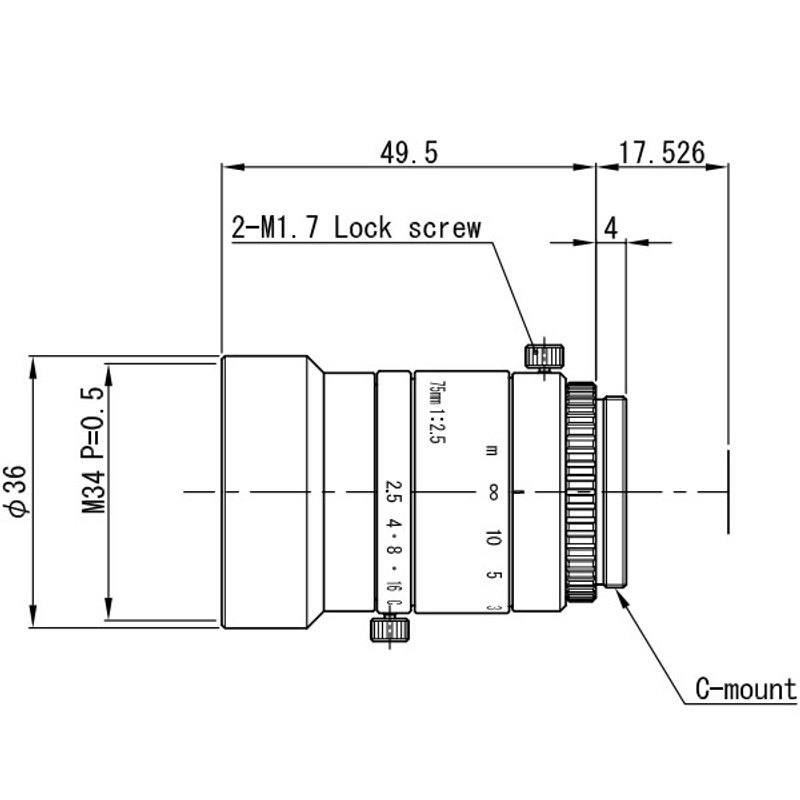
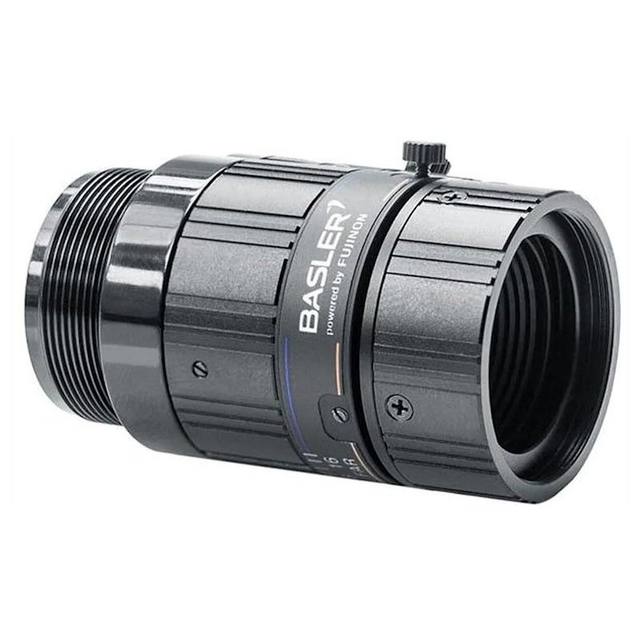
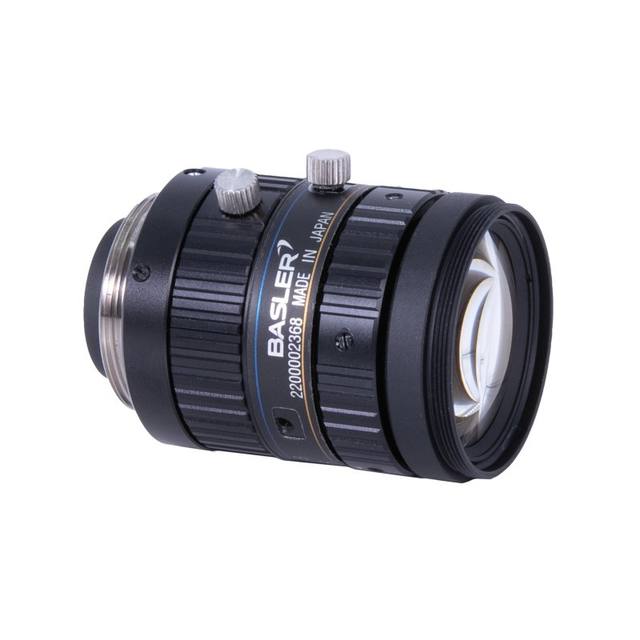
The Omron 3Z4S-LE SV-7525H is a 75 mm fixed focal length lens with a C-mount interface designed for high-resolution, low-distortion machine vision imaging. It supports sensor formats up to 1 inch and provides TV distortion of only 0.05%, rated for 4 to 9 megapixel cameras. The lens features manual iris and focus control with a lock screw, a minimum object distance of 1200 mm, and accepts M34 P=0.5 filters. Physical dimensions are Ø36 mm (max) x 49.5 mm length with an approximate weight of 85 g.
Brand
VS Technology (OEM); sold by Omron as 3Z4S-LE SV-7525H
The Omron 3Z4S-LE SV-7525H is a 75 mm fixed focal length C-mount lens engineered for demanding megapixel machine vision applications where optical fidelity matters more than fast cycle times. Its 75 mm focal length produces a narrow field of view at any given working distance, making it well suited to reading fine features or resolving small defects on parts that are relatively far from the camera. With a maximum aperture of F2.5, the lens gathers a useful amount of light for its class — enough to support moderate strobe intensities or diffuse continuous lighting without forcing impractically short exposures — while the ability to stop down to full close allows depth-of-field to be tuned when part geometry requires it. The manual iris and focus rings both carry lock screws, so once the optical station is calibrated, vibration or accidental contact will not shift the operating point.
Resolution and distortion are the defining strengths of this lens. The optic is rated for 4 to 9 MP sensors and covers image circles up to 1 inch (16 mm), meaning it pairs cleanly with popular formats such as 2/3-inch, 1/1.8-inch, and 1-inch CMOS sensors without corner softness or vignetting. TV distortion is specified at only 0.05%, an exceptionally low figure that makes pixel-level dimensional measurements reliable across the full frame without software distortion correction. An installer using a 5 MP or 9 MP camera can trust that a straight edge at the image periphery will render as a straight edge, which directly simplifies calibration routines and uncertainty budgets. The lens is not telecentric, so perspective error will increase if parts are presented at varying heights; for height-sensitive gauging, a consistent, repeatable part-presentation fixture is advisable.
The 1200 mm minimum object distance is the key mechanical constraint to plan around. The lens is designed for stand-off installations — overhead gantry cameras above a conveyor, end-of-line inspection stations, or document-reading portals — rather than close-proximity bench setups. At 1200 mm working distance the field of view will be determined by the specific sensor size, and installers should confirm the resulting pixel pitch against the smallest feature they need to resolve before finalising camera selection. The lens accepts M34 P=0.5 filters, allowing addition of polarising, bandpass, or neutral density elements to the optical path without changing the camera or mount. At 85 g and 49.5 mm length with a maximum diameter of 36 mm it is compact and will not overload the C-mount flange on most industrial camera housings.
Best for
Overhead conveyor inspection where the camera is mounted 1.2 m or more above the line and high pixel density across a wide sensor is needed to resolve print quality, label content, or surface defects
Dimensional measurement of machined or stamped parts where the 0.05% TV distortion eliminates the need for software barrel or pincushion correction and supports sub-pixel gauging accuracy
OCR and OCV on product labels, PCB silkscreen, or pharmaceutical packaging at standoff distances, pairing the narrow field of view with a 5–9 MP sensor to achieve small character resolution
Electronics and semiconductor component inspection on high-resolution area-scan cameras (4–9 MP, 2/3-inch to 1-inch sensors) where fine-pitch features must be imaged sharply to the frame corners
Traceability code reading (1D, 2D, DPM) at end-of-line stations where fixed standoff distance and a locked iris/focus guarantee repeatable decode performance across shifts
Selection notes
Minimum working distance is 1200 mm — confirm early that the mechanical envelope of the inspection station can accommodate this standoff before specifying the lens, as no close-focus adapter is implied by the spec sheet
The 1-inch maximum image circle supports sensors up to 1 inch; cameras with sensors larger than 1 inch will show corner vignetting and require a lens with a larger image circle
Rated for 4 to 9 MP sensors: pairing with cameras below 4 MP wastes the lens's resolving power, and pairing with sensors above 9 MP may reveal the lens's resolution limit at the pixel level — verify MTF data for sensors above 9 MP
Not telecentric: parts with significant height variation will introduce magnification change and lateral displacement errors proportional to the height delta divided by the working distance; for gauging applications requiring better than ±0.1 mm accuracy, control part presentation height or use a telecentric lens instead
The M34 P=0.5 filter thread makes it straightforward to add a bandpass filter matched to a monochromatic LED illumination source, improving contrast for surface or code reading without mechanical modification to the camera or mount
Specifications: General
Brand
VS Technology (OEM); sold by Omron as 3Z4S-LE SV-7525H
Specifications: Optical
Focal length
75 mm
Lens mount
C-mount
Aperture (f-number)
F2.5 to Close
Image circle / max sensor
1 inch max sensor (≥ 16 mm image circle)
Optical resolution
4 – 9 MP rated
Telecentric
No
Working distance
1200 mm minimum
Specifications: Mechanical
Dimensions
Ø36 (max) x 49.5 mm
Weight
85 g
Applications this camera is commonly selected for. Open one to see the full recommended hardware and approach.
Matched automatically by: camera mount fits the lens mount · camera sensor is covered by the lens image circle — this lens: C-mount · 1 inch max sensor (≥ 16 mm image circle) image circle.
These steps take an Omron Sentech (STC) camera from the box to a stable first image and on to your own application. They apply across the GigE Vision, USB3 Vision and CoaXPress STC families; the interface only changes how you cable and power the camera.
Download and install the Sentech SDK on the host PC. The package provides StViewer, the viewing and configuration software you use to bring the camera up, and StApi, the programming SDK you integrate later. Because the cameras are GenICam/GenTL-compliant, StApi also registers a GenTL producer, so any GenICam-compliant third-party vision software can discover and drive the camera as an alternative front end.
2. Cable, power and connect the camera
Connect according to the interface. GigE Vision: link to a Gigabit NIC (use PoE or the separate power input) and put the camera and host on the same subnet; for USB3 Vision use a USB 3.x port and a certified cable; for CoaXPress (STC) connect to a CoaXPress frame grabber, which also supplies Power-over-Coax. Then open StViewer and let it enumerate the camera. If a GigE camera does not appear, check the IP configuration and firewall, and on USB3 confirm the host bandwidth and driver.
3. Configure exposure, gain and white balance
Open the device in StViewer and start a live stream. Set exposure and gain for a well-exposed, low-noise image: raise exposure first and only add gain when more light or a faster shutter is not an option, keeping exposure short enough to freeze motion on global-shutter models. On colour cameras, run white balance under your actual production lighting. Adjust the lens aperture and focus on a representative target before tuning anything else.
4. Set the trigger and grab a first image
Start in free-run (continuous) acquisition to confirm a clean, stable image. For inline inspection switch to hardware or software triggering: select the trigger source, set the active edge and any delay, and wire the strobe or illumination to the camera's I/O so lighting fires with each exposure. Acquire and save a frame in StViewer; this saved image is your reference for the SDK stage and for downstream inspection.
5. Move to the StApi SDK (or any GenICam software)
Once the image is stable, reproduce the same settings in code. Use StApi to open the device, apply the GenICam features you validated in StViewer (exposure, gain, trigger, pixel format) and grab frames into your application via the bundled C++, C, C#/.NET or Python interfaces; the included samples are the fastest starting point. Prefer a different stack? The same GenICam/GenTL camera works with third-party vision libraries. With a reliable feed, you can route it into a deep-learning inspection such as Rosepetal for AI-based defect detection.
Frequently asked questions
The lens provides an image circle of at least 16 mm, which covers sensors up to 1 inch in format. Common compatible formats include 2/3-inch, 1/1.8-inch, and 1-inch sensors. Sensors larger than 1 inch will fall outside the illuminated image circle and exhibit corner darkening.
TV distortion is specified at 0.05%, which is very low for a standard (non-telecentric) C-mount lens. In practice this means a 10 mm feature at the edge of the frame will have a positional error on the order of 5 micrometres due to distortion alone, making software correction largely unnecessary for most gauging tasks.
1200 mm is the minimum object distance as specified. Operating below this distance will result in the lens being unable to achieve focus, regardless of the focus ring position. If shorter working distances are required, a different lens with a closer minimum focus specification must be chosen.
The lens accepts M34 P=0.5 threaded filters. Adding a narrowband bandpass filter matched to a monochromatic LED illumination wavelength is the most common use case — it suppresses ambient light and improves contrast for surface defect detection, OCR, or code reading in factory lighting environments.
The iris is manually adjustable via a ring on the lens body. A lock screw is provided so that once the correct aperture is set during commissioning, it can be secured against accidental movement. There is no auto-iris or remote iris function — any change requires manual access to the lens.