Omron / Sentech VS-TCH Series 0.5x Telecentric Lens, WD 65 mm, Coaxial, C-Mount
3Z4S-LE VS-TCH05-65CO-O
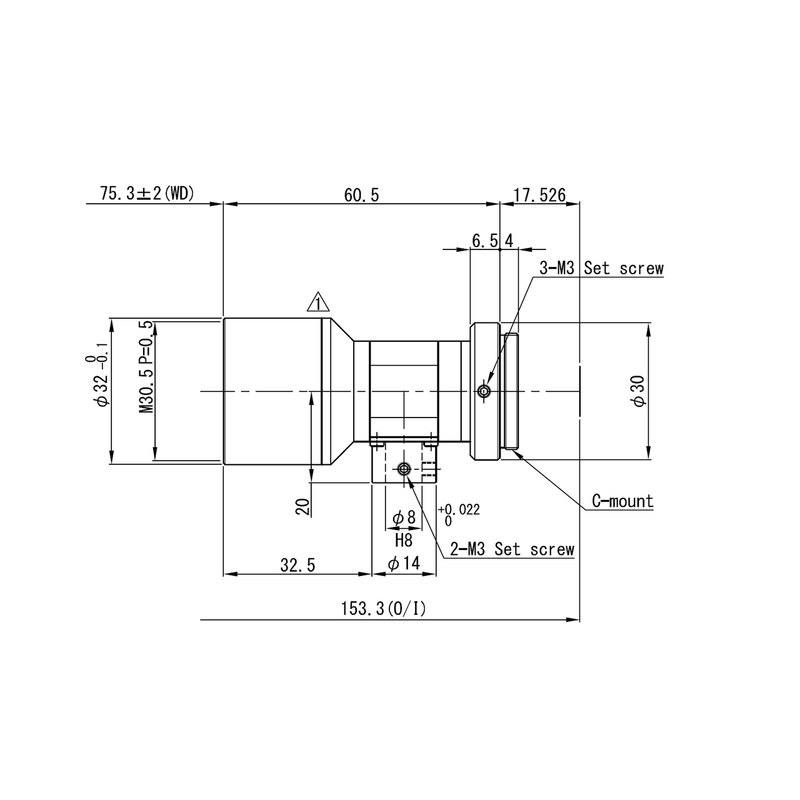
The VS-TCH05-65CO-O is part of Omron's VS-TCH series of high-resolution telecentric lenses designed for megapixel machine vision cameras. It provides 0.5x optical magnification with a true working distance of 75.3 mm (±2 mm) and covers up to a 2/3-inch sensor format, yielding a field of view of 13.2 × 17.6 mm. The built-in coaxial prism ("CO" suffix) enables direct integration with coaxial illumination sources, while the fixed-iris design delivers extremely low TV distortion of 0.02% maximum and a resolution of 12.43 µm at 550 nm. The lens mounts via standard C-mount and weighs 74.5 g.
Brand
VS Technology (OEM); sold by Omron as 3Z4S-LE VS-TCH05-65CO-O
The VS-TCH05-65CO-O is a true telecentric lens delivering 0.5x magnification on sensors up to the 2/3-inch format, producing a fixed field of view of 13.2 x 17.6 mm at its true working distance of 75.3 mm. Telecentricity means the chief ray travels parallel to the optical axis on the object side — so an object that shifts axially within the ±2 mm depth tolerance produces no measurable change in apparent size. For dimensional gauging and go/no-go inspection, this eliminates the parallax error that plagues conventional lenses and allows reliable sub-pixel edge location across the entire image circle. The 2 MP optical rating matches current-generation 2/3-inch area-scan cameras without resolution bottlenecking the sensor.
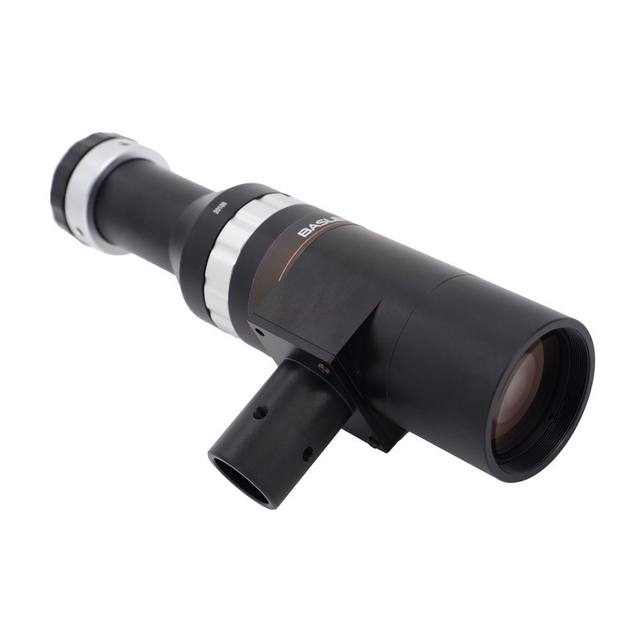
The coaxial prism built into the lens body is the defining integration feature of this variant. Rather than routing a separate ring light or dome ahead of the lens, a beam-splitter cube inside the barrel redirects illumination coaxially down the optical path, creating shadowless, specular-free illumination directly on axis. This geometry is particularly effective on mirror-finish metallic surfaces, solder joints, IC lead frames, and engraved or embossed marks where off-axis lighting would create hotspots or shadow artefacts. The illumination port accepts a compatible coaxial light source, keeping the assembly compact and alignment-free. The effective aperture of F9.42 is a consequence of the telecentric design and yields adequate depth of field for flat or near-flat targets at the 75.3 mm working distance.
The fixed-iris design contributes directly to metrology-grade repeatability: with no iris ring to accidentally adjust during installation or maintenance, the effective f-number and therefore depth of field remain constant across all production units. TV distortion is specified at 0.02% maximum — at the 13.2 mm short dimension of the field, that is approximately 2.6 µm of geometric error, well below one camera pixel for any 2 MP sensor in this format class. Optical resolution is quoted as 12.43 µm at 550 nm, consistent with the Rayleigh criterion at F9.42. The C-mount interface and 74.5 g body are compatible with standard machine-vision camera housings without additional support brackets on most production lines, and the 32 mm maximum outer diameter fits within the illumination aperture of most coaxial light heads sold for C-mount systems.
Best for
Precision dimensional gauging of flat or near-flat parts — IC packages, connector pins, stamped metal blanks — where object-space telecentricity eliminates parallax-induced size error across the ±2 mm depth of field.
Coaxial brightfield inspection of specular surfaces such as solder pads, lead frames, polished bearing faces, and pharmaceutical blister seals, where the integrated prism removes the need for a separate coaxial light head and keeps the optical axis aligned without manual setup.
High-accuracy character verification (OCR/OCV) and 2D/DM code reading on embossed, laser-marked, or dot-peen surfaces where even illumination and distortion below 0.02% are required for reliable decoding at the pixel level.
Go/no-go presence and position checks in electronics and semiconductor back-end assembly where the 13.2 x 17.6 mm field of view covers a single component nest or pocket and the 2 MP rating resolves fine-pitch features.
Pharmaceutical and medical-device packaging verification — tablet blister inspection, label print quality, and closure integrity — where the self-contained coaxial illumination path reduces particulate-shedding surfaces.
Selection notes
Working distance is fixed at 75.3 mm true optical distance (nominal label reads 65 mm, matching the part number suffix). The ±2 mm depth tolerance covers only very flat targets; do not use this lens on parts with significant Z-relief or curved surfaces, as features outside the telecentric depth band will show magnification shift.
The maximum sensor format is 2/3 inch. Mounting this lens on a camera with a larger sensor — 1-inch or 4/3-inch — will result in vignetting in the image corners. Confirm your camera's sensor format before ordering.
The built-in coaxial prism reduces light throughput compared to a bare telecentric lens at the same f-number; budget for a coaxial illuminator with sufficient exit irradiance for the exposure times your cycle rate requires. Verify mechanical and optical interface compatibility between the lens illumination port and your chosen coaxial light source.
The fixed iris at F9.42 cannot be opened for low-light scenes. If your application requires very short exposures on dark materials, evaluate whether a strobe illuminator with high peak output can compensate, rather than attempting to use a different aperture.
Lens resolution is rated at 2 MP. Pairing with a camera above 2 MP on this sensor format will outrun the optical resolving power (12.43 µm at 550 nm) — additional sensor pixels will not recover finer detail, and you will be paying for sensor resolution that the optics cannot deliver.
Specifications: General
Brand
VS Technology (OEM); sold by Omron as 3Z4S-LE VS-TCH05-65CO-O
Specifications: Optical
Lens mount
C-mount
Telecentric
Yes
Magnification
0.5x (±5%)
Working distance
75.3 mm (nominal 65 mm)
Aperture (f-number)
F9.42 (effective)
Image circle / max sensor
2/3 inch (max sensor format)
Optical resolution
2 MP rated
Specifications: Environment
Operating temperature
0 to +50 °C
Specifications: Mechanical
Dimensions
Ø32 (max) × 60.5 mm
Weight
74.5 g
Applications this camera is commonly selected for. Open one to see the full recommended hardware and approach.
Matched automatically by: camera mount fits the lens mount · camera sensor is covered by the lens image circle — this lens: C-mount · 2/3 inch (max sensor format) image circle.
By category
All 758Area scan cameras 622High-speed cameras 108High-resolution cameras 28
By brand
All 758Omron / Sentech 297Basler 242iRAYPLE 200Datalogic / Datasensing 19
These steps take an Omron Sentech (STC) camera from the box to a stable first image and on to your own application. They apply across the GigE Vision, USB3 Vision and CoaXPress STC families; the interface only changes how you cable and power the camera.
Download and install the Sentech SDK on the host PC. The package provides StViewer, the viewing and configuration software you use to bring the camera up, and StApi, the programming SDK you integrate later. Because the cameras are GenICam/GenTL-compliant, StApi also registers a GenTL producer, so any GenICam-compliant third-party vision software can discover and drive the camera as an alternative front end.
2. Cable, power and connect the camera
Connect according to the interface. GigE Vision: link to a Gigabit NIC (use PoE or the separate power input) and put the camera and host on the same subnet; for USB3 Vision use a USB 3.x port and a certified cable; for CoaXPress (STC) connect to a CoaXPress frame grabber, which also supplies Power-over-Coax. Then open StViewer and let it enumerate the camera. If a GigE camera does not appear, check the IP configuration and firewall, and on USB3 confirm the host bandwidth and driver.
3. Configure exposure, gain and white balance
Open the device in StViewer and start a live stream. Set exposure and gain for a well-exposed, low-noise image: raise exposure first and only add gain when more light or a faster shutter is not an option, keeping exposure short enough to freeze motion on global-shutter models. On colour cameras, run white balance under your actual production lighting. Adjust the lens aperture and focus on a representative target before tuning anything else.
4. Set the trigger and grab a first image
Start in free-run (continuous) acquisition to confirm a clean, stable image. For inline inspection switch to hardware or software triggering: select the trigger source, set the active edge and any delay, and wire the strobe or illumination to the camera's I/O so lighting fires with each exposure. Acquire and save a frame in StViewer; this saved image is your reference for the SDK stage and for downstream inspection.
5. Move to the StApi SDK (or any GenICam software)
Once the image is stable, reproduce the same settings in code. Use StApi to open the device, apply the GenICam features you validated in StViewer (exposure, gain, trigger, pixel format) and grab frames into your application via the bundled C++, C, C#/.NET or Python interfaces; the included samples are the fastest starting point. Prefer a different stack? The same GenICam/GenTL camera works with third-party vision libraries. With a reliable feed, you can route it into a deep-learning inspection such as Rosepetal for AI-based defect detection.
Frequently asked questions
Yes. The '65' in the part number refers to the nominal working distance used for product labeling. The true optical working distance — measured from the front of the lens to the object plane — is 75.3 mm, with a ±2 mm usable depth band. Design your fixture to the 75.3 mm figure.
The lens covers up to a 2/3-inch image circle. It is fully compatible with 1/3-inch, 1/2-inch, and 2/3-inch sensors. Using it on a 1-inch or larger sensor will vignette the corners. The C-mount interface is standard across all of these camera families.
The prism is integrated into the lens barrel and requires a coaxial illuminator designed to couple into the VS-TCH series illumination port. Verify mechanical and optical interface compatibility with your chosen light source before purchasing; third-party coaxial heads may not fit without an adapter.
The specification is 0.02% maximum TV distortion. Over the 13.2 mm short dimension of the 0.5x field, this corresponds to approximately 2.6 µm of geometric error at the image edge — a negligible contribution to uncertainty for most 2 MP vision systems.
No. The VS-TCH05-65CO-O has a fixed iris. The effective aperture is F9.42 and cannot be changed. Depth of field and exposure must be controlled through illumination intensity, camera gain, and shutter time only.