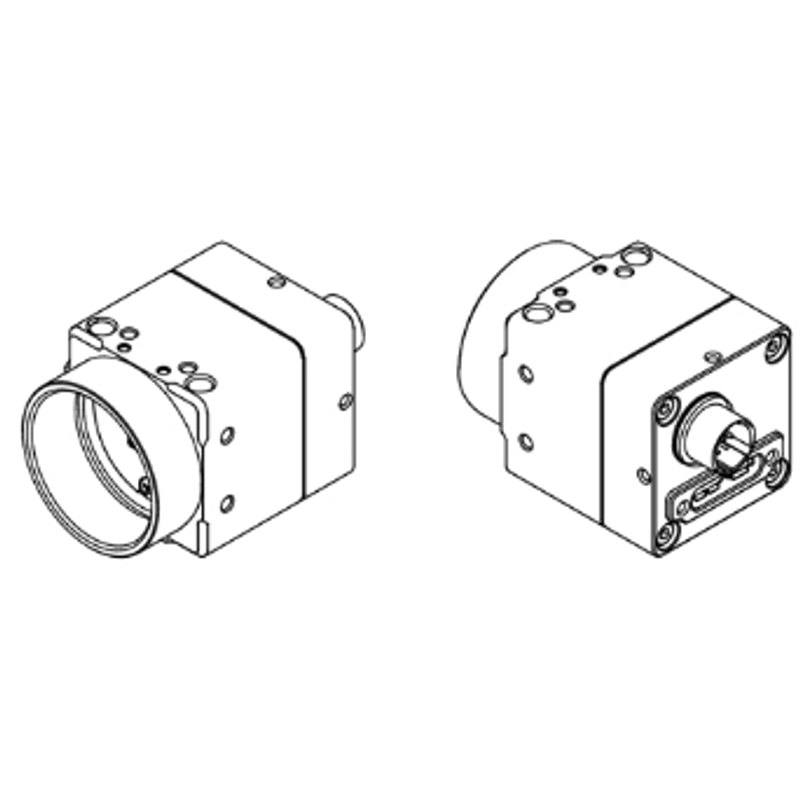
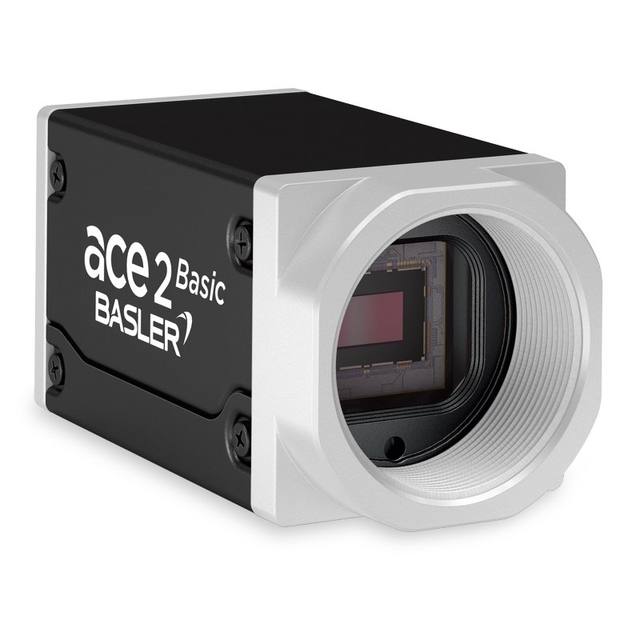
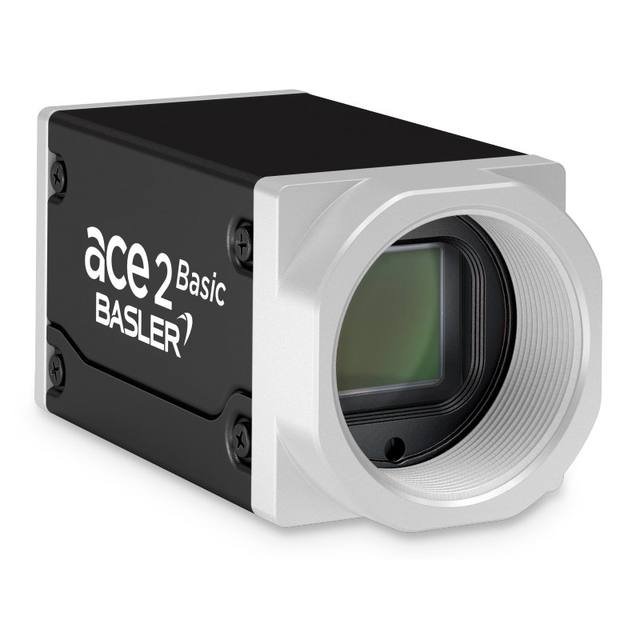
The STC-MBS241U3V (mono) and STC-MCS241U3V (color) are C-mount USB3 Vision cameras using the 1/1.2-inch Sony IMX174 global-shutter CMOS sensor at 1920 x 1200 (2.3 MP) with 5.86 um square pixels. They reach up to 163 fps in full-frame readout (higher in AOI mode) over a USB 3.0 SuperSpeed Micro-B interface and are USB3 Vision 1.0.1 / GenICam compliant. The camera is bus-powered (+5 V) at under 4.0 W in a small 28 x 28 x 40 mm aluminium housing weighing about 48 g, with analog gain to 24 dB and exposure from 18.6 us to 20 s.
The Omron Sentech STC-MBS241U3V (mono) and its STC-MCS241U3V color sibling are compact 2.3 MP area-scan cameras built around the Sony IMX174, a 1/1.2-inch global-shutter CMOS sensor delivering 1920 x 1200 pixels on a generous 5.86 um square pitch. That combination is the heart of the camera's value: the global shutter exposes every pixel simultaneously, so parts moving on a conveyor, a rotating index table, or under a robot arm are captured without the skew or smearing that a rolling-shutter sensor introduces. The relatively large 5.86 um pixels collect a lot of light per exposure, which translates into clean images at short exposure times and good performance in the kind of strobed, motion-freezing setups industrial inspection demands. With analog gain available up to 24 dB and exposure adjustable from 18.6 us all the way to 20 s, the same camera spans bright high-speed strobe work and dim, long-integration scenes.
The interface is USB 3.0 SuperSpeed over a Micro-B connector, conforming to USB3 Vision 1.0.1 and GenICam, so the camera is plug-compatible with standard machine-vision software stacks and frame grabbers are unnecessary. USB3 Vision keeps cabling simple and the camera bus-powered at +5 V under 4.0 W, but it also defines the practical envelope: passive USB3 runs are limited to roughly 3-5 m before you need active or optical extension, so this is a camera for inspection cells where the PC sits near the imaging station rather than a long factory-floor cable run (where a GigE or CoaXPress camera would be more natural). The headline 163 fps applies to full-frame readout; defining a smaller area-of-interest pushes the achievable frame rate higher still, which is how you turn this into a genuine high-speed tool for catching fast events or running multiple captures per part.
Optically the camera uses a C-mount and the 1/1.2-inch format, a mid-size sensor that is well served by readily available C-mount lenses; you will want a lens rated to cover at least 1/1.2 inch and resolve the 5.86 um pixel pitch so the optics do not become the limiting factor. The body is small and rugged for the class: a 28 x 28 x 40 mm aluminium housing weighing about 48 g, which makes it easy to mount on robot end-effectors, in tight inspection fixtures, or in multi-camera arrays. Rated for 0 to +64 degC operation, the camera tolerates the warm environments around presses, ovens and enclosed cells. The mono STC-MBS241U3V is the choice for maximum sensitivity and detail in measurement, OCR/OCV and code reading, while the color STC-MCS241U3V uses a Bayer color filter on the same 2.3 MP sensor, trading per-pixel luminance detail and sensitivity for color discrimination where part sorting or color-coded features matter.
Best for
High-speed defect and surface inspection of parts in motion on a conveyor or index table, where the global shutter freezes movement without distortion
OCR/OCV and 2D code (traceability) reading on the mono variant, which gives the cleanest contrast for character and code recognition
Dimensional measurement and gauging tasks that need geometrically accurate, distortion-free images of moving or stepped product
Robot-guidance and end-of-arm vision, where the small 48 g aluminium body and bus-powered USB3 cabling fit a moving payload
Color-dependent sorting or verification using the STC-MCS241U3V color variant when part color or color-coded marks must be discriminated
Selection notes
USB3 Vision over a Micro-B connector means the camera must sit within a short passive cable run (roughly 3-5 m) of the host PC; plan active or fiber-optic USB3 extension for longer distances, and confirm the host has a dedicated USB 3.0 controller with enough bandwidth for the 163 fps stream.
The 163 fps figure is full-frame; if your application needs more speed, budget for area-of-interest (AOI) readout, which raises frame rate by reading out fewer lines, and pair it with a lighting/strobe controller capable of the short exposures (down to 18.6 us) needed to freeze motion.
Choose a C-mount lens that covers the 1/1.2-inch optical format and resolves the 5.86 um pixel pitch; an under-spec lens will soften the corners and waste the sensor's 2.3 MP detail. Compute working distance and field of view from the 1920 x 1200 array and pixel size for your required measurement resolution.
Decide mono versus color up front: the STC-MBS241U3V (mono) maximizes sensitivity and per-pixel detail for measurement, OCR and code reading, while the STC-MCS241U3V (color) is only warranted when color information is part of the inspection decision.
The camera is bus-powered at +5 V under 4.0 W with no separate power or I/O power supply needed, but verify your machine-vision software supports USB3 Vision 1.0.1 / GenICam, and account for the 0 to +64 degC operating range plus heat dissipation through the aluminium housing in enclosed or warm cells.
Specifications: General
Brand
Omron / Sentech
Camera type
Area scan
Specifications: Sensor
Resolution
2.3 MP
Horizontal resolution
1920 (H) x 1200 (V) px
Mono / color
Mono (MBS) / Color (MCS)
Sensor manufacturer
Sony Pregius (IMX174)
Sensor model
Sony IMX174 CMOS
Shutter
Global shutter
Sensor size
1/1.2 inch optical format
Pixel size
5.86 x 5.86 um
Specifications: Performance
FPS
Up to 163 fps (full frame)
Specifications: Interface
Interface
USB 3.0 SuperSpeed (USB3 Vision)
Protocols
USB3 Vision 1.0.1 / GenICam
Specifications: Optics
Mount
C-mount
Specifications: Electrical
Power
USB bus power (+5 V)
Power consumption
4 W
Specifications: Environment
Operating temperature
0 to +64 degC
Specifications: Mechanical
Dimensions
28 x 28 x 40 mm
Weight
48 g
Housing material
Aluminium
Applications this camera is commonly selected for. Open one to see the full recommended hardware and approach.
Matched automatically by: lens mount fits the camera mount · lens image circle covers the camera sensor — this camera: C-mount · 1/1.2 inch optical format sensor.
By category
All 90C-mount lenses 66Telecentric lenses 24
By brand
All 90Basler 34iRAYPLE 26Omron / Sentech 24Datalogic / Datasensing 6
These steps take an Omron Sentech (STC) camera from the box to a stable first image and on to your own application. They apply across the GigE Vision, USB3 Vision and CoaXPress STC families; the interface only changes how you cable and power the camera.
Download and install the Sentech SDK on the host PC. The package provides StViewer, the viewing and configuration software you use to bring the camera up, and StApi, the programming SDK you integrate later. Because the cameras are GenICam/GenTL-compliant, StApi also registers a GenTL producer, so any GenICam-compliant third-party vision software can discover and drive the camera as an alternative front end.
2. Cable, power and connect the camera
Connect according to the interface. GigE Vision: link to a Gigabit NIC (use PoE or the separate power input) and put the camera and host on the same subnet; for USB3 Vision use a USB 3.x port and a certified cable; for CoaXPress (STC) connect to a CoaXPress frame grabber, which also supplies Power-over-Coax. Then open StViewer and let it enumerate the camera. If a GigE camera does not appear, check the IP configuration and firewall, and on USB3 confirm the host bandwidth and driver.
3. Configure exposure, gain and white balance
Open the device in StViewer and start a live stream. Set exposure and gain for a well-exposed, low-noise image: raise exposure first and only add gain when more light or a faster shutter is not an option, keeping exposure short enough to freeze motion on global-shutter models. On colour cameras, run white balance under your actual production lighting. Adjust the lens aperture and focus on a representative target before tuning anything else.
4. Set the trigger and grab a first image
Start in free-run (continuous) acquisition to confirm a clean, stable image. For inline inspection switch to hardware or software triggering: select the trigger source, set the active edge and any delay, and wire the strobe or illumination to the camera's I/O so lighting fires with each exposure. Acquire and save a frame in StViewer; this saved image is your reference for the SDK stage and for downstream inspection.
5. Move to the StApi SDK (or any GenICam software)
Once the image is stable, reproduce the same settings in code. Use StApi to open the device, apply the GenICam features you validated in StViewer (exposure, gain, trigger, pixel format) and grab frames into your application via the bundled C++, C, C#/.NET or Python interfaces; the included samples are the fastest starting point. Prefer a different stack? The same GenICam/GenTL camera works with third-party vision libraries. With a reliable feed, you can route it into a deep-learning inspection such as Rosepetal for AI-based defect detection.
Frequently asked questions
It uses the Sony IMX174, a 1/1.2-inch global-shutter CMOS sensor (Sony Pregius family) at 1920 x 1200 (2.3 MP) with 5.86 um square pixels. The global shutter exposes all pixels at once, so moving parts are captured without the skew or smear a rolling shutter would produce, which is why it suits inspection of product on conveyors and index tables.
It connects over USB 3.0 SuperSpeed via a Micro-B connector and is USB3 Vision 1.0.1 / GenICam compliant, so it works with standard machine-vision software and needs no frame grabber. It is also bus-powered at +5 V, drawing under 4.0 W, so no separate power supply is required.
Up to 163 fps in full-frame (1920 x 1200) readout. Defining a smaller area-of-interest (AOI) allows higher frame rates, and exposure can be set from 18.6 us to 20 s, so it covers both motion-freezing high-speed work and long-integration low-light scenes.
Yes. The STC-MBS241U3V is the monochrome version and the STC-MCS241U3V is the color version. Both share the same IMX174 sensor, 2.3 MP resolution, USB3 Vision interface and housing; choose mono for maximum detail and sensitivity in measurement, OCR and code reading, or color when color discrimination is needed.
It has a C-mount and a 1/1.2-inch optical format, so it needs a C-mount lens that covers that format. The housing is aluminium, measures 28 x 28 x 40 mm and weighs about 48 g, and it operates from 0 to +64 degC, making it easy to fit in tight fixtures, multi-camera arrays or on a robot arm.