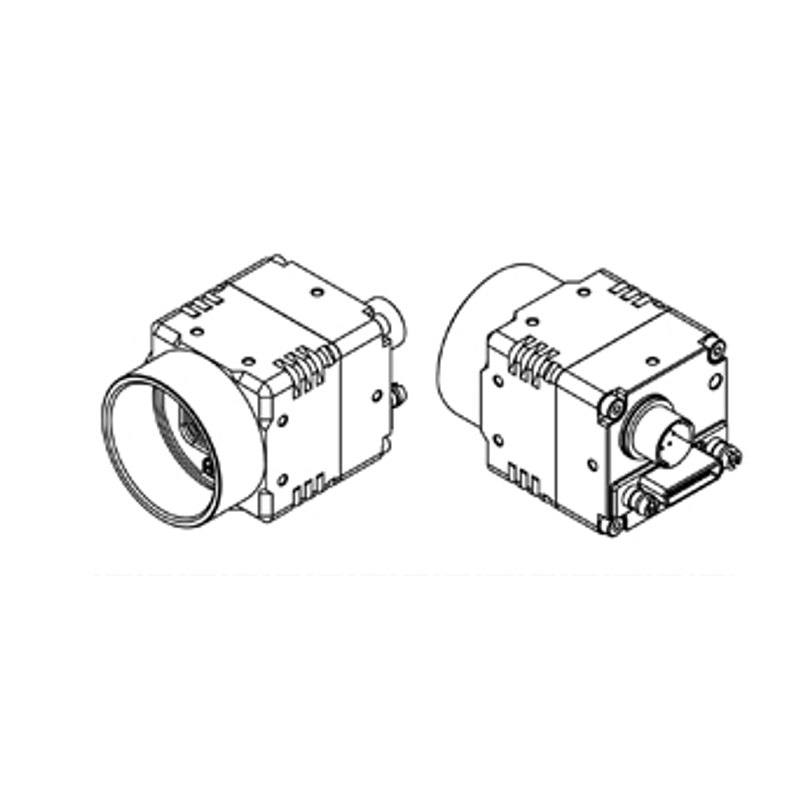
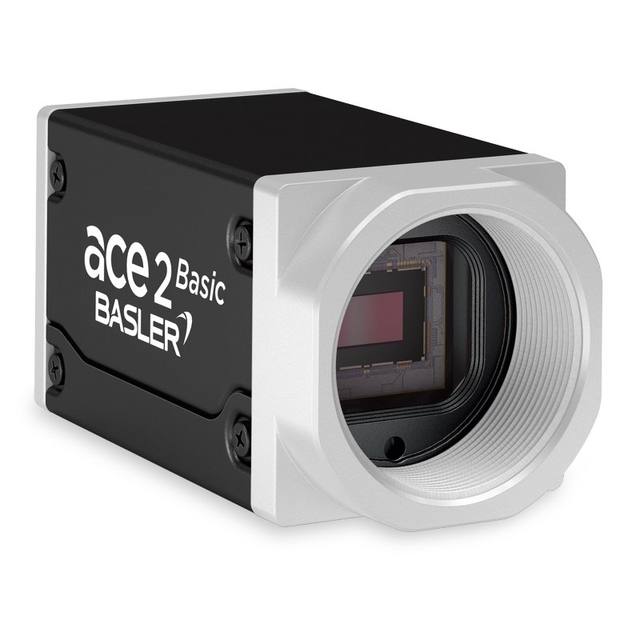
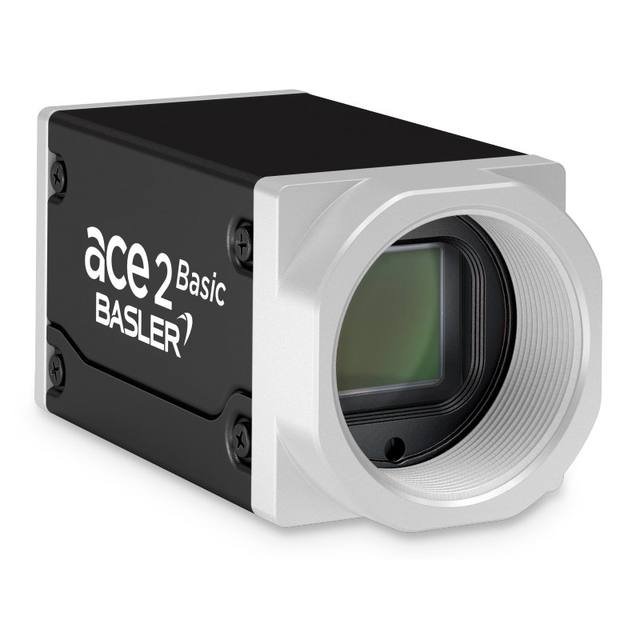
The STC-SPB52PCL (mono) and STC-SPC52PCL (color) are cased Camera Link Base area-scan cameras built around the 1/1.7" Sony IMX433 global-shutter CMOS sensor (812 x 620 px, 0.5 MP, 9.0 µm pixels). They reach 166.5 fps over a Camera Link 2.1 Base interface with a C-mount lens flange. Exposure is adjustable from 1 µs to 16.777 s, with analog gain 0-42 dB and digital gain 1-16x. The camera is powered via PoCL or external +12 Vdc, consumes 2.4 W or less, weighs about 40 g in a 28 x 28 x 40 mm housing, and operates from 0 to +41 °C.
The Omron Sentech STC-SPB52PCL (monochrome) and STC-SPC52PCL (color) are cased Camera Link Base area-scan cameras built on the 1/1.7-inch Sony IMX433 global-shutter CMOS sensor. At 812 x 620 pixels (0.5 MP) with large 9.0 x 9.0 micron pixels, this is deliberately a low-resolution, high-sensitivity, high-speed pairing rather than a detail-density camera. The big pixels collect a lot of light per well, so the camera reaches a clean signal at short exposures, and the global shutter freezes the entire frame at once. Together those two traits make it well suited to fast-moving parts on a conveyor or rotary index, where a rolling shutter would smear or skew the image and where you need enough photons in a sub-millisecond window to keep the picture usable.
The headline is speed for the pixel count: 166.5 fps at full frame over a Camera Link 2.1 Base interface. Camera Link is a deterministic, low-latency wired link, which is why a 0.5 MP camera bothers with it at all; it gives you tight, jitter-free triggering and predictable frame delivery into a frame grabber, the kind of timing discipline that high-speed sort, reject, and synchronized-strobe stations depend on. Exposure is adjustable across an unusually wide range, from 1 microsecond up to 16.777 seconds, so the same camera can freeze a fast index in microseconds or integrate for long stills. Image gain is handled with 0-42 dB analog gain plus 1-16x digital gain, giving headroom to lift a dim scene before you add more light. The C-mount flange and 1/1.7-inch format keep optics conventional and inexpensive; standard C-mount lenses for that sensor size are widely stocked.
Mechanically and electrically the camera is built to disappear into a machine. It is tiny at 28 x 28 x 40 mm and about 40 g, and it draws 2.4 W or less, powered either over the Camera Link cable via PoCL or from an external +12 Vdc supply, which removes a separate power run when your grabber supports PoCL. The operating range is a relatively narrow 0 to +41 C, so for hot enclosures or near furnaces you will want to confirm airflow or cooling. The monochrome SPB version gives you maximum sensitivity and the sharpest per-pixel response for gauging, edge-finding, and code reading; the color SPC version trades some sensitivity for color information where the inspection actually depends on hue.
Best for
High-speed presence/absence and reject sorting on a conveyor or rotary index, where the 166.5 fps global shutter freezes moving parts without smear
Triggered, strobe-synchronized inspection stations that need the deterministic, low-latency timing of a Camera Link Base link into a frame grabber
Reading 1D/2D codes and printed characters (OCR/OCV) on fast-moving packaging or electronics, using the high-sensitivity 9.0 micron pixels and short exposures
Dimensional gauging and edge measurement on small parts where a compact 0.5 MP field is sufficient and frame rate matters more than pixel count
Surface and defect inspection in low-light or short-exposure conditions where large pixels and 0-42 dB analog gain recover a usable signal (monochrome SPB version)
Selection notes
This is a 0.5 MP / 812 x 620 sensor: confirm your smallest defect or character still spans enough pixels at your field of view before committing, since resolution is the trade made for speed and sensitivity here
You need a Camera Link Base frame grabber to use this camera; there is no GigE or USB option, so budget for the grabber and a Camera Link cable, and check PoCL support if you want to power the camera over that cable
Choose the version by task: monochrome STC-SPB52PCL for maximum sensitivity, gauging, and code/character reading; color STC-SPC52PCL only when the inspection genuinely depends on color
Size your lens for the 1/1.7-inch format and C-mount flange, and match it to the 9.0 micron pixel pitch so the optics are not the limiting factor; the large pixels are forgiving but still need a lens that covers the format cleanly
Plan thermal management for the 0 to +41 C operating range; the 2.4 W draw is low, but a sealed or hot enclosure can exceed +41 C and needs airflow
To exploit the global shutter at 166.5 fps, pair it with adequate lighting and a strobe or hardware trigger; very short microsecond exposures demand bright, well-aimed illumination
Specifications: General
Brand
Omron / Sentech
Camera type
Area scan
Specifications: Sensor
Resolution
0.5 MP
Horizontal resolution
812 (H) x 620 (V) px
Mono / color
Monochrome (SPB) / Color (SPC)
Sensor manufacturer
Sony
Sensor model
Sony IMX433 CMOS
Shutter
Global shutter
Sensor size
1/1.7"
Pixel size
9.0 x 9.0 µm
Specifications: Performance
FPS
166.5 fps
Specifications: Interface
Interface
Camera Link Base (Camera Link 2.1)
Protocols
camera_link_2.1 (Camera Link Base, Camera Link 2.1)
Specifications: Optics
Mount
C-mount
Specifications: Electrical
Power
12vdc (PoCL or external +12 Vdc)
Supply voltage
PoCL / external +12 Vdc
Power consumption
2.4 W
Specifications: Environment
Operating temperature
0 to +41 °C
Specifications: Mechanical
Dimensions
28 x 28 x 40 mm
Weight
40 g
Applications this camera is commonly selected for. Open one to see the full recommended hardware and approach.
These steps take an Omron Sentech (STC) camera from the box to a stable first image and on to your own application. They apply across the GigE Vision, USB3 Vision and CoaXPress STC families; the interface only changes how you cable and power the camera.
Download and install the Sentech SDK on the host PC. The package provides StViewer, the viewing and configuration software you use to bring the camera up, and StApi, the programming SDK you integrate later. Because the cameras are GenICam/GenTL-compliant, StApi also registers a GenTL producer, so any GenICam-compliant third-party vision software can discover and drive the camera as an alternative front end.
2. Cable, power and connect the camera
Connect according to the interface. GigE Vision: link to a Gigabit NIC (use PoE or the separate power input) and put the camera and host on the same subnet; for USB3 Vision use a USB 3.x port and a certified cable; for CoaXPress (STC) connect to a CoaXPress frame grabber, which also supplies Power-over-Coax. Then open StViewer and let it enumerate the camera. If a GigE camera does not appear, check the IP configuration and firewall, and on USB3 confirm the host bandwidth and driver.
3. Configure exposure, gain and white balance
Open the device in StViewer and start a live stream. Set exposure and gain for a well-exposed, low-noise image: raise exposure first and only add gain when more light or a faster shutter is not an option, keeping exposure short enough to freeze motion on global-shutter models. On colour cameras, run white balance under your actual production lighting. Adjust the lens aperture and focus on a representative target before tuning anything else.
4. Set the trigger and grab a first image
Start in free-run (continuous) acquisition to confirm a clean, stable image. For inline inspection switch to hardware or software triggering: select the trigger source, set the active edge and any delay, and wire the strobe or illumination to the camera's I/O so lighting fires with each exposure. Acquire and save a frame in StViewer; this saved image is your reference for the SDK stage and for downstream inspection.
5. Move to the StApi SDK (or any GenICam software)
Once the image is stable, reproduce the same settings in code. Use StApi to open the device, apply the GenICam features you validated in StViewer (exposure, gain, trigger, pixel format) and grab frames into your application via the bundled C++, C, C#/.NET or Python interfaces; the included samples are the fastest starting point. Prefer a different stack? The same GenICam/GenTL camera works with third-party vision libraries. With a reliable feed, you can route it into a deep-learning inspection such as Rosepetal for AI-based defect detection.
Frequently asked questions
It uses a 1/1.7-inch Sony IMX433 global-shutter CMOS sensor at 812 x 620 pixels (0.5 MP) with 9.0 x 9.0 micron pixels. The global shutter exposes the whole frame at once, so it freezes fast-moving parts without the smear or skew you get from a rolling shutter.
It reaches 166.5 fps at full resolution over a Camera Link 2.1 Base interface. Camera Link is a deterministic wired link into a frame grabber, which is what enables the tight, low-latency triggering needed for high-speed inspection and reject stations.
They are the same camera in two sensor variants: the STC-SPB52PCL is monochrome and the STC-SPC52PCL is color. Pick monochrome for maximum sensitivity and the sharpest per-pixel response (gauging, code and character reading); pick color only when the inspection depends on hue.
It has a C-mount lens flange for the 1/1.7-inch format, so standard C-mount lenses fit. Exposure is adjustable from 1 microsecond to 16.777 seconds, with 0-42 dB analog gain and 1-16x digital gain to lift dim scenes before adding light.
It is powered either over the Camera Link cable via PoCL or from an external +12 Vdc supply, and consumes 2.4 W or less. The housing is 28 x 28 x 40 mm at about 40 g, and it operates from 0 to +41 C.