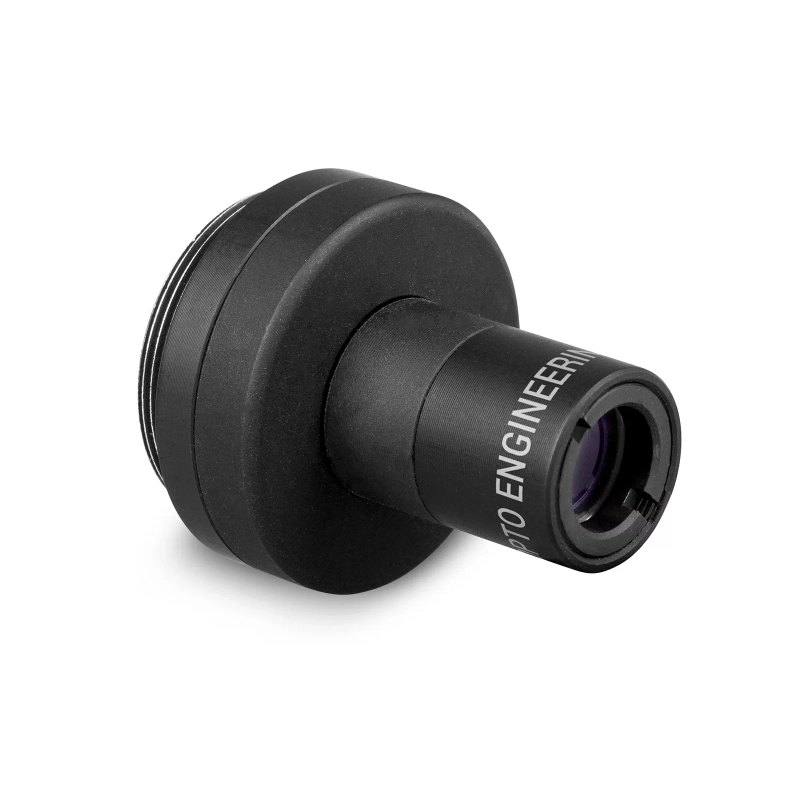
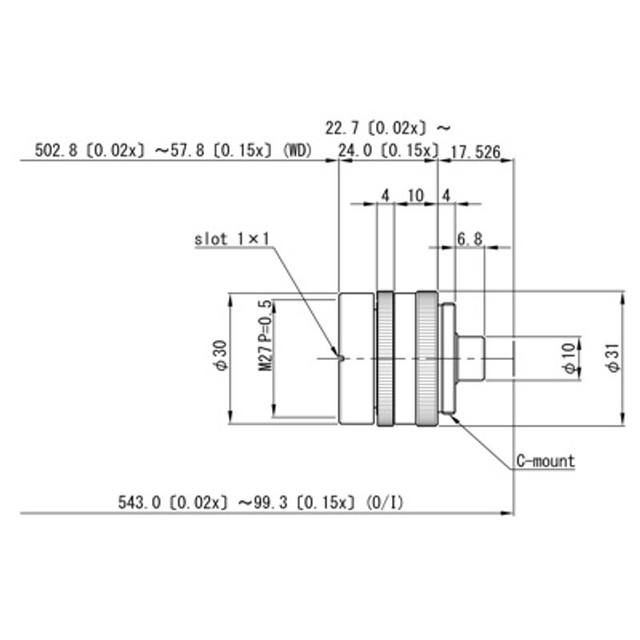
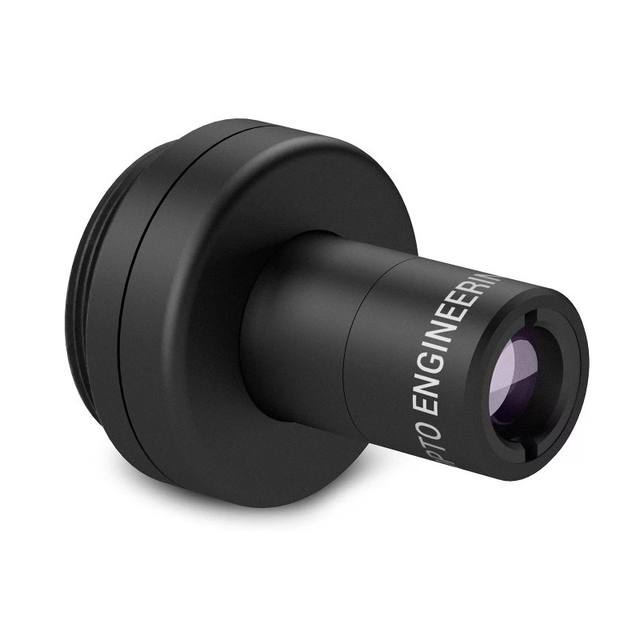
The Opto Engineering MC033X is a C-mount macro lens with a 28 mm focal length, a marked aperture of F5.3 and 0.333× magnification. Its Ø 11.0 mm image circle covers sensors up to 2/3″, and the manufacturer describes the MC series as nearly zero distortion macro lenses. At 0.333×, each sensor dimension corresponds to roughly three times that length on the object, a close-range magnification.
The 103.0 mm working distance is the main mechanical constraint. Fixtures, lighting and any enclosure window have to fit in the space between the lens and the target. The working f-number of 7 is higher than the marked F5.3, so the effective aperture is more closed at this distance and the depth of field is greater than the marked value suggests. That extra depth helps when parts sit at slightly different heights on the fixture.
Match the camera to the lens with a C-mount body whose sensor is up to 2/3″. Size the illumination for the working f-number of 7 and place it inside the 103.0 mm working distance. The nearly zero distortion description suits this model where image geometry must stay true to the part.
Best for
Close-range inspection at 0.333× magnification, where each sensor dimension corresponds to roughly three times that length on the part.
Dimensional checks where the nearly zero distortion description of the MC series matters.
Machines with 103.0 mm between the lens and the part.
Setups with C-mount cameras and sensors up to 2/3″.
Parts with slight height variation, where the working f-number of 7 adds depth of field.
Selection notes
Choose a sensor no larger than 2/3″; the Ø 11.0 mm image circle is the coverage limit.
Build the fixture and camera stand-off around 103.0 mm, and check that the lighting can be placed within that distance.
Estimate depth of field and exposure from the working f-number of 7 rather than the marked F5.3.
Consider a protective window if dust or splashes can reach the front element at this stand-off.
Specifications: General
Brand
Opto Engineering
Specifications: Optical
Focal length
28 mm
Aperture (f-number)
F5.3
Lens mount
C-mount
Image circle / max sensor
Ø 11.0 mm (max sensor 2/3″)
Magnification
0.333×
Working distance
103.0 mm
Applications this product is commonly selected for. Open one to see the full recommended hardware and approach.
Matched automatically by: camera mount fits the lens mount · camera sensor is covered by the lens image circle — this lens: C-mount · Ø 11.0 mm (max sensor 2/3″) image circle.