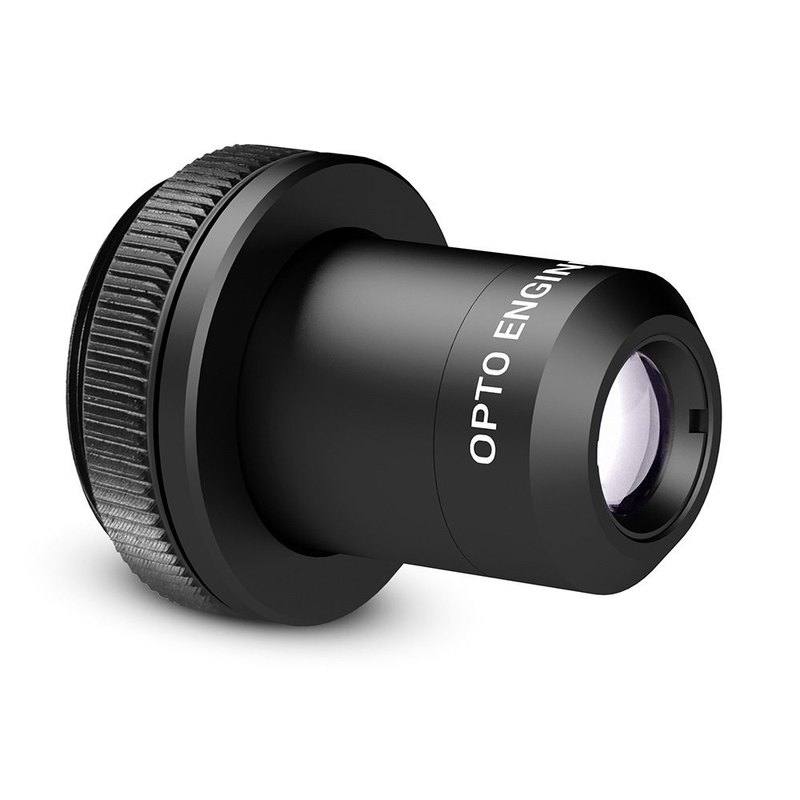
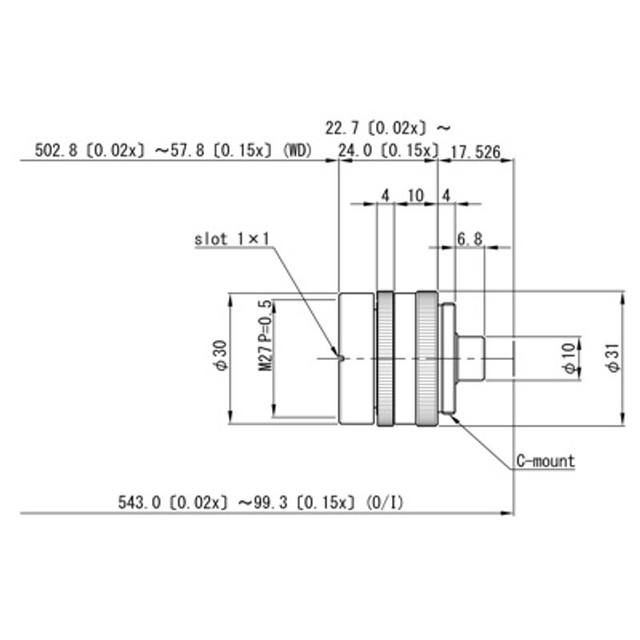
The Opto Engineering MC3M040X is a C-mount macro lens with a 32 mm focal length and an F5 aperture, rated at 0.400× magnification. Its Ø 17.6 mm image circle is listed for sensors up to 1.1″. At 0.400× the object is imaged at 0.400× of its actual size on the sensor, a scale that shows overall part geometry with moderate detail. The working distance of 106.6 mm sets the standoff between lens and part.
The working f-number of 7 is somewhat above the nominal F5, so the lens passes less light than its aperture alone suggests but gives more depth of field. A working f-number of 7 provides moderate depth of field, which tolerates some part height variation, while illumination must still cover the full field at the 106.6 mm standoff. Keep the mount rigid so each part is imaged at the same focus.
The lens is described as a nearly zero distortion macro lens, which supports dimensional accuracy within the 1.1″ image circle. For installation, verify the C-mount camera and sensor size, plan the 106.6 mm working distance into the fixture, and calibrate the scale before measurement. This setting suits inspections at 0.400× that need a 106.6 mm standoff to keep the camera clear of the part.
Best for
Inspection at 0.400× on sensors up to 1.1″
Dimensional checks with nearly zero distortion across a Ø 17.6 mm image circle
Fixtures with a 106.6 mm working distance that keep the camera clear of the part
Applications with some height variation, where a working f-number of 7 gives moderate depth of field
Selection notes
Verify the sensor fits inside the Ø 17.6 mm image circle, which covers sensors up to 1.1″.
Plan the 106.6 mm working distance into the mechanical design, since focus depends on it.
Size the illumination for a working f-number of 7 across the full field so exposure stays practical.
Use a C-mount camera body to match the lens mount.
Calibrate the scale at 0.400× with a reference target before relying on measurements.
Specifications: General
Brand
Opto Engineering
Specifications: Optical
Focal length
32 mm
Aperture (f-number)
F5
Lens mount
C-mount
Image circle / max sensor
Ø 17.6 mm (max sensor 1.1″)
Magnification
0.400×
Working distance
106.6 mm
Applications this product is commonly selected for. Open one to see the full recommended hardware and approach.
Matched automatically by: camera mount fits the lens mount · camera sensor is covered by the lens image circle — this lens: C-mount · Ø 17.6 mm (max sensor 1.1″) image circle.