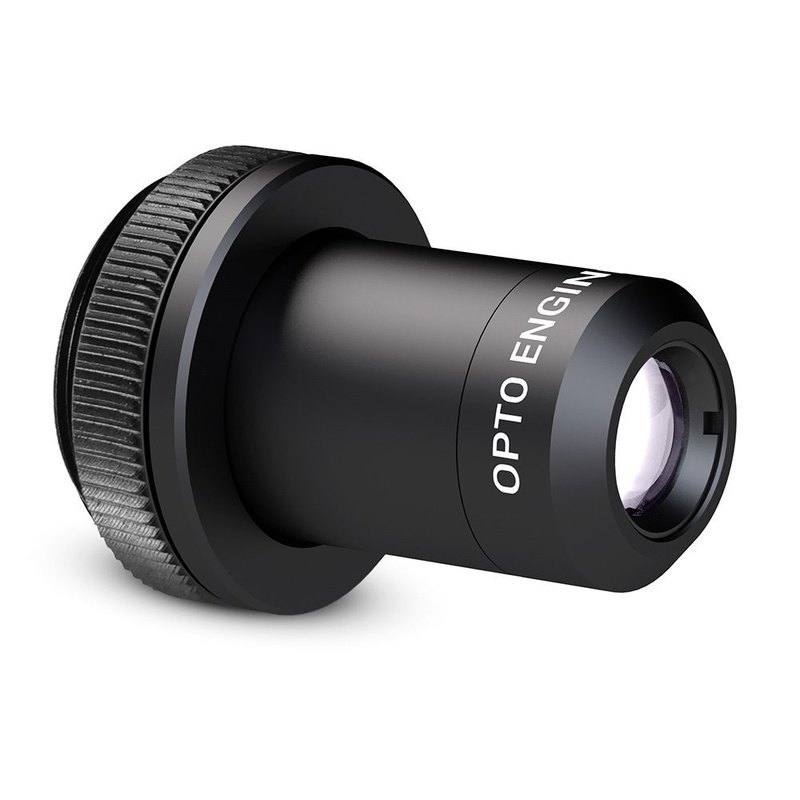
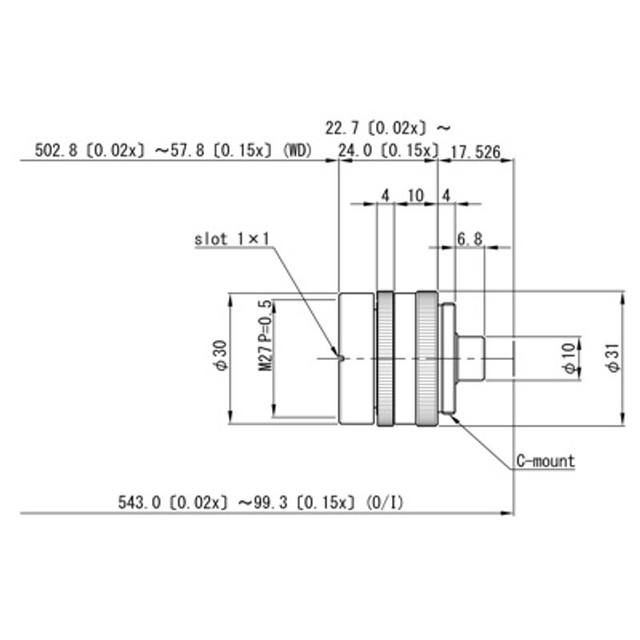
The Opto Engineering MC3M050X is a C-mount macro lens with a 32 mm focal length and an F5 aperture, rated at 0.500× magnification. Its Ø 17.6 mm image circle covers sensors up to 1.1″. At 0.500× the object is imaged at half its actual size on the sensor, a scale that keeps the overall geometry of a part while still showing useful detail. The working distance of 90.5 mm provides a moderate standoff for fixtures and lighting.
The working f-number of 7.5 is above the nominal F5, so the working aperture is effectively stopped down. The result is greater depth of field than the nominal aperture implies, and less light reaching the sensor. Plan the lighting for a 0.500× field at 90.5 mm with enough intensity to keep exposures short for moving parts, or allow longer exposure times for static inspection.
The lens is described as a nearly zero distortion macro lens, supporting measurement accuracy across the image circle. For installation, specify a C-mount camera with a sensor up to 1.1″, mount the lens rigidly at 90.5 mm so focus and scale stay consistent, and calibrate the scale at 0.500× before measurements begin.
Best for
Inspecting parts where overall geometry and small details both matter, at 0.500× on sensors up to 1.1″
Measurement with nearly zero distortion within a Ø 17.6 mm image circle
Setups with a 90.5 mm working distance for fixtures and lighting
Applications that need extra depth of field from a working f-number of 7.5
Selection notes
Confirm the sensor is no larger than 1.1″, since the image circle is Ø 17.6 mm.
Mount the lens rigidly at 90.5 mm, because focus and the calibrated scale depend on a stable distance.
Plan the lighting for a working f-number of 7.5: less light reaches the sensor than at the nominal F5, so provide enough intensity or allow longer exposure.
Use a C-mount camera body to match the lens mount.
Calibrate the image scale at 0.500× with a known reference before measurement.
Specifications: General
Brand
Opto Engineering
Specifications: Optical
Focal length
32 mm
Aperture (f-number)
F5
Lens mount
C-mount
Image circle / max sensor
Ø 17.6 mm (max sensor 1.1″)
Magnification
0.500×
Working distance
90.5 mm
Applications this product is commonly selected for. Open one to see the full recommended hardware and approach.
Matched automatically by: camera mount fits the lens mount · camera sensor is covered by the lens image circle — this lens: C-mount · Ø 17.6 mm (max sensor 1.1″) image circle.