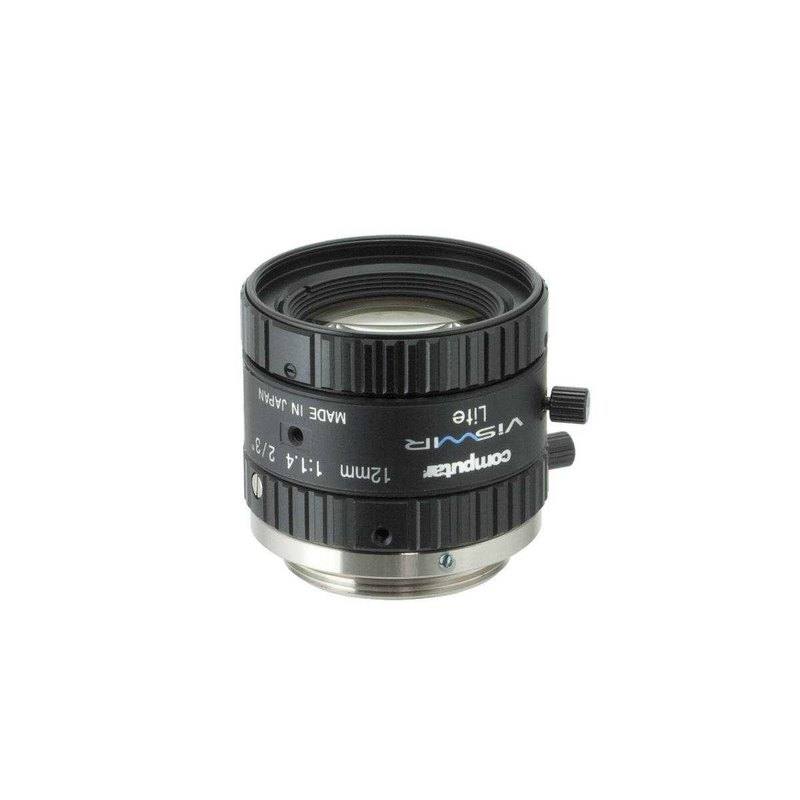
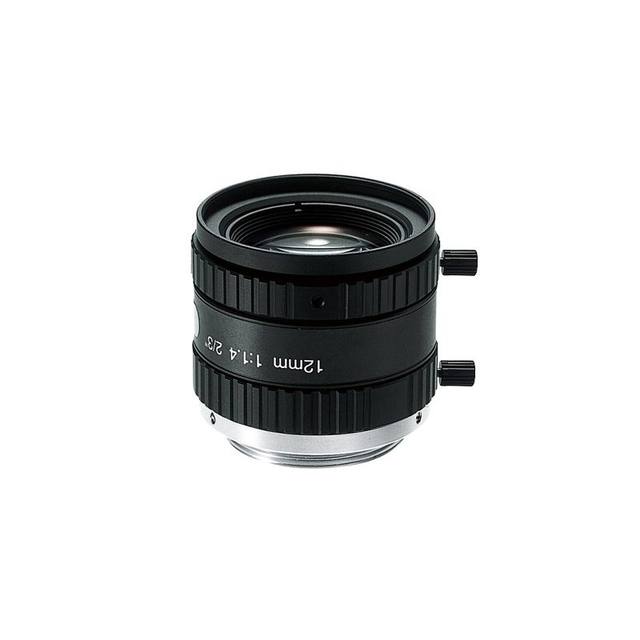
Opto Engineering RT-M1214-VSW — 12 mm focal length, F1.4–closed, Ø 11.0 mm (max sensor 2/3″) image circle, WD 150 mm min. (focus range 0.15 m – ∞), C-mount.
The RT-M1214-VSW is a 12 mm VIS-SWIR lens covering 400-1700 nm, part of the ENVIS-SWIRMP series and built for 2/3″ sensors with an Ø 11.0 mm image circle. The 12 mm focal length determines how much of the scene the sensor captures at the working distance. The aperture is listed as F1.4–closed, which gives a wide-open setting at F1.4 and a range that runs down to closed for controlling how much light reaches the sensor.
The minimum working distance is 150 mm, with a focus range of 0.15 m to infinity. The object should sit at 150 mm or more from the lens, and because focus extends to infinity, objects placed further back can also be imaged. The 400-1700 nm band means the lens is intended for visible and short-wave infrared imaging, and the choice of illumination determines which features show contrast.
The mount is C-mount with a thread size of M30.5 × 0.5. The 2/3″ image circle is the format limit. For SWIR imaging the camera sensor must respond in the same band, because the lens does not add wavelength response to a sensor that lacks it.
Best for
Visible and SWIR imaging across 400-1700 nm on 2/3″ sensors
Objects at 150 mm or more from the lens, with focus out to infinity
Projects that need one lens for both visible and short-wave infrared work
Inspections where feature contrast differs between visible and SWIR wavelengths
Selection notes
Confirm the camera sensor responds across 400-1700 nm before choosing this lens for SWIR work.
Keep the object at 150 mm or more from the lens.
Select illumination in the wavelength band that gives the contrast the application needs.
Use a sensor of 2/3″ or smaller to stay within the rated image circle.
Verify the M30.5 × 0.5 thread and C-mount flange against the camera and accessories.
Specifications: General
Brand
Opto Engineering
Specifications: Optical
Focal length
12 mm
Aperture (f-number)
F1.4–closed
Lens mount
C-mount
Image circle / max sensor
Ø 11.0 mm (max sensor 2/3″)
Working distance
150 mm min. (focus range 0.15 m – ∞)
Specifications: Mechanical
Thread / filter size
M30.5 × 0.5
Applications this product is commonly selected for. Open one to see the full recommended hardware and approach.
Matched automatically by: camera mount fits the lens mount · camera sensor is covered by the lens image circle — this lens: C-mount · Ø 11.0 mm (max sensor 2/3″) image circle.