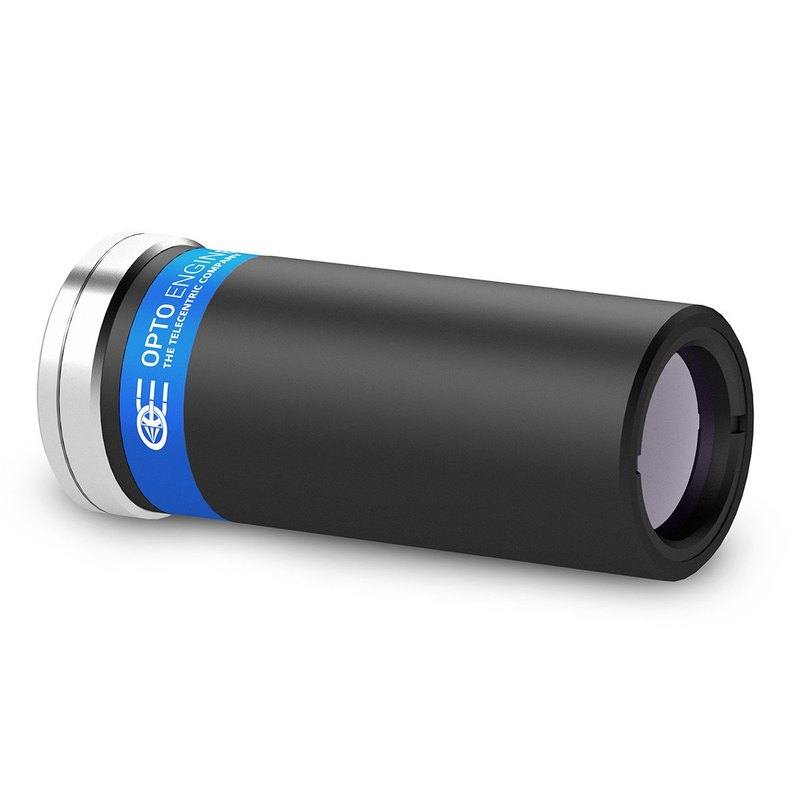
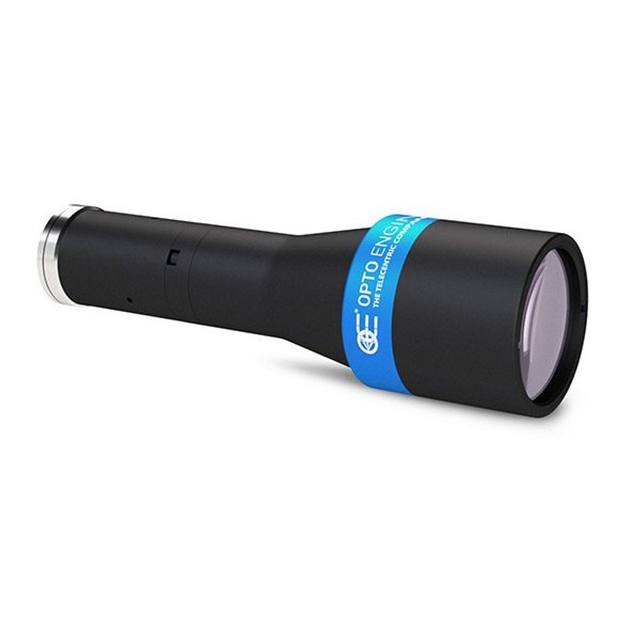
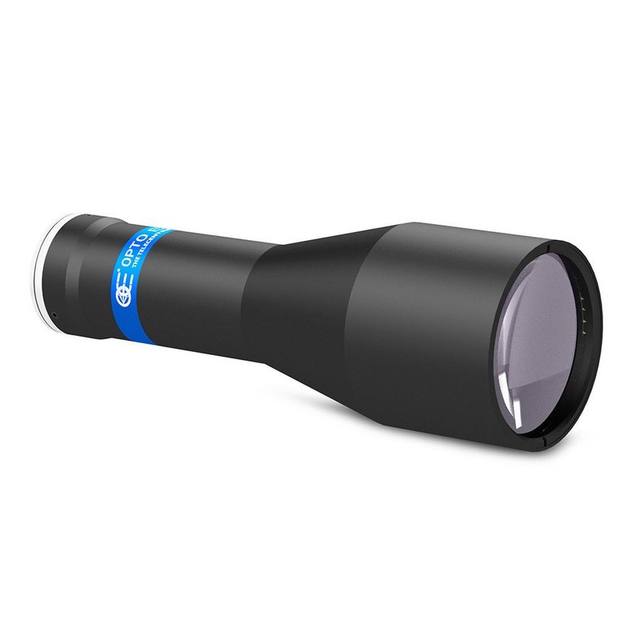
The Opto Engineering TC12016 is a bi-telecentric lens for 1/2″ sensors with a C-mount. Its 0.385× magnification and 43.1 mm working distance place the lens close to the object, which suits inspection layouts where the camera sits near the part. The image circle is Ø 8.0 mm (max sensor 1/2″), so the optics are matched to a 1/2″ format sensor.
The telecentric design is what makes this lens useful for gauging. Telecentricity is listed as <0.04 (0.10) deg typ. (max), meaning the chief rays are nearly parallel, so the image scale changes little as the object moves in depth. Distortion is listed as <0.04 (0.08) % typ. (max), a low typical figure that is relevant to edge and position measurement. The wF/# 8 working aperture gives depth of field but reduces the light reaching the sensor, so bright, well-controlled illumination is needed.
On the integration side, the C-mount and the Ø 8.0 mm image circle set the format, so use a camera with a 1/2″ sensor. The TC series is described for sensors up to 2/3″, but this model's image circle is Ø 8.0 mm for a maximum 1/2″ sensor, so size the camera to that figure. The 43.1 mm working distance means the lens sits close to the part, so lighting and mechanical clearance need planning from the start.
Best for
Close-range dimensional gauging where the 43.1 mm working distance keeps the lens near the part.
Edge and hole location on components imaged with a 1/2″ sensor camera at 0.385×.
Alignment and position checks in layouts where the lens must sit close to the part.
Telecentric measurement where small changes in part distance should have minimal effect on image scale.
Selection notes
Choose a camera with a 1/2″ sensor or smaller so the sensor stays within the Ø 8.0 mm image circle.
Confirm the C-mount on the camera side before ordering.
Plan clearance at the 43.1 mm working distance, since fixtures, lights and the part all sit close to the front of the lens.
Light for wF/# 8 with bright, controlled illumination.
For tolerance planning, use the maxima in parentheses, 0.10 deg telecentricity and 0.08 % distortion, as the bounds.
Specifications: General
Brand
Opto Engineering
Specifications: Optical
Lens mount
C-mount
Image circle / max sensor
Ø 8.0 mm (max sensor 1/2″)
Magnification
0.385×
Working distance
43.1 mm
Telecentric
Yes
Applications this product is commonly selected for. Open one to see the full recommended hardware and approach.
Matched automatically by: camera mount fits the lens mount · camera sensor is covered by the lens image circle — this lens: C-mount · Ø 8.0 mm (max sensor 1/2″) image circle.