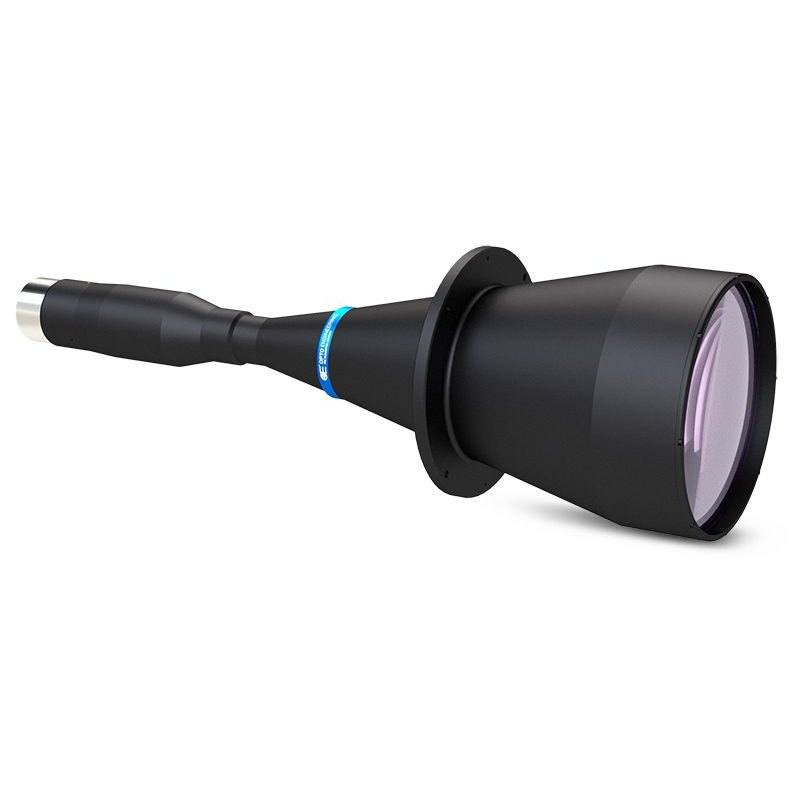
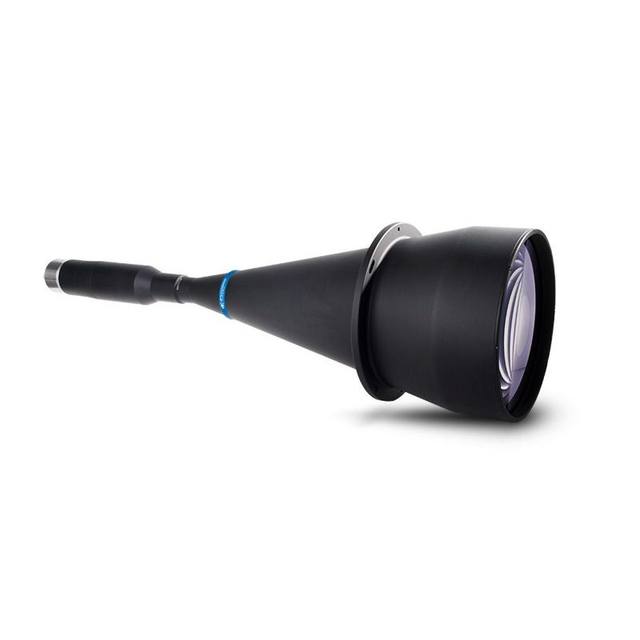
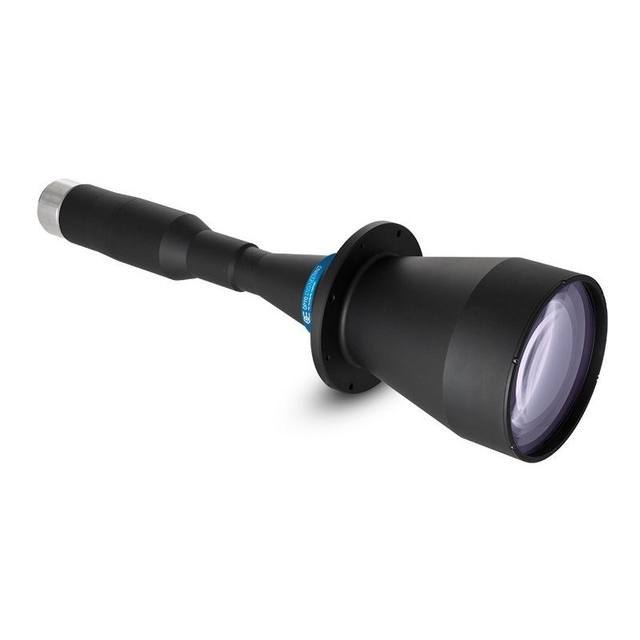
The Opto Engineering TC12K192 is a telecentric lens for 12k and 16k line scan cameras, with 0.320× magnification and a 265.5 mm working distance. It has an M72x0.75 FD 6.56 mount and a Ø 62.4 mm image circle (max sensor 12k/16k). At 0.320× the lens reduces the object strongly onto the sensor, so the sensor line covers a long section of the part, which suits wide scans.
Telecentricity is specified at less than 0.06 deg typical and 0.08 deg maximum, and distortion at less than 0.08 % typical with a 0.10 % maximum. Telecentric imaging keeps the scale constant across small changes in object distance, so a width or position measurement in a line scan image is less sensitive to a part that sits slightly closer or farther from the lens. The distortion figure keeps the geometry accurate over the scanned width.
Installation is about the mount, the clearance and the light. Match the M72x0.75 FD 6.56 mount on the camera. The 265.5 mm working distance gives clearance between the lens and the part for the conveyor, lighting and enclosure. The wF/# 16 aperture gives depth of field but lowers the light reaching the sensor, so the illumination must be sized for the scan speed and exposure.
Best for
Wide-web and continuous-material width measurement at 0.320× magnification.
Line scan inspection of long parts where the sensor line must cover a long section of the object.
Telecentric measurement of parts that drift in distance from the lens within a 265.5 mm working distance.
Applications that need a 265.5 mm standoff for lighting, conveyors or enclosures.
Inspection where distortion below 0.08 % typical must be held across the scanned width.
Selection notes
Confirm the M72x0.75 FD 6.56 mount on the camera before ordering.
Keep the sensor within Ø 62.4 mm, the maximum for 12k/16k sensors.
Compute the scanned length from the line length and the 0.320× magnification before setting the layout.
Size the line light for wF/# 16 and the scan speed.
Plan the fixture and conveyor around the 265.5 mm working distance.
Specifications: General
Brand
Opto Engineering
Specifications: Optical
Lens mount
M72x0.75 FD 6.56
Image circle / max sensor
Ø 62.4 mm (max sensor 12k/16k)
Magnification
0.320×
Working distance
265.5 mm
Telecentric
Yes
Applications this product is commonly selected for. Open one to see the full recommended hardware and approach.
Matched automatically by: camera mount fits the lens mount · camera sensor is covered by the lens image circle — this lens: M72x0.75 FD 6.56 · Ø 62.4 mm (max sensor 12k/16k) image circle.
By category
All 13High-resolution cameras 9Line scan cameras 4
By brand
All 13Hikrobot 4iRAYPLE 4Omron / Sentech 3Basler 2