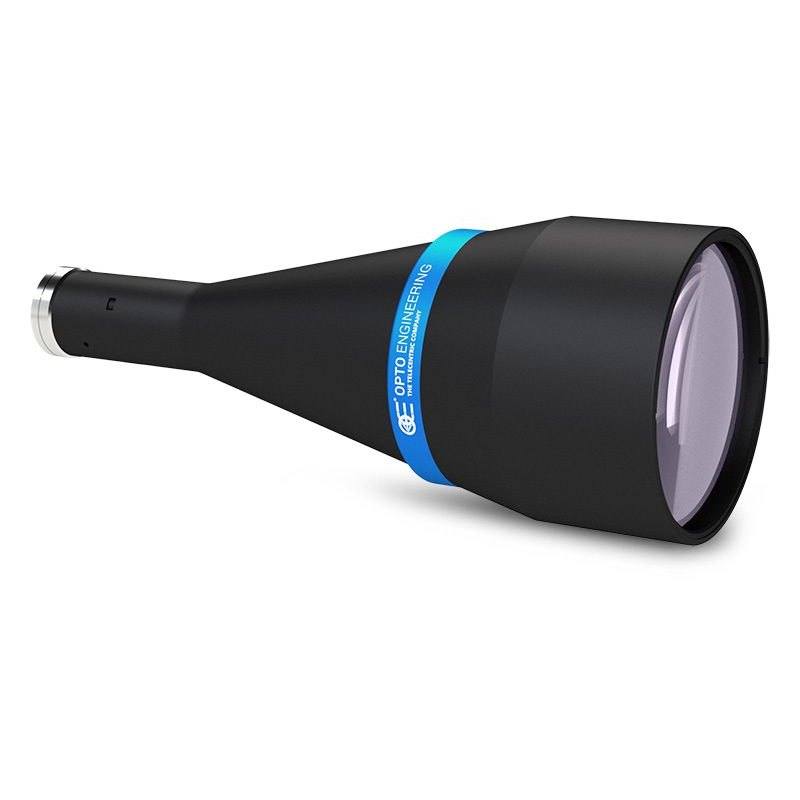
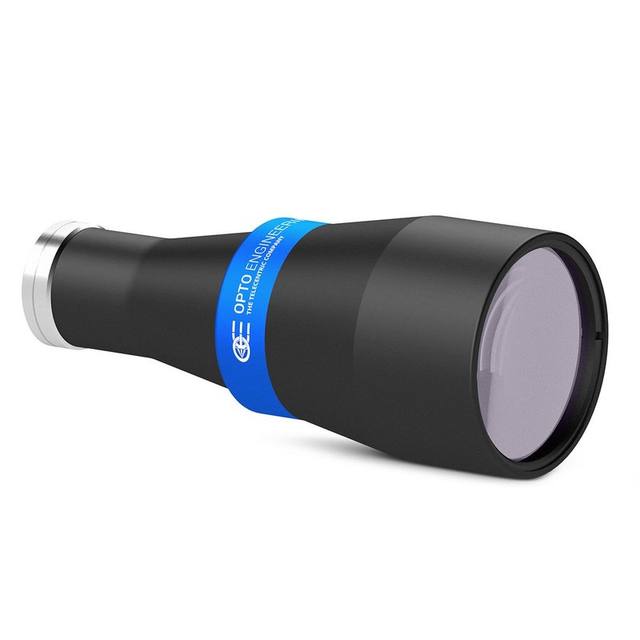
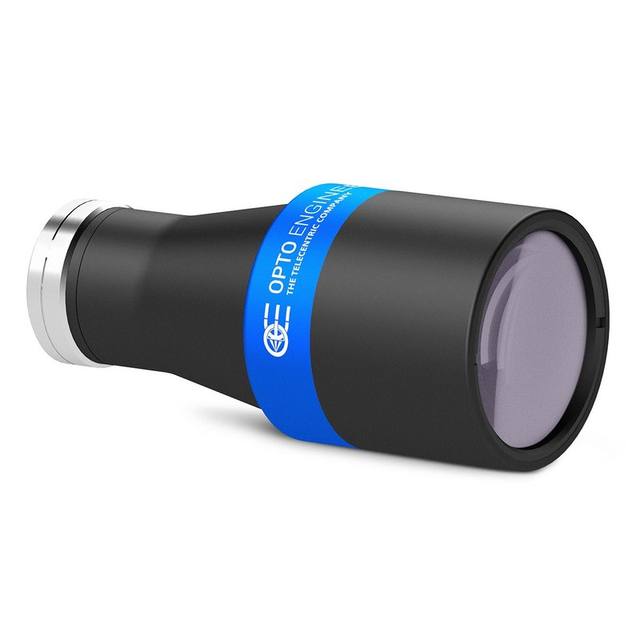
The Opto Engineering TC1MHR080-C is a high resolution telecentric lens with a C-mount and a magnification of 0.134×. The Ø 13.3 mm image circle is the manufacturer's stated maximum for a 1/1.2″ sensor, so the lens is built around that format. At 0.134× the sensor covers a field larger than itself, which makes the lens a practical choice for measuring sizeable features or whole assemblies within a single frame.
The working distance is 226.8 mm, which sets the object plane in front of the lens. The telecentric design keeps the chief rays nearly parallel to the optical axis, which limits how much a feature's apparent size changes when the object shifts toward or away from the lens. Telecentricity is listed below 0.08° typical and 0.10° maximum, and distortion below 0.08% typical and 0.10% maximum. These values set the optical contribution to measurement error and should be checked against the accuracy target before the setup is fixed.
With a working f-number of 8 the aperture is stopped down, which favours depth of field over light throughput, so the illumination should be sized to give the sensor enough signal at the chosen exposure. The 226.8 mm working distance also leaves space between the lens and the part for fixtures, guarding or a light source, provided the mechanical layout keeps the object at that distance.
Best for
Gauging of larger parts or assemblies at a 226.8 mm working distance
Edge and hole position checks where telecentric imaging limits size change with part height
Backlit silhouette inspection that needs a low-distortion image across the field
Installations with fixtures or guarding positioned between the lens and the part
Selection notes
Use a sensor no larger than 1/1.2″, since the Ø 13.3 mm image circle is the stated maximum.
Hold the part at 226.8 mm with a repeatable fixture so it stays on the designed object plane.
Plan illumination for a working f-number of 8, which trades light throughput for depth of field.
Build the uncertainty budget around telecentricity (below 0.08°, maximum 0.10°) and distortion (below 0.08%, maximum 0.10%).
Specifications: General
Brand
Opto Engineering
Specifications: Optical
Lens mount
C-mount
Image circle / max sensor
Ø 13.3 mm (max sensor 1/1.2″)
Magnification
0.134×
Working distance
226.8 mm
Telecentric
Yes
Applications this product is commonly selected for. Open one to see the full recommended hardware and approach.
Matched automatically by: camera mount fits the lens mount · camera sensor is covered by the lens image circle — this lens: C-mount · Ø 13.3 mm (max sensor 1/1.2″) image circle.