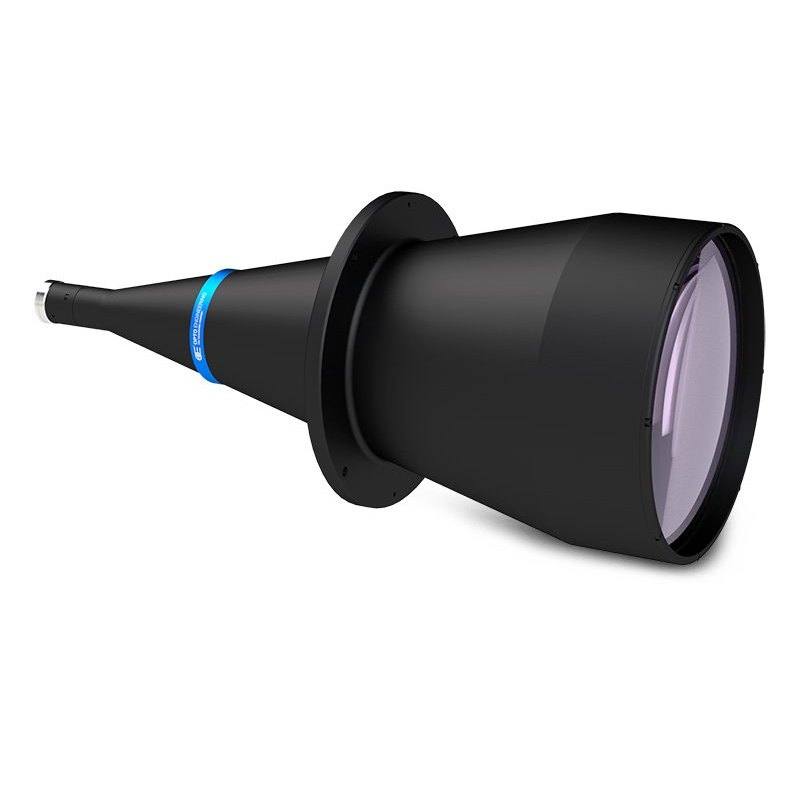
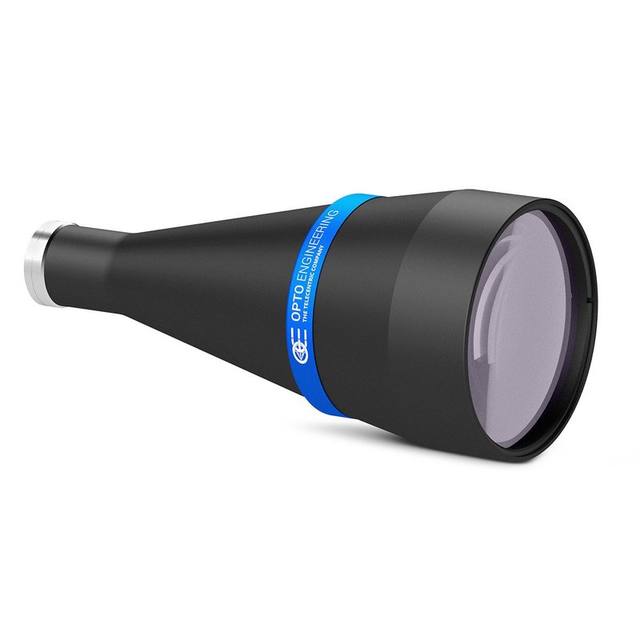
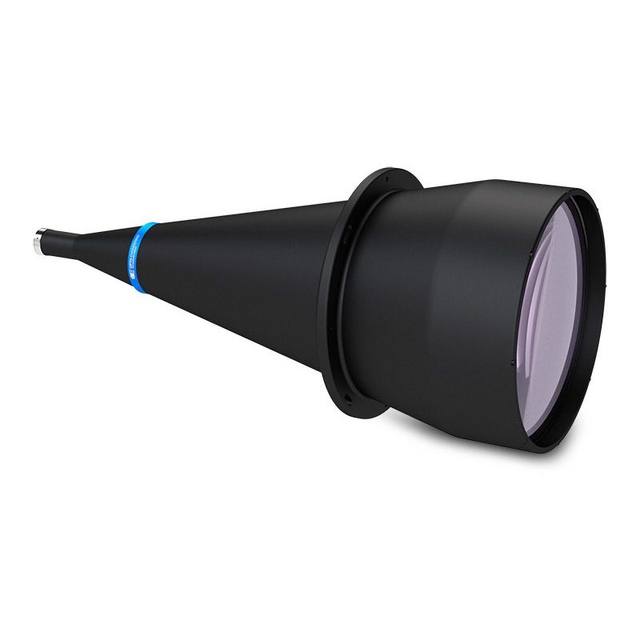
The Opto Engineering TC1MHR192-C is a high resolution telecentric lens with a C-mount and a magnification of 0.056×. Its Ø 13.3 mm image circle is listed as the maximum for a 1/1.2″ sensor, so that is the sensor format the lens is designed for. At 0.056× the lens gives a wide field of view on that sensor, which is the reason to choose it when the object area to be imaged is large.
The working distance of 527.6 mm places the object far from the front of the lens. Telecentric optics keep the chief rays nearly parallel to the optical axis, so the apparent size of a feature changes little when the object shifts within the depth of field. The manufacturer lists telecentricity below 0.08° typical and 0.10° maximum, and distortion below 0.08% typical and 0.10% maximum, which are the optical inputs to a gauging error budget.
The working f-number of 8 favours depth of field over light throughput, so the illumination must provide adequate light at the sensor for the chosen exposure time. At 527.6 mm the object sits well away from the lens, so the mechanical layout has to hold the part at that distance repeatably, and the lighting has to reach the object without intruding into the camera's view.
Best for
Wide-area measurement of large parts at a 527.6 mm working distance
Installations that need clearance between the lens and the object for fixtures, guarding or enclosures
Telecentric gauging where part height can vary within the depth of field
Imaging broad object areas on C-mount cameras with 1/1.2″ sensors
Selection notes
Choose a sensor of 1/1.2″ or smaller, as the Ø 13.3 mm image circle is the stated maximum.
Position the object at 527.6 mm and make the fixture repeatable, since the measurement depends on that object plane.
Plan illumination for a working f-number of 8, which adds depth of field but lowers the light reaching the sensor.
Include telecentricity (below 0.08°, maximum 0.10°) and distortion (below 0.08%, maximum 0.10%) in the uncertainty budget.
Specifications: General
Brand
Opto Engineering
Specifications: Optical
Lens mount
C-mount
Image circle / max sensor
Ø 13.3 mm (max sensor 1/1.2″)
Magnification
0.056×
Working distance
527.6 mm
Telecentric
Yes
Applications this product is commonly selected for. Open one to see the full recommended hardware and approach.
Matched automatically by: camera mount fits the lens mount · camera sensor is covered by the lens image circle — this lens: C-mount · Ø 13.3 mm (max sensor 1/1.2″) image circle.