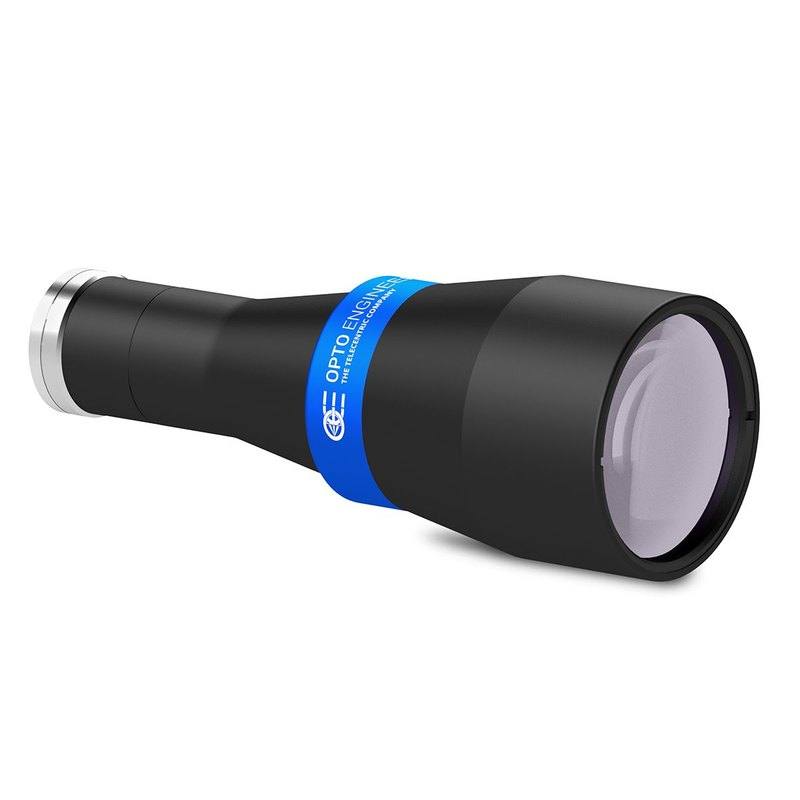
The Opto Engineering TC23048 is a bi-telecentric C-mount lens with 0.184× magnification and a 132.9 mm working distance. It is designed for 2/3″ sensors and specified with an image circle of Ø 11.0 mm (max sensor 2/3″). At 0.184× the sensor covers a wide area of the object, and the 132.9 mm working distance places the camera well back from the part, which suits applications where the camera has to stand off from the process.
The working f-number is 8. Because the sensor sees a large field, each pixel maps to a large patch of the object, and the camera's pixel count and pitch set the achievable measurement resolution. Illumination should be sized to light the full field evenly at the 132.9 mm working distance so the sensor receives consistent signal across the image.
Distortion is specified at below 0.05 % typical with a 0.10 % maximum, and telecentricity at below 0.08 deg typical with a 0.10 deg maximum. Telecentricity governs how much apparent feature size can change as the part shifts along the optical axis, and the typical figure indicates how much of that drift to expect. Together with distortion, these values set the accuracy to plan for in gauging across a wide field.
Best for
Wide-field dimensional inspection of larger parts captured in one image at 0.184×.
Installations where the camera must stand 132.9 mm from the part for mechanical or process clearance.
Presence and position verification across a broad field of view on a 2/3″ C-mount camera.
Gauging of parts with some height variation, using bi-telecentric imaging to limit apparent size drift.
Selection notes
Position the camera at the 132.9 mm working distance and hold it on a rigid mount so the working distance is repeatable.
At 0.184× each pixel covers a large object area. Confirm your camera's pixel pitch resolves the smallest feature you need to measure.
The working f-number of 8 governs depth of focus. Keep part height repeatable or include it in the tolerance budget.
Distortion is specified at below 0.05 % typical (0.10 % maximum) and telecentricity at below 0.08 deg typical (0.10 deg maximum). For tight gauging tolerances, verify both on your own setup.
Specifications: General
Brand
Opto Engineering
Specifications: Optical
Lens mount
C-mount
Image circle / max sensor
Ø 11.0 mm (max sensor 2/3″)
Magnification
0.184×
Working distance
132.9 mm
Telecentric
Yes
Applications this product is commonly selected for. Open one to see the full recommended hardware and approach.
Matched automatically by: camera mount fits the lens mount · camera sensor is covered by the lens image circle — this lens: C-mount · Ø 11.0 mm (max sensor 2/3″) image circle.