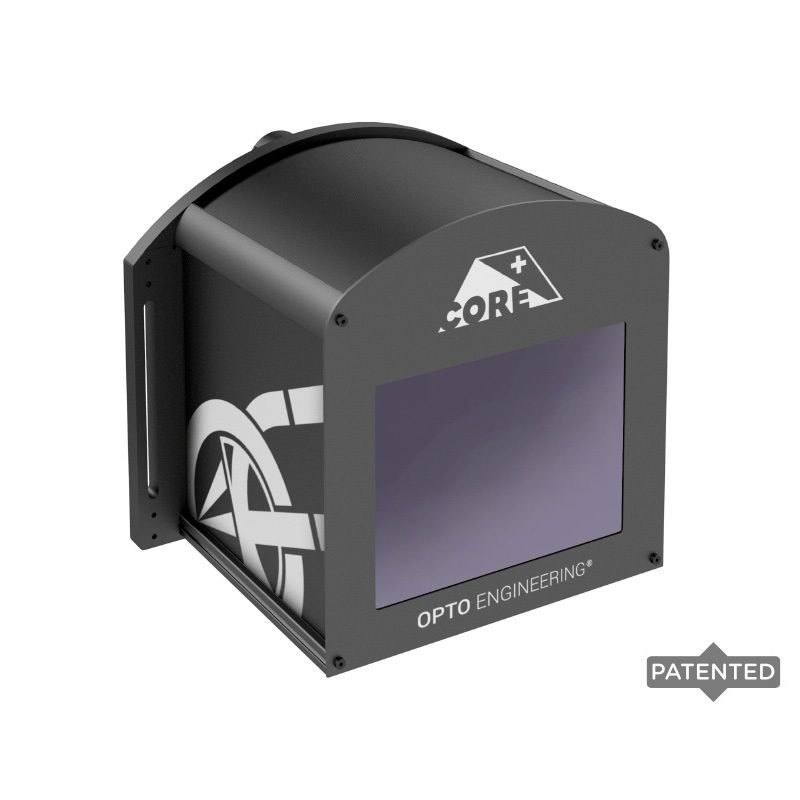
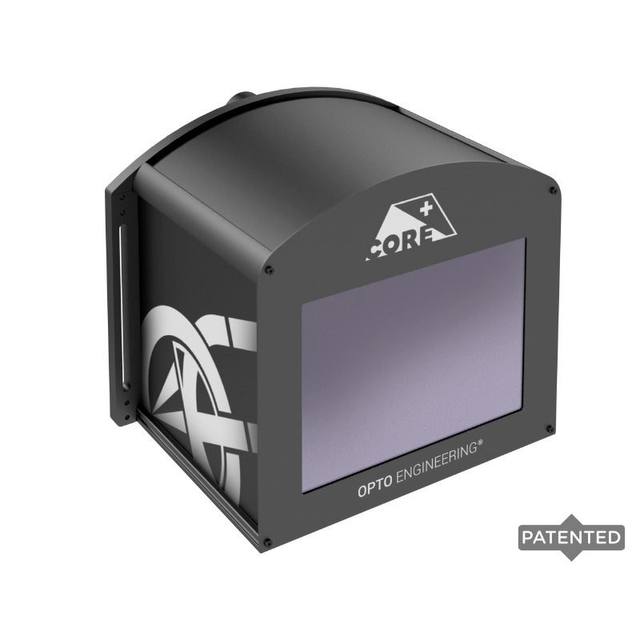
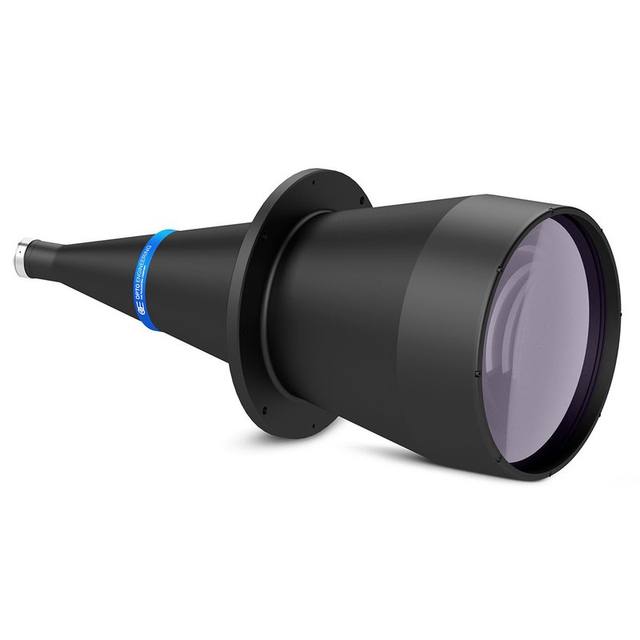
The TCCP12192 is an ultra compact bi-telecentric lens with a C-mount for matrix detectors up to 1/1.8″. At 0.033× magnification and a 328.0 mm working distance, it is set up to view a wide field from a fixed standoff, with a working f-number of wF/# 8. The TC CORE PLUS series it belongs to is described as compact, large field-of-view bi-telecentric lenses, and the 328.0 mm working distance leaves clearance around the object.
Telecentricity is listed as < 0.12 (0.18) deg typ. (max) and distortion as < 0.8 % typ. (max). The telecentricity figure matters most when parts can sit at slightly different heights: a typical value of 0.12° and a maximum of 0.18° mean the apparent size can shift slightly with object distance, so tolerances should be set against the maximum. The distortion figure is a systematic geometric error to include in the measurement budget and to correct through calibration when converting pixels to millimeters.
The lens is designed for sensors up to 1/1.8″, so a C-mount camera of that format or smaller fits the image circle. The 328.0 mm working distance gives room for fixtures, guards or handling equipment between the lens and the part. At 0.033× a large object area is spread over the sensor, so the illumination must cover the wide field evenly, and the lighting should be planned for the wF/# 8 aperture and the 328.0 mm standoff.
Best for
Wide field-of-view presence and position checks at 0.033× magnification.
Inspection from a 328.0 mm standoff where fixtures or guards need clearance.
Feature location across large areas with a camera of up to 1/1.8″.
Dimensional screening where the 0.18° maximum telecentricity is included in the tolerance budget.
Compact C-mount systems that need an ultra compact bi-telecentric lens.
Selection notes
Use a C-mount camera with a sensor up to 1/1.8″ to stay within the lens coverage.
Keep the object at 328.0 mm so the lens works at the standoff it is specified for.
Budget telecentricity at 0.12° typical and 0.18° maximum, and distortion at < 0.8 % typ. (max).
Calculate the object-side pixel size from the sensor pixel pitch and 0.033×.
Plan lighting for the wF/# 8 aperture across the wide illuminated field.
Specifications: General
Brand
Opto Engineering
Specifications: Optical
Lens mount
C-mount
Image circle / max sensor
1/1.8″ max sensor
Magnification
0.033×
Working distance
328.0 mm
Telecentric
Yes
Applications this product is commonly selected for. Open one to see the full recommended hardware and approach.
Matched automatically by: camera mount fits the lens mount · camera sensor is covered by the lens image circle — this lens: C-mount · 1/1.8″ max sensor image circle.