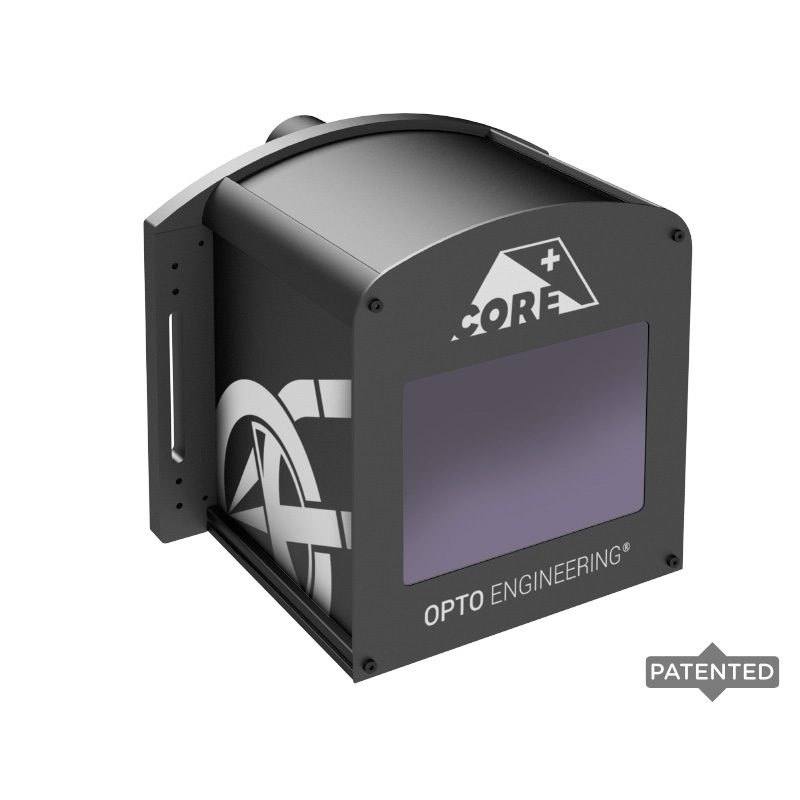
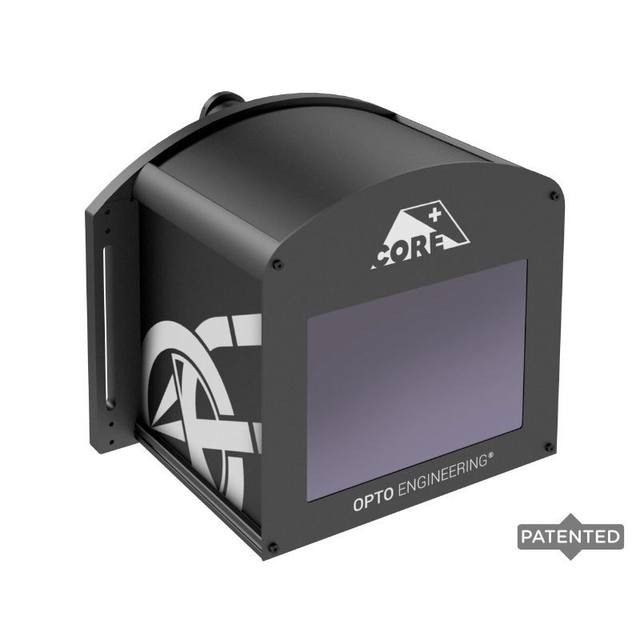
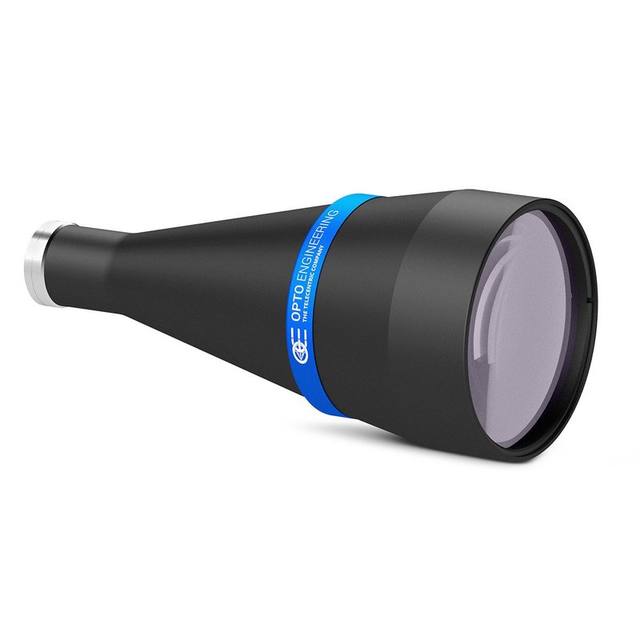
The TCCP23144 is an ultra compact bi-telecentric lens with a C-mount, designed for matrix detectors up to 2/3″. At 0.059× magnification with a 217.4 mm working distance and a wF/# 8 working aperture, it covers a 2/3″ sensor format. The TC CORE PLUS series is described as compact, large field-of-view bi-telecentric lenses for sensors up to 2/3″, and this model falls within that description.
Telecentricity is listed as < 0.06 (0.1) deg typ. (max) and distortion as < 0.8 % typ. (max). Telecentricity keeps the apparent size of a feature close to constant as the object moves toward or away from the lens, which is important for consistent measurement across a 2/3″ field. The typical telecentricity is 0.06° and the maximum is 0.1°, so the 0.1° figure is the one to use in tolerance planning. The distortion value is a systematic geometric error that calibration can correct when converting pixels to millimeters.
Pairing the lens with a C-mount camera whose sensor is up to 2/3″ matches the image circle the lens is specified for. The 217.4 mm working distance leaves room for fixtures and handling around the part. The object-side field follows from the sensor's active area and the 0.059× magnification, so the stability of the fixture at the working distance matters for repeatability.
Best for
Dimensional gauging of parts on a 2/3″ sensor at 0.059× magnification and a 217.4 mm standoff.
Inline measurement where telecentric geometry limits the effect of small part-height variations.
Presence and position checks of parts across the 2/3″ field.
Edge and feature location where distortion of < 0.8 % typ. (max) fits within the tolerance budget.
Machine-integrated inspection using a C-mount camera at a 217.4 mm working distance.
Selection notes
Use a C-mount camera with a sensor up to 2/3″ to match the lens coverage.
Hold the object at the 217.4 mm working distance.
Budget telecentricity against the 0.1° maximum and distortion against the < 0.8 % figure.
Calculate the object-side pixel size as the sensor pixel pitch divided by 0.059×.
Plan lighting for the wF/# 8 working aperture.
Specifications: General
Brand
Opto Engineering
Specifications: Optical
Lens mount
C-mount
Image circle / max sensor
2/3″ max sensor
Magnification
0.059×
Working distance
217.4 mm
Telecentric
Yes
Applications this product is commonly selected for. Open one to see the full recommended hardware and approach.
Matched automatically by: camera mount fits the lens mount · camera sensor is covered by the lens image circle — this lens: C-mount · 2/3″ max sensor image circle.