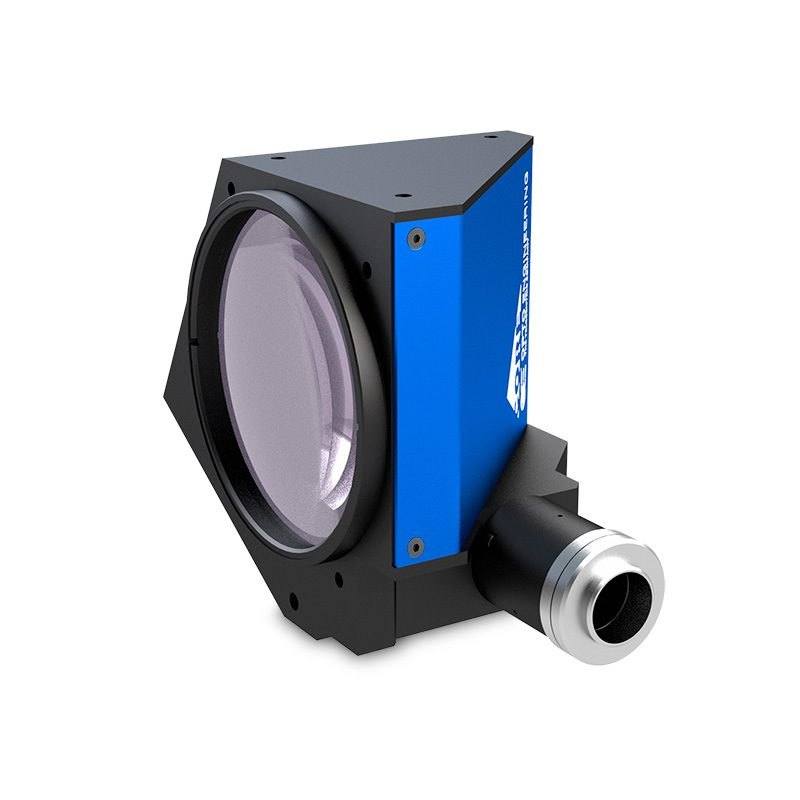
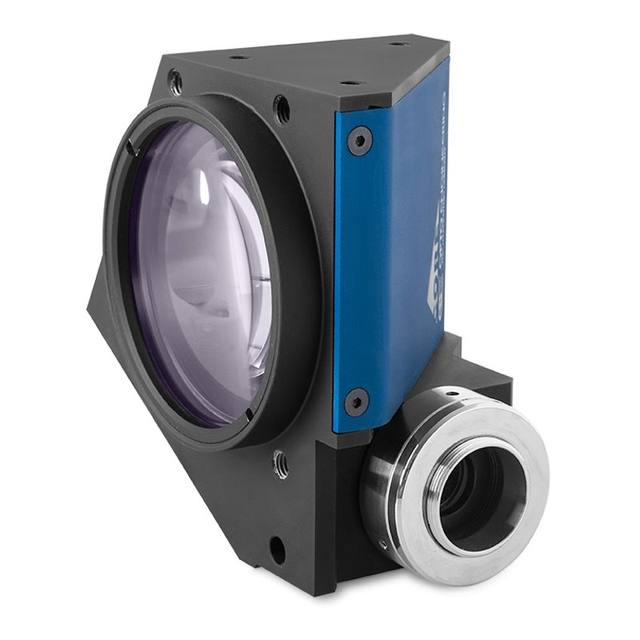
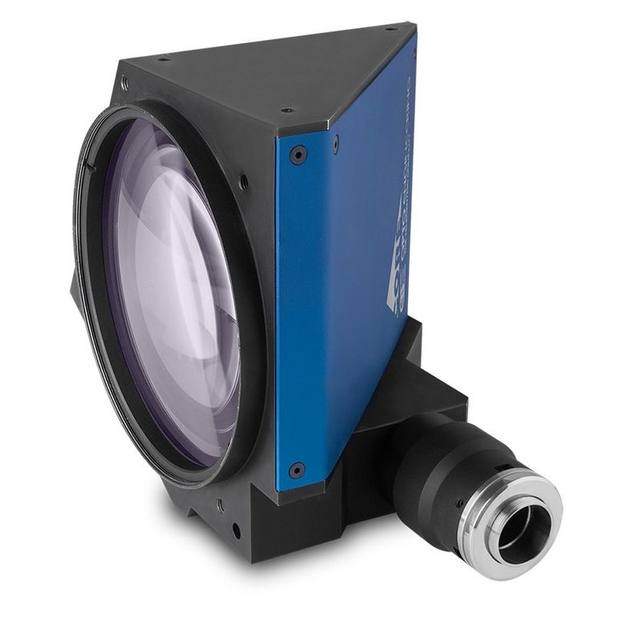
The Opto Engineering TCCR1M080-C is a C-mount telecentric CORE lens from the TC1MHR CORE series for sensors up to 1/1.2″ (listed as “1/1.2″ max sensor”). It works at 0.134× magnification with a working distance of 226.8 mm. At 0.134× the sensor records 0.134 mm for every millimetre of the object, so a large section of the part fits in one frame, and each pixel covers a larger distance on the part. The 226.8 mm working distance places the object well away from the front of the lens, which is practical when enclosures, light arrays or fixtures need to surround the measurement point.
Telecentric optics keep the chief rays close to parallel to the optical axis. The published figures are distortion typically below 0.08% with a maximum of 0.10% and telecentricity typically below 0.08° with a maximum of 0.10°, which keeps geometric error low for gauging. The working f-number is 8 (wF/# 8), so the illumination and exposure have to be designed around that value. The C-mount interface and the 1/1.2″ sensor rating define the camera pairing.
This configuration suits fixtured assemblies where the object plane must stay clear of the optics. Typical uses include dimensional checks, feature presence and edge location on parts that sit on a fixture or conveyor at 226.8 mm.
Best for
Dimensional checks on parts imaged at 226.8 mm
Fixtured measurement where enclosures, lights or grippers sit in front of the lens
Feature presence and edge location at a 0.134× image scale
Telecentric gauging with a C-mount camera with a sensor up to 1/1.2″
Inspection cells where the object plane must stay well clear of the optics
Selection notes
Confirm the camera sensor is within the 1/1.2″ rating and that the camera has a C-mount.
Mount the part at 226.8 mm; the fixture or enclosure must hold the object plane at this distance and limit vibration that would blur the image.
Because the working f-number is 8, plan light intensity and exposure time together.
Include the 0.10% distortion and 0.10° telecentricity maxima in the measurement uncertainty analysis.
Specifications: General
Brand
Opto Engineering
Specifications: Optical
Lens mount
C-mount
Image circle / max sensor
1/1.2″ max sensor
Magnification
0.134×
Working distance
226.8 mm
Telecentric
Yes
Applications this product is commonly selected for. Open one to see the full recommended hardware and approach.
Matched automatically by: camera mount fits the lens mount · camera sensor is covered by the lens image circle — this lens: C-mount · 1/1.2″ max sensor image circle.