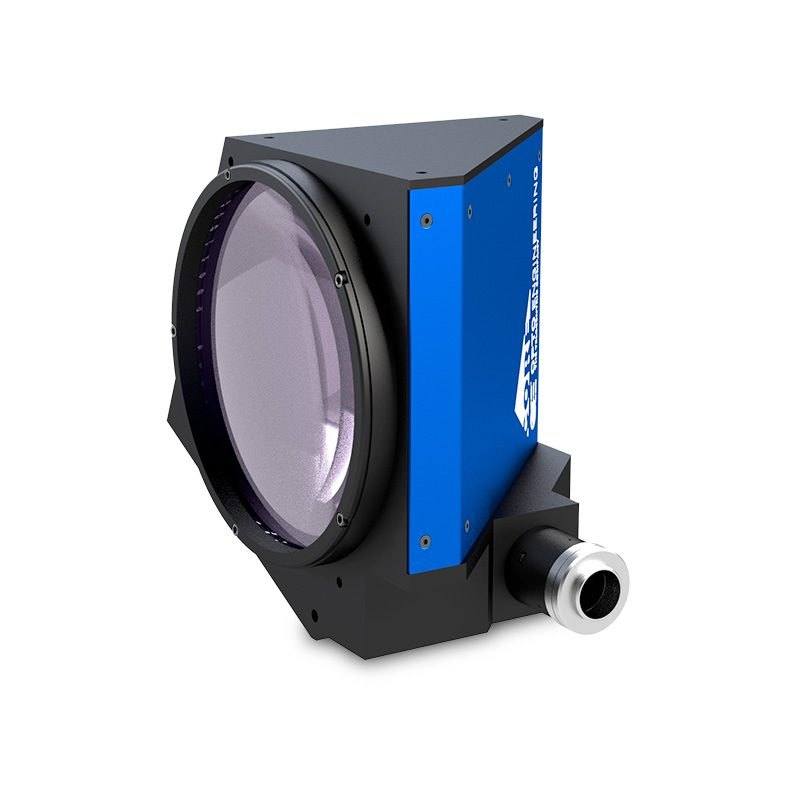
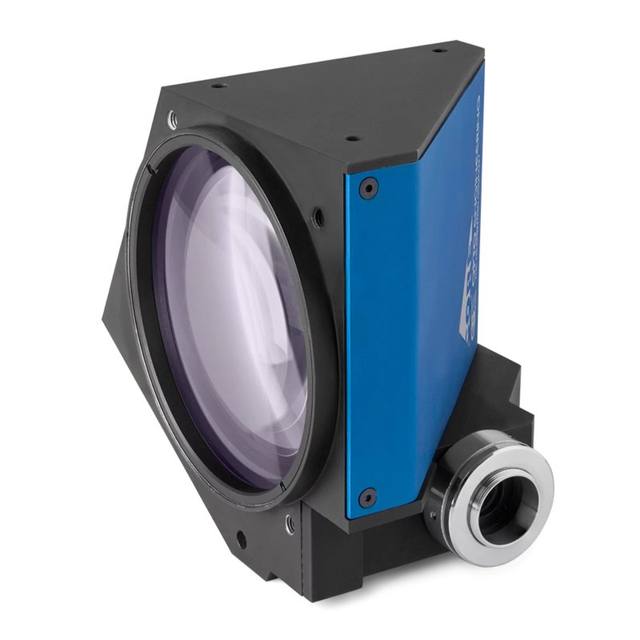
The Opto Engineering TCCR1M120-C is a telecentric CORE lens from the TC1MHR CORE series for sensors up to 1/1.2″ (listed as “1/1.2″ max sensor”), with a C-mount. It operates at 0.087× magnification with a working distance of 334.6 mm. At 0.087× the sensor records 0.087 mm for every millimetre of the object, so a wide section of the part can be captured in one image, with each pixel covering a larger distance on the part. The 334.6 mm working distance leaves a large open space between the front of the lens and the object, which accommodates enclosures, fixtures and lighting around the measurement point.
The optical figures are distortion typically below 0.08% with a maximum of 0.10% and telecentricity typically below 0.08° with a maximum of 0.10°. These describe geometric error that stays low across the image and a near-parallel chief ray, both important for measurement accuracy. The working f-number is 8 (wF/# 8), so brightness control rests with the light source and exposure time. Pair the lens with a camera that has a C-mount and a sensor within the 1/1.2″ rating.
This lens suits gauging and inspection cells where the part and its fixture sit well back from the optics. Typical jobs include measuring the overall outline or hole pattern of a part, checking presence across the image and backlit silhouette work.
Best for
Gauging of parts at a 334.6 mm working distance
Outline and hole-pattern measurement on parts
Inspection cells with room for lights, fixtures and enclosures around the object
Presence checks at a 0.087× image scale
Telecentric measurement on a C-mount camera platform with a sensor up to 1/1.2″
Selection notes
Verify the sensor fits the 1/1.2″ rating and that the camera has a C-mount.
Locate the part precisely at 334.6 mm so that focus and scale calibration stay consistent from part to part.
Plan the lighting for wF/# 8, the working f-number of this lens.
Use the maximum distortion (0.10%) and telecentricity (0.10°) in worst-case error estimates.
Specifications: General
Brand
Opto Engineering
Specifications: Optical
Lens mount
C-mount
Image circle / max sensor
1/1.2″ max sensor
Magnification
0.087×
Working distance
334.6 mm
Telecentric
Yes
Applications this product is commonly selected for. Open one to see the full recommended hardware and approach.
Matched automatically by: camera mount fits the lens mount · camera sensor is covered by the lens image circle — this lens: C-mount · 1/1.2″ max sensor image circle.