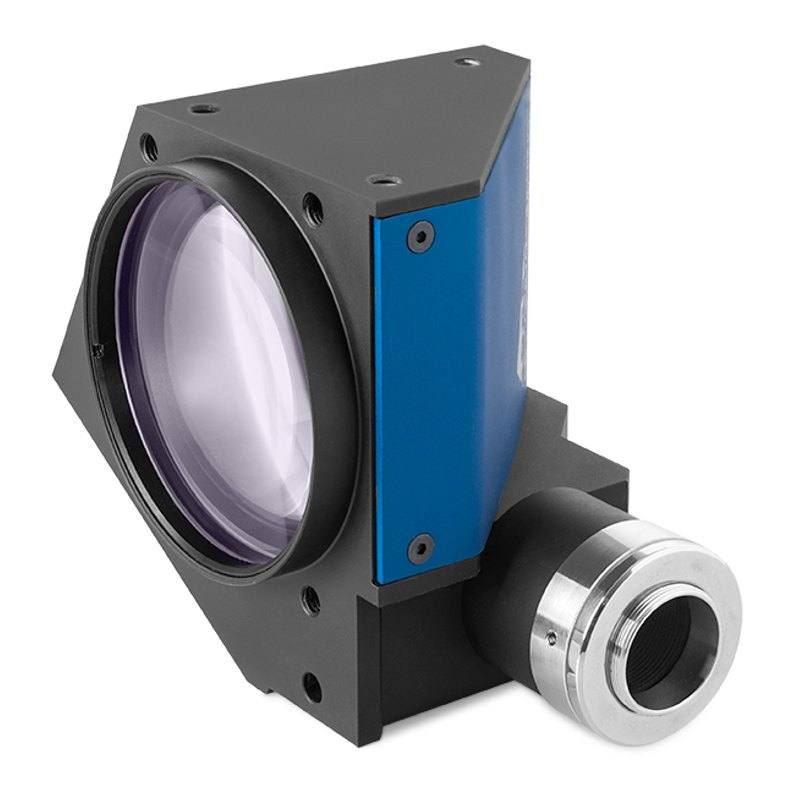
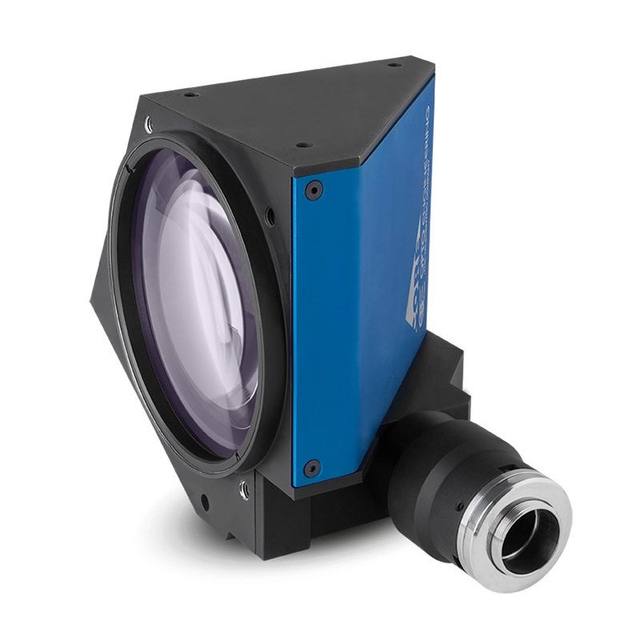
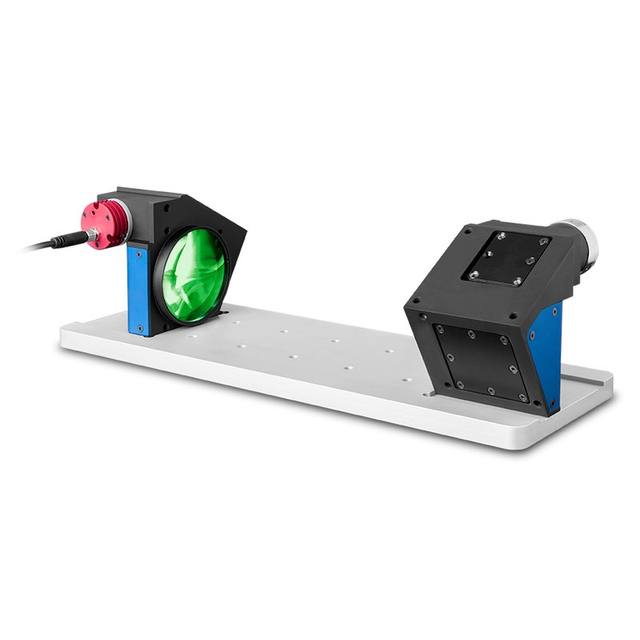
The Opto Engineering TCCR23056 is a bi-telecentric CORE lens for 2/3″ detectors, from the TC CORE series of compact bi-telecentric lenses for sensors up to 2/3″. It uses a C-mount, is listed for a maximum sensor of 2/3″ (shown as “2/3″ max sensor”), and operates at 0.157× magnification with a working distance of 157.8 mm. At 0.157× the sensor records 0.157 mm for every millimetre of the object, so each pixel of the camera covers a defined distance on the part. Telecentric imaging on both the object and image sides keeps the scale stable as the part moves in distance and reduces sensitivity to small changes in the lens-to-sensor spacing.
This lens lists distortion typically below 0.03% with a maximum of 0.10%, and telecentricity typically below 0.05° with a maximum of 0.08°. Those figures describe small geometric error and a near-parallel chief ray, which suit accurate gauging. The working f-number is 8 (wF/# 8), so the illumination and exposure must supply the brightness. Use a camera with a C-mount and a sensor within the 2/3″ rating.
Typical applications include dimensional gauging, edge measurement and feature location on parts. Mount the part at 157.8 mm with a fixture and use the working distance as the reference for focus and calibration, with backlight or front light selected for the working f-number of 8.
Best for
Dimensional gauging of parts at 157.8 mm
Edge and feature location where the image scale must stay consistent
Measurement setups where camera spacing may vary slightly
Telecentric inspection on a C-mount camera with a sensor up to 2/3″
Backlit silhouette measurement at a 0.157× image scale
Selection notes
Confirm the camera sensor is within the 2/3″ rating and that the camera has a C-mount.
Fix the part at 157.8 mm; the working distance is the reference for focus and calibration.
Design the illumination for wF/# 8, the working f-number of this lens.
Carry the maximum values (distortion 0.10%, telecentricity 0.08°) into the uncertainty budget and use the typical values for expected performance.
Specifications: General
Brand
Opto Engineering
Specifications: Optical
Lens mount
C-mount
Image circle / max sensor
2/3″ max sensor
Magnification
0.157×
Working distance
157.8 mm
Telecentric
Yes
Applications this product is commonly selected for. Open one to see the full recommended hardware and approach.
Matched automatically by: camera mount fits the lens mount · camera sensor is covered by the lens image circle — this lens: C-mount · 2/3″ max sensor image circle.