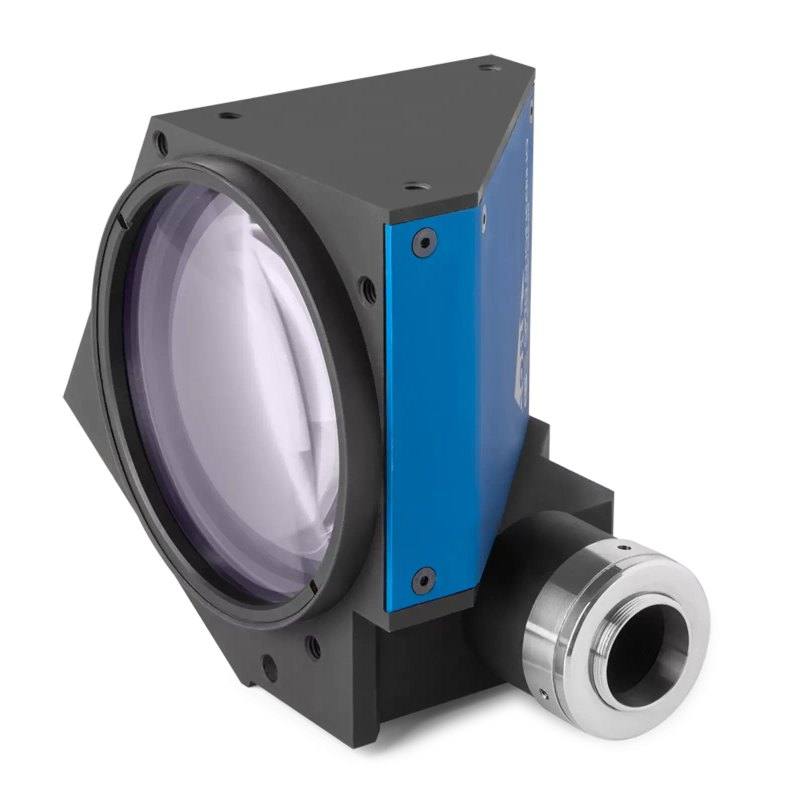
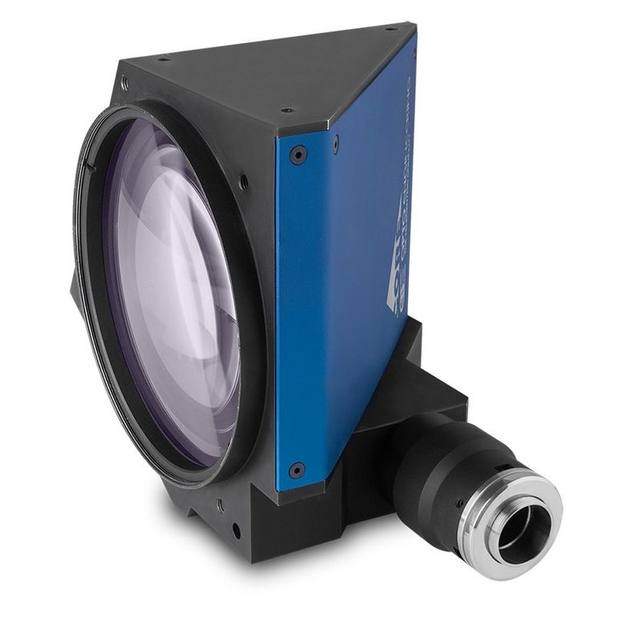
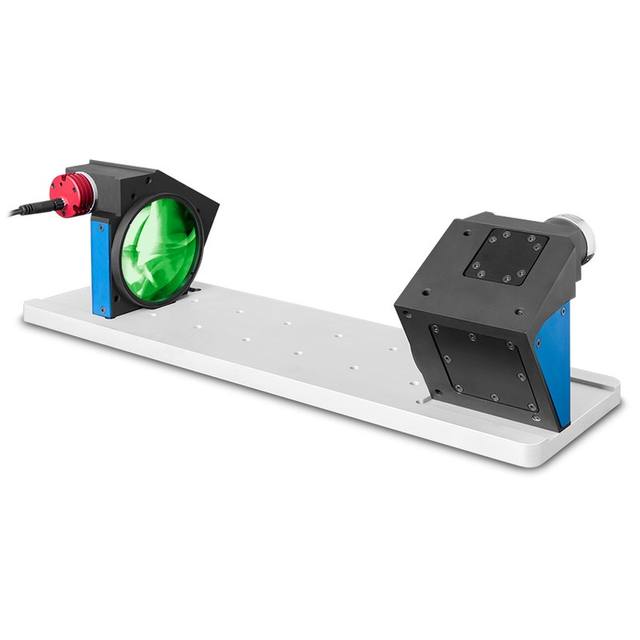
The Opto Engineering TCCR23064 is a bi-telecentric CORE lens for 2/3″ detectors, part of the TC CORE series of compact bi-telecentric lenses for sensors up to 2/3″. It has a C-mount, a listed maximum sensor of 2/3″, and operates at 0.138× magnification with a working distance of 181.9 mm. At 0.138× the sensor records 0.138 mm for every millimetre of the object, so a broad section of the part fits in one frame, while each pixel covers a larger distance on the part. The bi-telecentric design applies telecentric imaging on the object side and the image side, which keeps the scale stable as the part moves in distance and reduces sensitivity to small changes in the lens-to-sensor spacing.
The figures show distortion typically below 0.03% with a maximum of 0.10%, and telecentricity typically below 0.05° with a maximum of 0.08°. Small geometric error and a near-parallel chief ray make the lens suitable for measurement where edge positions are converted to millimetres. The working f-number is 8 (wF/# 8), so the illumination and exposure time must provide the brightness. The camera should have a C-mount and a sensor within the 2/3″ rating.
Applications include dimensional gauging and feature location on parts, with the part held at 181.9 mm on a fixture. Backlit silhouette work fits this lens well, and the working distance leaves room for lighting and handling around the part.
Best for
Dimensional gauging of parts at 181.9 mm
Backlit edge and feature location with a stable image scale
Setups where small changes in lens-to-sensor spacing should not change the scale
Telecentric inspection on a C-mount camera with a sensor up to 2/3″
Fixtured stations with room for lights and handling around the part
Selection notes
Verify the camera sensor is within the 2/3″ rating and that the camera has a C-mount.
Position the part at 181.9 mm with a repeatable fixture; the working distance is the reference for focus and calibration.
Design the illumination for wF/# 8, the working f-number of this lens.
Carry the maximum values (0.10% distortion and 0.08° telecentricity) into the uncertainty budget, and use the typical values for expected performance.
Specifications: General
Brand
Opto Engineering
Specifications: Optical
Lens mount
C-mount
Image circle / max sensor
2/3″ max sensor
Magnification
0.138×
Working distance
181.9 mm
Telecentric
Yes
Applications this product is commonly selected for. Open one to see the full recommended hardware and approach.
Matched automatically by: camera mount fits the lens mount · camera sensor is covered by the lens image circle — this lens: C-mount · 2/3″ max sensor image circle.