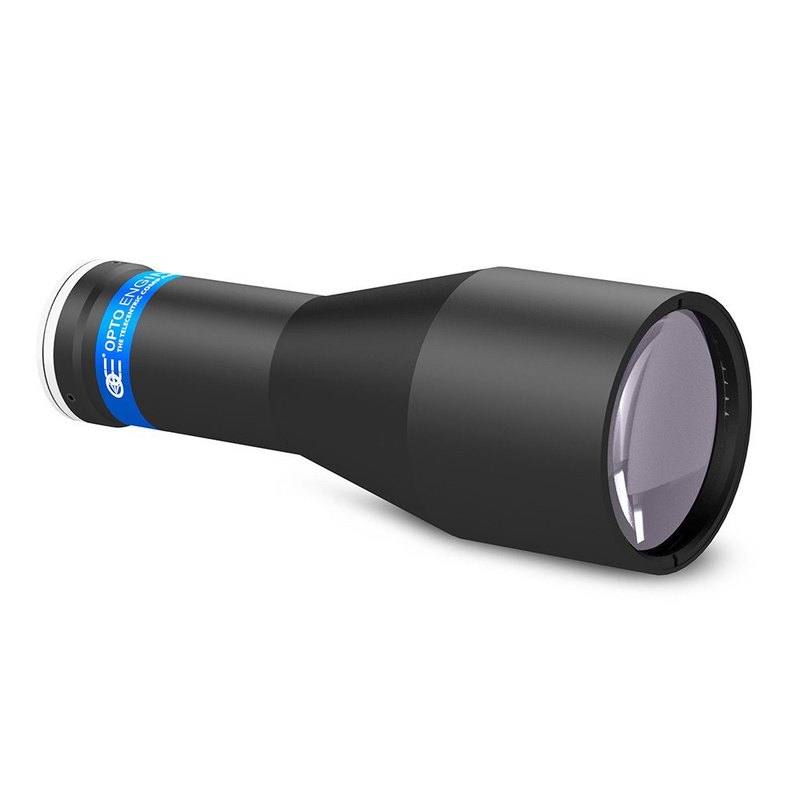
The Opto Engineering TCLWD030-110-23 is a telecentric lens for 2/3″ sensors, with 0.300× magnification, a Ø 11.0 mm image circle, and a 109 mm working distance. It is part of the TCLWD3M series of fixed working distance telecentric lenses, uses a C-mount, and has a working f-number of wF/# 10.
Telecentric optics hold magnification nearly constant across small changes in object distance, so the 0.300× scale stays stable when parts vary slightly in position along the optical axis. That behavior is central to dimensional measurement, where the image scale has to be reliable from part to part. The 109 mm working distance places the lens close to the object, so clearance for fixtures, lighting and handling must be planned early in the design.
The wF/# 10 aperture sets the balance between depth of field and the light reaching the sensor, so illumination should be sized accordingly. Pair the lens with a C-mount camera whose sensor is 2/3″ or smaller so the full Ø 11.0 mm image circle is used. Because the part sits at a fixed object distance, the fixture and object plane must be repeatable for the 0.300× scale to hold across parts.
Best for
Dimensional gauging of parts at 0.300× on 2/3″ sensors
Fixed-distance inspection where the part sits 109 mm from the lens
Inline measurement that requires telecentric optics
Stations where a 109 mm working distance fits the mechanical layout
Feature positioning on C-mount camera systems with 2/3″ sensors
Selection notes
Set the part at 109 mm with a repeatable fixture; the fixed working distance is part of the imaging geometry.
Confirm the sensor is 2/3″ or smaller to fit inside the Ø 11.0 mm image circle.
Check the clearance between the lens front and the part, fixtures and lighting before finalizing the layout.
Size the lighting for the wF/# 10 aperture so exposure is consistent across the field.
Derive the pixel-to-millimeter scale from 0.300× and the camera's pixel size before setting tolerances.
Specifications: General
Brand
Opto Engineering
Specifications: Optical
Lens mount
C-mount
Image circle / max sensor
Ø 11.0 mm (max sensor 2/3″)
Magnification
0.300×
Working distance
109 mm
Telecentric
Yes
Applications this product is commonly selected for. Open one to see the full recommended hardware and approach.
Matched automatically by: camera mount fits the lens mount · camera sensor is covered by the lens image circle — this lens: C-mount · Ø 11.0 mm (max sensor 2/3″) image circle.