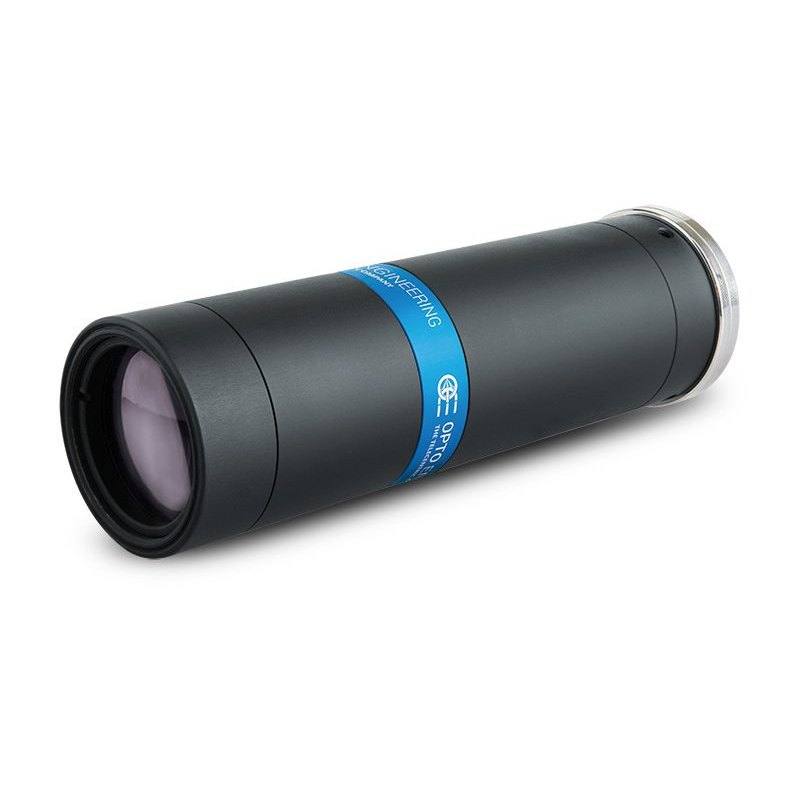
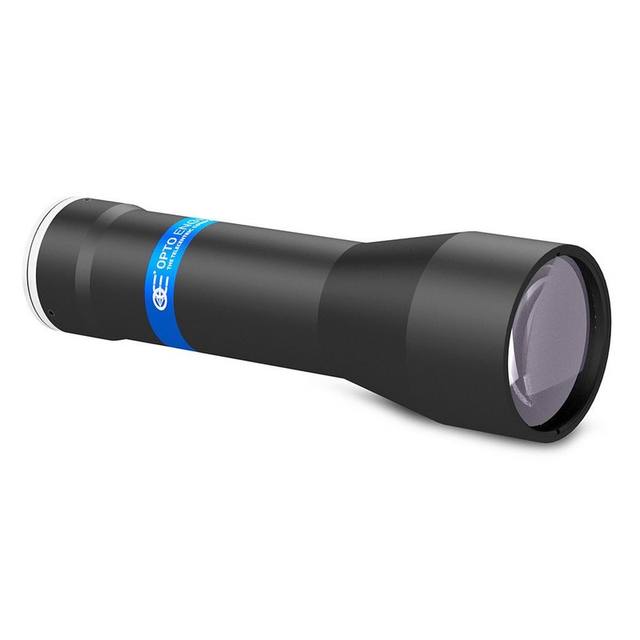
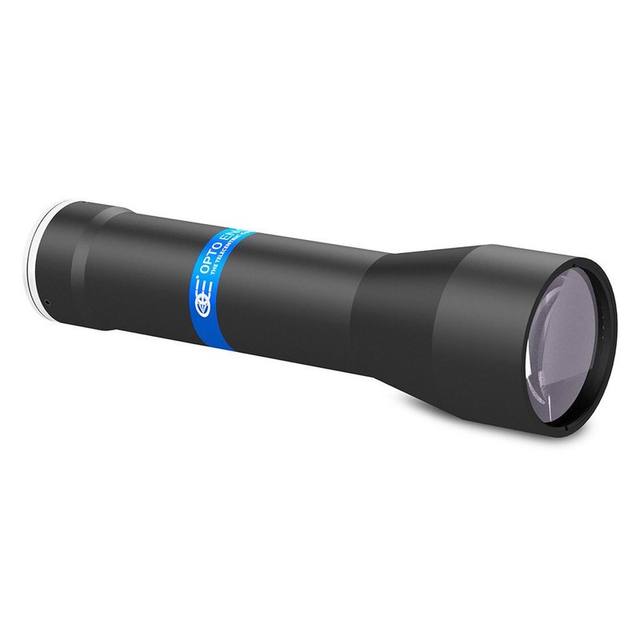
The Opto Engineering TCLWD050 is a long working distance telecentric lens for 2/3″ sensors, with 0.500× magnification, a Ø 11.0 mm image circle, and a 132.6 mm working distance. It uses a C-mount, and its working f-number is wF/# 12.
Distortion is below 0.1 % typical and 0.2 % at maximum, and telecentricity is below 0.04 deg typical and 0.06 deg at maximum. For dimensional work these values describe how faithfully the lens reproduces geometry and how consistently the image scale holds across small changes in object distance. Telecentricity in particular limits the perspective error that would otherwise change apparent feature sizes, so the maximum figures should be carried into any measurement uncertainty budget.
The 132.6 mm working distance gives the lens substantial standoff from the part, which leaves room for lighting, fixtures and handling in front of the optic. Pair it with a C-mount camera whose sensor is 2/3″ or smaller so the full Ø 11.0 mm image circle is used, and fix the part at the working distance on every cycle. The wF/# 12 aperture sets the balance between depth of field and light, so plan the illumination around it.
Best for
Gauging of parts on 2/3″ sensors where a long working distance is needed
Dimensional inspection at 0.500× with telecentric geometry
Stations with room for lighting, fixtures or handling between the lens and the part
Measurement applications where distortion below 0.1 % typical and telecentricity below 0.04 deg typical matter
C-mount camera systems that need a telecentric lens for 2/3″ sensors
Selection notes
Place the part at 132.6 mm with repeatable fixturing so the imaging geometry stays stable.
Confirm the camera sensor is 2/3″ or smaller to fit within the Ø 11.0 mm image circle.
Use the 0.2 % maximum distortion and 0.06 deg maximum telecentricity figures in the measurement uncertainty budget.
Plan illumination for the wF/# 12 aperture so exposure is consistent across the field.
Derive the pixel-to-millimeter scale from the 0.500× magnification and the camera's pixel size before setting tolerances.
Specifications: General
Brand
Opto Engineering
Specifications: Optical
Lens mount
C-mount
Image circle / max sensor
Ø 11.0 mm (max sensor 2/3″)
Magnification
0.500×
Working distance
132.6 mm
Telecentric
Yes
Applications this product is commonly selected for. Open one to see the full recommended hardware and approach.
Matched automatically by: camera mount fits the lens mount · camera sensor is covered by the lens image circle — this lens: C-mount · Ø 11.0 mm (max sensor 2/3″) image circle.