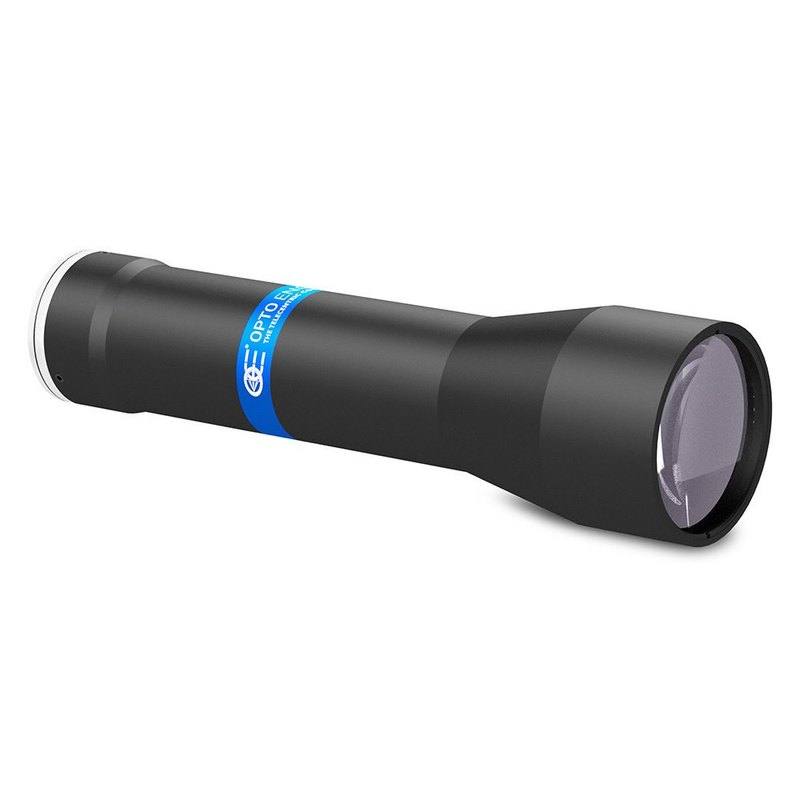
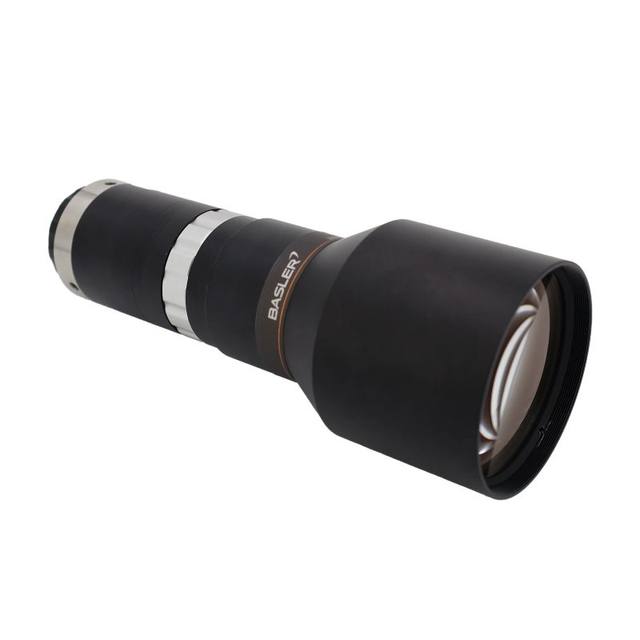
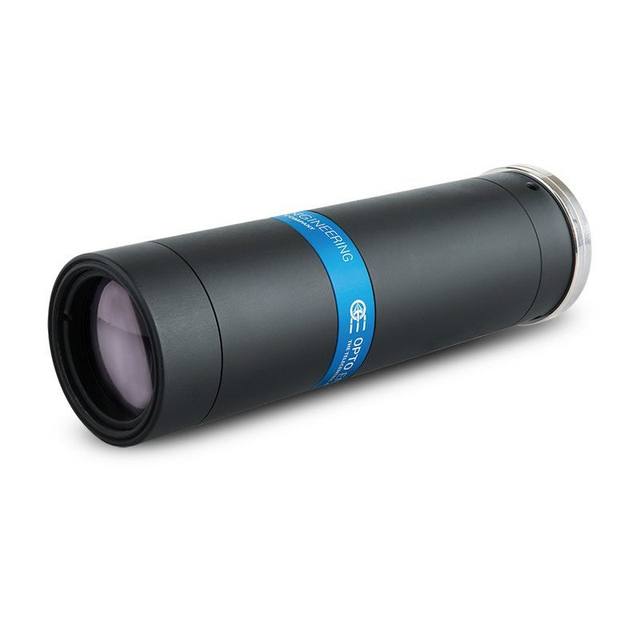
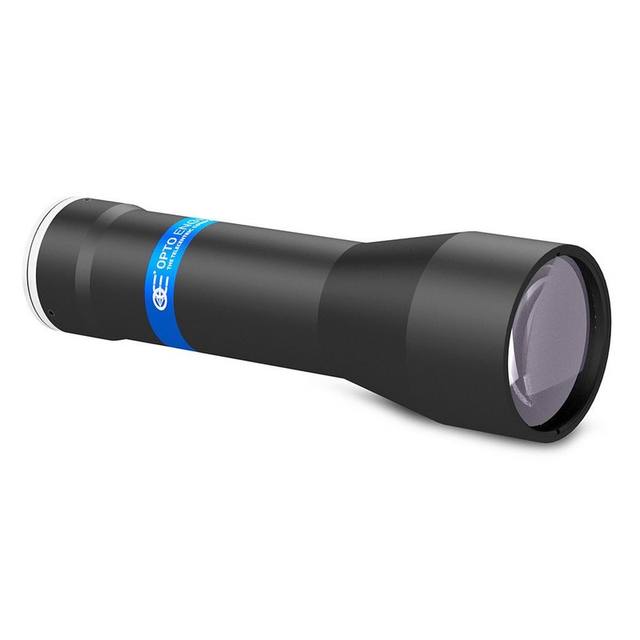
The TCLWD050-180-3M is a telecentric lens from the TCLWD3M series, described as fixed working distance telecentric lenses for sensors up to 1.1″. It provides 0.500× magnification on a Ø 17.6 mm image circle (max sensor 1.1″), with the object imaged at a fixed working distance of 178 mm. The lens uses a C-mount, so the camera body needs a C-mount flange.
The working f-number is wF/# 10. This is the main lever between depth of field and light: a higher working f-number widens the depth of field at the cost of brightness, while a lower one passes more light. Because the working distance is fixed at 178 mm, the part plane is set by the mechanics, and the fixture or conveyor has to hold the object at that distance for the image to stay in focus.
The lens is telecentric. A telecentric design keeps magnification close to constant across a range of object distances, so a part that sits slightly higher or lower within the depth of field still measures at the same scale. That is the basis for using it in dimensional gauging. For measurement accuracy, verify the complete setup with a calibration target at 178 mm rather than relying on nominal values alone.
Best for
Dimensional gauging of parts imaged at 0.500× on a 1.1″ sensor at a fixed 178 mm working distance
Inline measurement cells where parts are presented at a set height and the lens stands 178 mm from the object
Telecentric measurement of parts whose height varies within the depth of field, where constant magnification keeps readings consistent
Fixed-plane inspection at 0.500× across a 1.1″ sensor
Selection notes
Confirm the sensor format before ordering. The Ø 17.6 mm image circle is rated for sensors up to 1.1″, so a larger sensor would fall outside that coverage.
Design the 178 mm working distance into the mechanics. Use a fixture or conveyor that holds the part plane at that distance, and lock the camera and lens once focus is set.
Specify a C-mount camera, since the lens uses a C-mount.
Plan illumination around the telecentric path and the wF/# 10 aperture, and check exposure on the installed setup.
Specifications: General
Brand
Opto Engineering
Specifications: Optical
Lens mount
C-mount
Image circle / max sensor
Ø 17.6 mm (max sensor 1.1″)
Magnification
0.500×
Working distance
178 mm
Telecentric
Yes
Applications this product is commonly selected for. Open one to see the full recommended hardware and approach.
Matched automatically by: camera mount fits the lens mount · camera sensor is covered by the lens image circle — this lens: C-mount · Ø 17.6 mm (max sensor 1.1″) image circle.