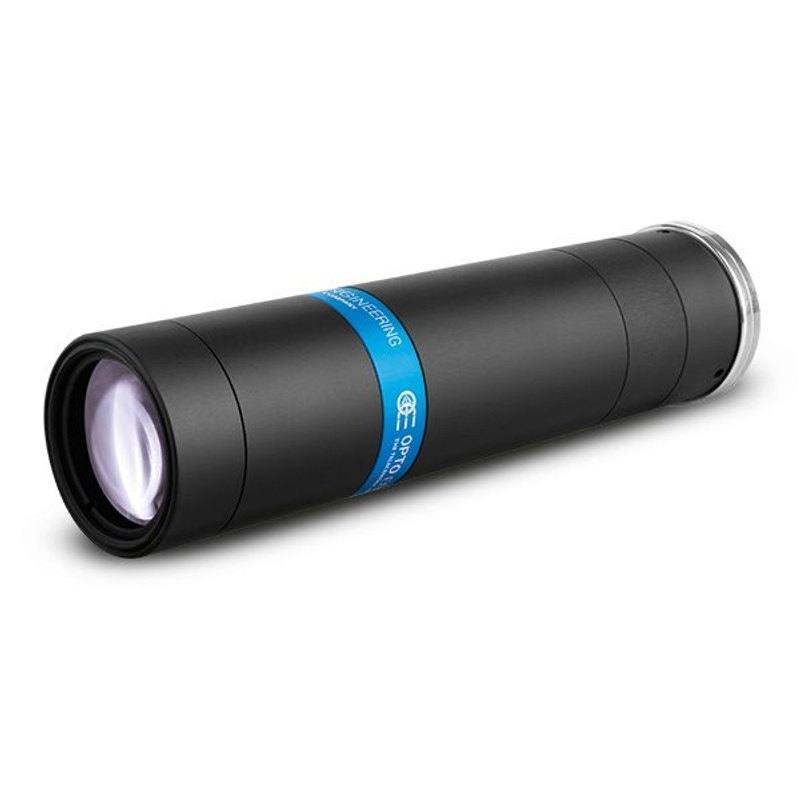
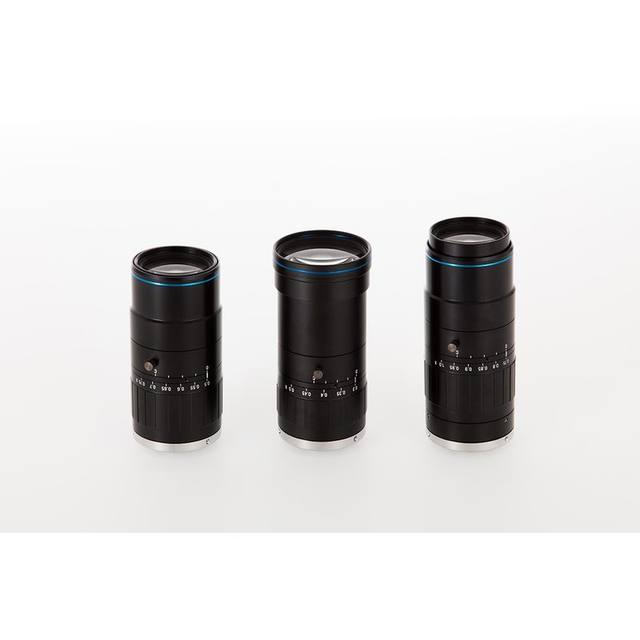
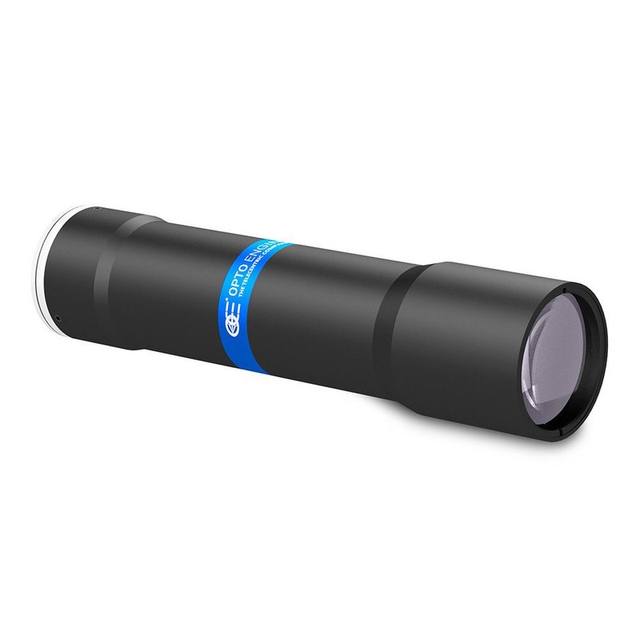
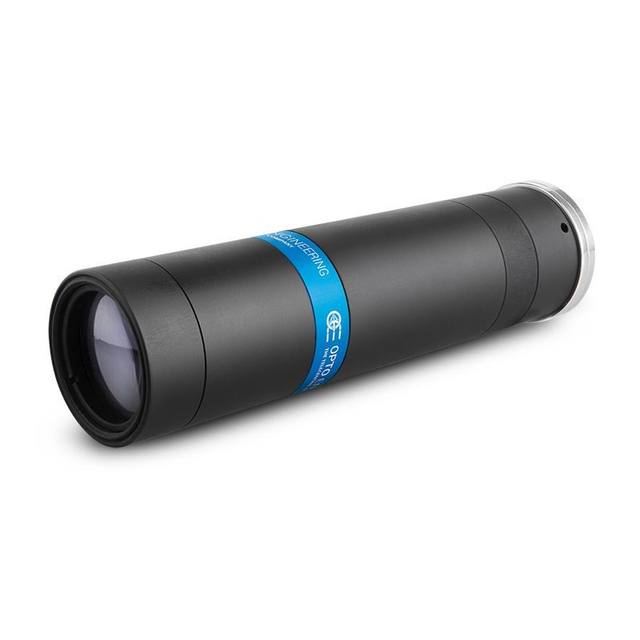
The TCLWD075 is a long working distance telecentric lens for 2/3″ sensors, part of the TCLWD series of 132 mm working distance telecentric lenses for sensors up to 2/3″. It provides 0.750× magnification on a Ø 11.0 mm image circle (max sensor 2/3″), with a working distance of 132.6 mm. The lens is C-mount, so the camera side needs a C-mount flange and a sensor no larger than 2/3″.
Distortion is given as < 0.1 (0.2) % typ. (max) and telecentricity as < 0.04 (0.06) deg typ. (max), so the typical figures are below 0.1 % and 0.04 degrees, with maximums of 0.2 % and 0.06 degrees. The lens is telecentric, which keeps magnification close to constant across the depth of field. At 0.750× the sensor image is three-quarters of the object size, so the sensor records an object field larger than itself, and the distortion and telecentricity figures matter across that whole field.
The wF/# 12 aperture sets the balance between depth of field and light. The 132.6 mm working distance means the mechanical layout should place the part at that distance, and a stable fixture helps keep the part in the focal plane. Carry the typical and maximum figures into the measurement uncertainty and confirm accuracy on the installed setup.
Best for
Gauging of parts on 2/3″ sensors at a 132.6 mm working distance
Measurement tasks where typical distortion below 0.1 % and telecentricity below 0.04 degrees limit geometric error
Dimensional inspection at 0.750×, where the object is imaged at three-quarters of its size
Stand-off inspection of parts held in a fixed fixture
Selection notes
Use a sensor no larger than 2/3″ within the Ø 11.0 mm image circle.
Plan the 132.6 mm working distance into the mechanical design, and use a fixture that keeps the part plane consistent.
Carry the typical and maximum distortion and telecentricity values into the uncertainty budget.
Confirm the camera has a C-mount flange, since this lens uses that mount.
Specifications: General
Brand
Opto Engineering
Specifications: Optical
Lens mount
C-mount
Image circle / max sensor
Ø 11.0 mm (max sensor 2/3″)
Magnification
0.750×
Working distance
132.6 mm
Telecentric
Yes
Applications this product is commonly selected for. Open one to see the full recommended hardware and approach.
Matched automatically by: camera mount fits the lens mount · camera sensor is covered by the lens image circle — this lens: C-mount · Ø 11.0 mm (max sensor 2/3″) image circle.