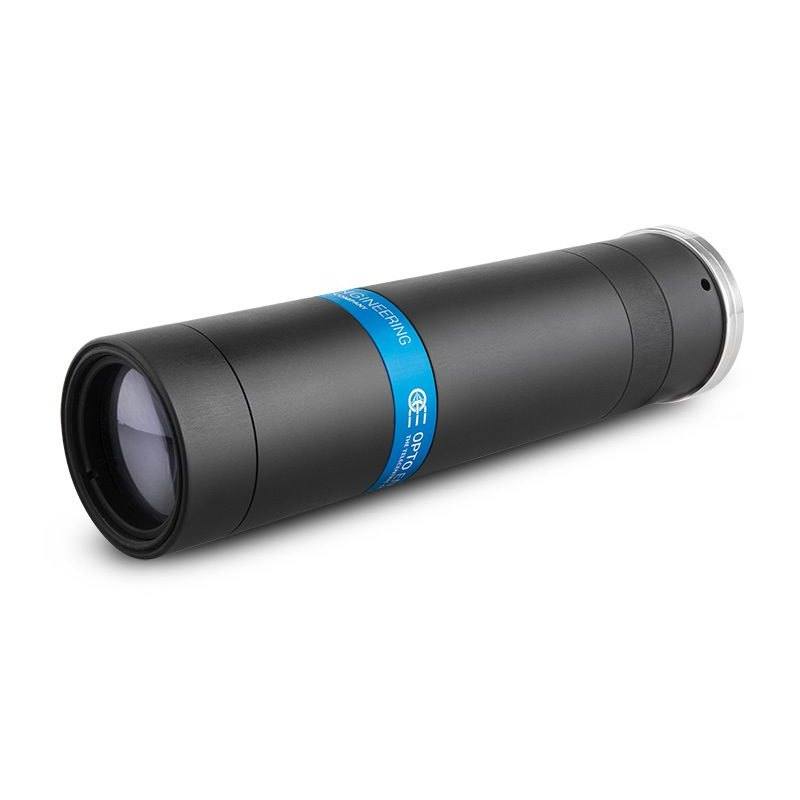
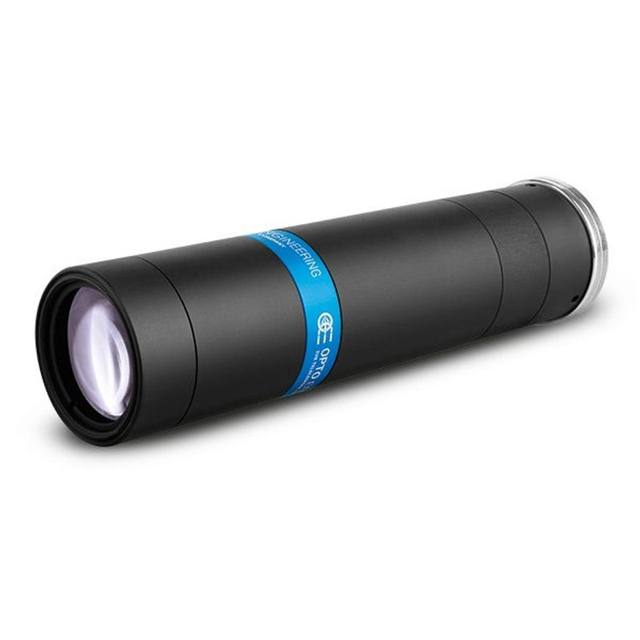
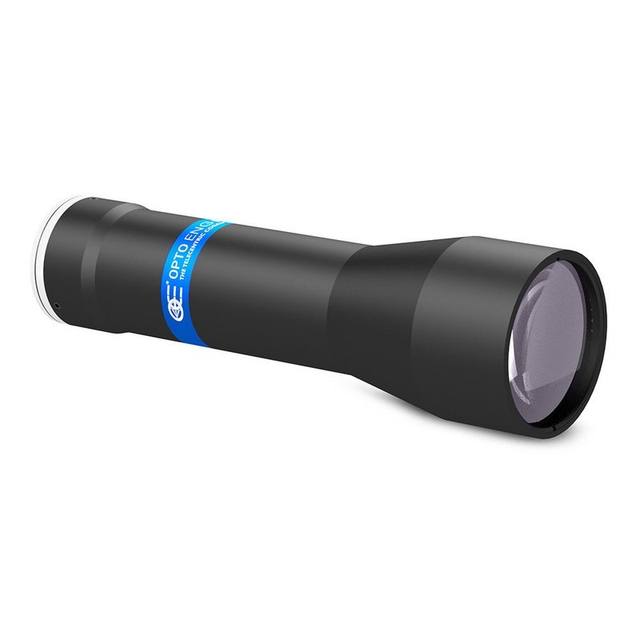
The TCLWD066 is a long working distance telecentric lens for 2/3″ sensors, from the TCLWD series of 132 mm working distance telecentric lenses for sensors up to 2/3″. It provides 0.660× magnification on a Ø 11.0 mm image circle (max sensor 2/3″), with a working distance of 132.8 mm. The lens is C-mount, so it pairs with a camera that has a C-mount flange and a sensor no larger than 2/3″.
Two accuracy figures are specified. Distortion is given as < 0.1 (0.2) % typ. (max), and telecentricity as < 0.04 (0.06) deg typ. (max): the first value in each pair is the typical figure and the value in brackets is the maximum. Distortion governs how straight edges map across the image, and telecentricity governs how much apparent size changes as the object moves in depth, so both feed directly into gauging uncertainty.
The wF/# 12 working aperture sets the balance between depth of field and light at 0.660×. Because the working distance is 132.8 mm, the lens is best used with a stable fixture that holds the part at that distance. Treat the typical and maximum figures as the baseline for the measurement error budget, and verify final accuracy on the installed setup.
Best for
Precision gauging on 2/3″ sensors, where the distortion and telecentricity figures feed the error budget
Dimensional inspection of parts held at a 132.8 mm working distance
Telecentric imaging of parts with height variation inside the depth of field at 0.660×
Inline checks that need a long working distance with a 2/3″ sensor
Selection notes
Keep the sensor within 2/3″. The Ø 11.0 mm image circle is rated for sensors up to 2/3″.
Hold the object at 132.8 mm. Plan a fixture or conveyor that places the part plane at this distance, and lock the optics once focus is set.
Carry the distortion and telecentricity figures into the uncertainty budget: the typical values are < 0.1 % and < 0.04 deg, and the maximums are 0.2 % and 0.06 deg.
Confirm the camera uses a C-mount, since this lens uses that mount.
Specifications: General
Brand
Opto Engineering
Specifications: Optical
Lens mount
C-mount
Image circle / max sensor
Ø 11.0 mm (max sensor 2/3″)
Magnification
0.660×
Working distance
132.8 mm
Telecentric
Yes
Applications this product is commonly selected for. Open one to see the full recommended hardware and approach.
Matched automatically by: camera mount fits the lens mount · camera sensor is covered by the lens image circle — this lens: C-mount · Ø 11.0 mm (max sensor 2/3″) image circle.