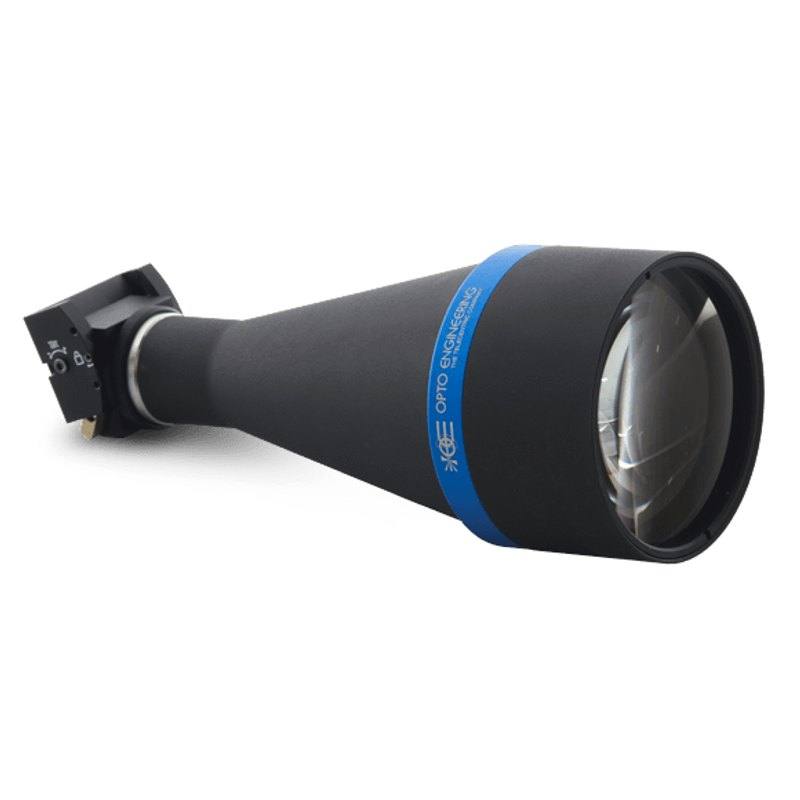
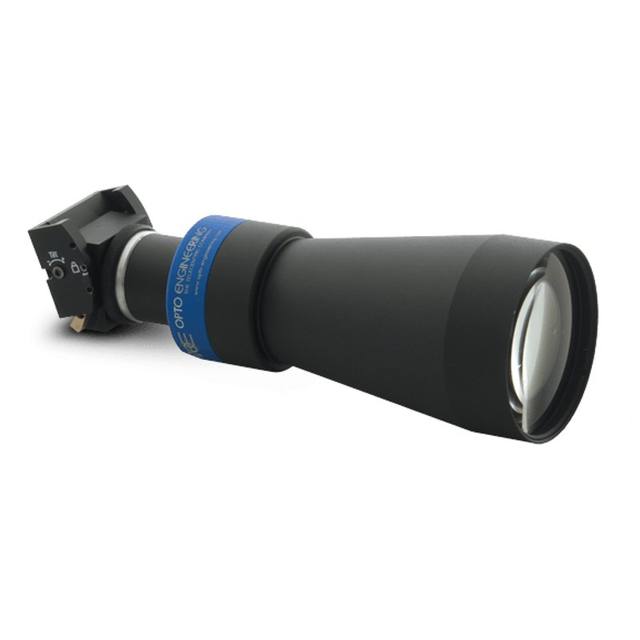
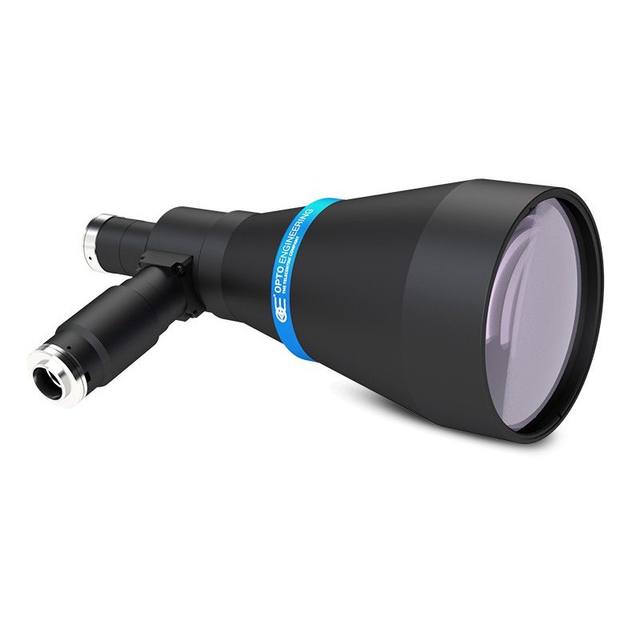
The Opto Engineering TCSM064 is a C-mount bi-telecentric lens with Scheimpflug adjustment, rated for sensors up to 2/3″. It works at 0.137× horizontal magnification, with a working distance of 181.8 mm and a wF/# of 8. At this standoff the camera can sit well back from the part, leaving space for fixtures, guards and lighting, and the telecentric design keeps the image scale steady when the part position varies slightly in depth.
The accuracy figures are a typical distortion below 0.03 %, with a maximum of 0.07 %, and a typical telecentricity error below 0.05 deg, with a maximum of 0.08 deg. Distortion controls how uniform the image scale is across the field, and telecentricity error controls how much a measured dimension changes as the part moves in depth. The wF/# 8 aperture gives useful depth of field, which tolerates some variation in part position, but the lighting must deliver enough light at that aperture.
The Scheimpflug adjustment lets the focal plane be tilted to follow an inclined surface, so sloped or angled faces can be brought into focus. Because the lens is rated for sensors up to 2/3″, the camera should use a sensor of that size or smaller. The result is a telecentric lens suited to dimensional inspection of parts that need a large standoff and tilted-plane focus.
Best for
Measurement stations where the part sits at a 181.8 mm working distance with clearance for fixtures, guards or lighting.
Inspection of inclined or angled surfaces using the Scheimpflug adjustment.
Dimensional gauging where low distortion and telecentricity keep the measurement stable across the field.
C-mount 2/3″ camera setups that need a 0.137× view of the part.
Selection notes
Position the part at 181.8 mm and let the fixture locate it at that distance.
Stay within the 2/3″ max rating when choosing the camera sensor.
Plan the illumination for wF/# 8 so the exposure stays short and stable.
Set the Scheimpflug tilt against the actual inclined surface and verify focus on a sample part before production.
Specifications: General
Brand
Opto Engineering
Specifications: Optical
Lens mount
C-mount
Image circle / max sensor
2/3″ max sensor
Magnification
0.137× (horizontal)
Working distance
181.8 mm
Telecentric
Yes
Applications this product is commonly selected for. Open one to see the full recommended hardware and approach.
Matched automatically by: camera mount fits the lens mount · camera sensor is covered by the lens image circle — this lens: C-mount · 2/3″ max sensor image circle.