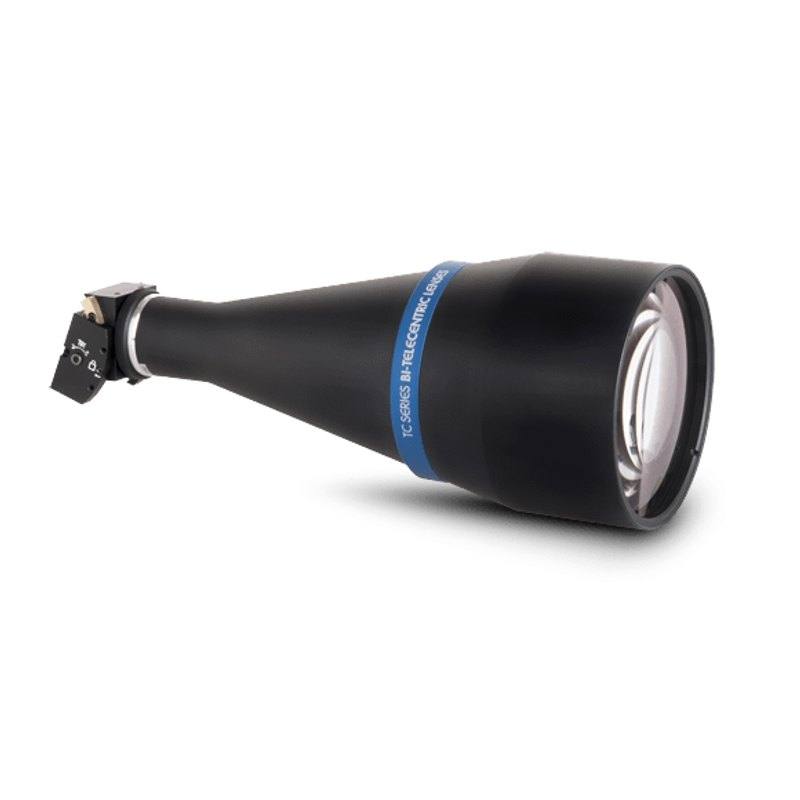
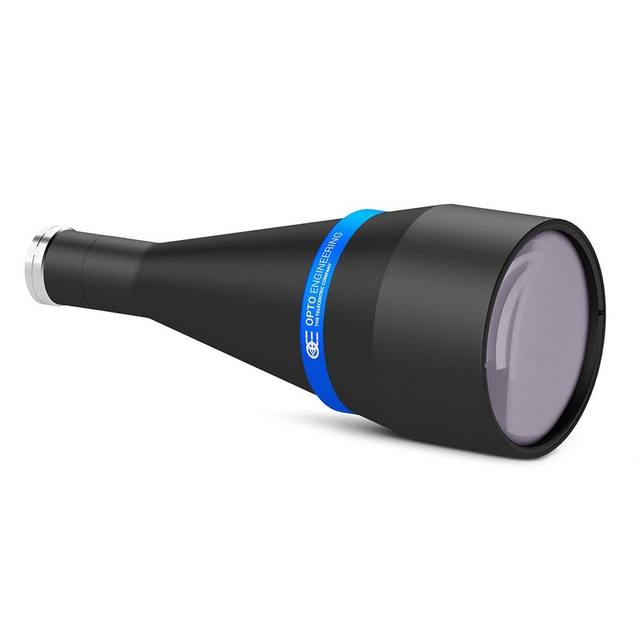
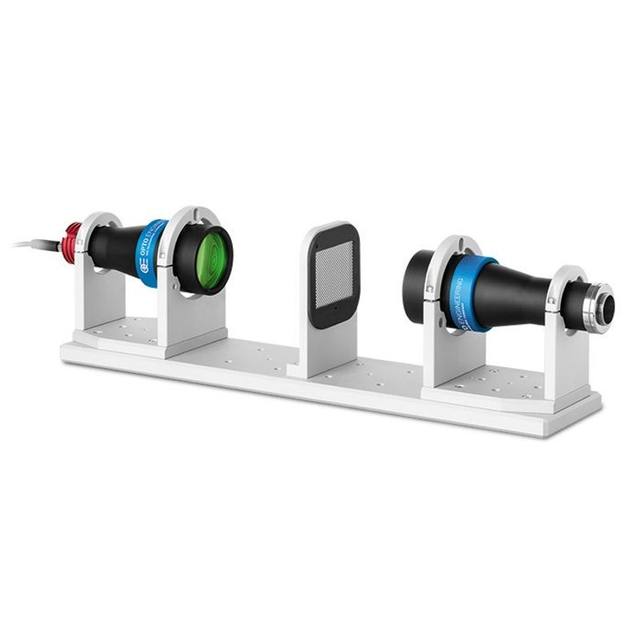
The Opto Engineering TCSM080 is a C-mount bi-telecentric lens with Scheimpflug adjustment, rated for sensors up to 2/3″. It works at 0.110× horizontal magnification with a working distance of 226.7 mm and a wF/# of 8. The large standoff puts the camera well back from the part, which leaves more room for guarding, handling equipment and lighting between the lens and the object.
Accuracy is set by a typical distortion below 0.02 %, with a maximum of 0.10 %, and a typical telecentricity error below 0.04 deg, with a maximum of 0.08 deg. Telecentricity determines how much the measured size changes when the part moves in depth, and distortion determines how uniform the image scale is across the field. At the 226.7 mm working distance, small changes in part depth have a limited effect on measured size. The wF/# 8 aperture gives useful depth of field, but the illumination must deliver enough light at that aperture.
The Scheimpflug adjustment lets the plane of focus be tilted to match an inclined surface, which helps when a part face is not perpendicular to the optical axis. The lens is rated for sensors up to 2/3″, so the camera sensor should be 2/3″ or smaller. At 0.110× magnification the field of view on a 2/3″ sensor is large, which suits inspection tasks that need more of the object in one frame.
Best for
Inspection of parts where the camera must stand back 226.7 mm for clearance from guarding or handling equipment.
Imaging a large part area in one frame at 0.110× magnification.
Telecentric gauging where the part position varies slightly in depth and the scale must stay consistent.
Angled-surface inspection with Scheimpflug adjustment on 2/3″ C-mount cameras.
Selection notes
Position the part at the 226.7 mm working distance and confirm the mechanical layout allows that standoff.
Choose a camera with a sensor of 2/3″ or smaller to stay within the rated image circle.
Design the lighting for wF/# 8, because the aperture limits how much light reaches the sensor.
Verify the Scheimpflug adjustment on a sample of the inclined target, since the tilt sets which part of the surface is in focus.
Specifications: General
Brand
Opto Engineering
Specifications: Optical
Lens mount
C-mount
Image circle / max sensor
2/3″ max sensor
Magnification
0.110× (horizontal)
Working distance
226.7 mm
Telecentric
Yes
Applications this product is commonly selected for. Open one to see the full recommended hardware and approach.
Matched automatically by: camera mount fits the lens mount · camera sensor is covered by the lens image circle — this lens: C-mount · 2/3″ max sensor image circle.