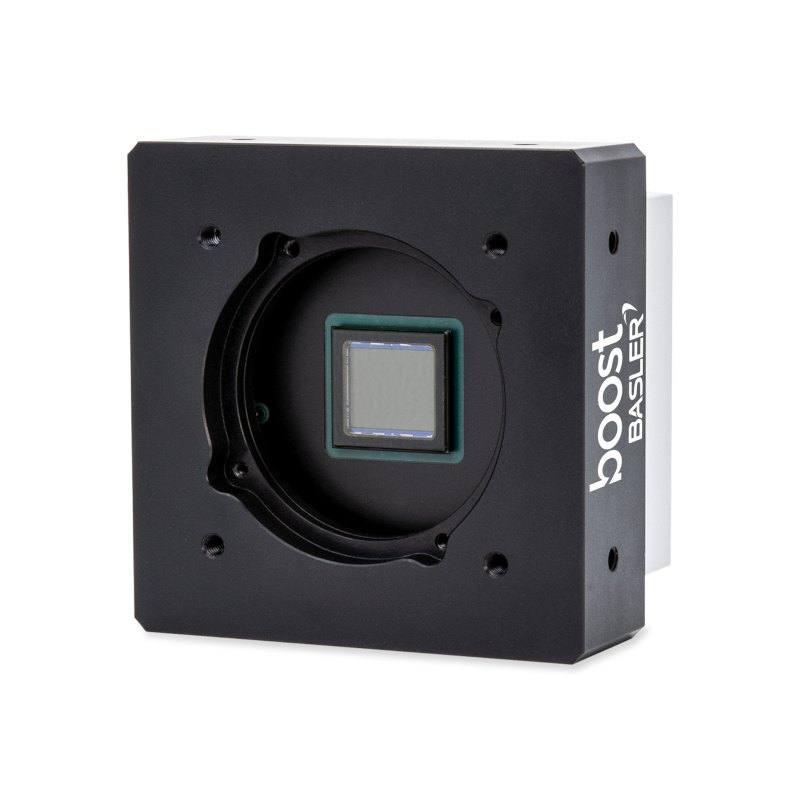
The Basler boost boA4504-100cc is a high-resolution industrial area-scan camera using a 1.1" Sony IMX531 progressive-scan global-shutter CMOS sensor with 4504 x 4504 active pixels (20 MP) and 2.74 µm square pixels. It connects over a CoaXPress 2.0 interface with two CXP-12 channels (up to 12.5 Gbps per channel), reaching approximately 102.9 fps at full resolution. The camera outputs 10-bit color images and is powered at 24 VDC via Power over CoaXPress (PoCXP) or the M8 I/O connector (AUX power). It uses Basler's universal camera front, supporting C-mount, F-mount, M42x0.75 and M42x1 lens-mount options, with a 45 x 80 x 80 mm housing weighing about 442 g.
Brand
Basler
Camera type
Area scan
Interface
CoaXPress 2.0, 2x CXP-12 (up to 12.5 Gbps/channel)
Resolution
20 MP (4504 x 4504, ~20.3 MP effective)
Horizontal resolution
4504 x 4504 px
Mono / color
Color (no IR cut filter)
Sensor manufacturer
Sony
Sensor model
Sony IMX531 (IMX531-AAQJ-C), progressive-scan CMOS
Shutter
Global shutter
FPS
~102.9 fps at full resolution (2x CXP-12)
Mount
Universal camera front (C-mount, F-mount, M42x0.75, M42x1 options)
The Basler boost boA4504-100cc is a high-resolution area-scan camera built around the 1.1-inch Sony IMX531 progressive-scan CMOS sensor, giving you a 4504 x 4504 square pixel array (20 MP, ~20.3 MP effective) on a 12.3 x 12.3 mm active area with 2.74 um pixels. Two characteristics define what this camera is good at. First, the sensor uses a global shutter, so every pixel is exposed simultaneously and fast-moving or vibrating parts are frozen without the geometric skew a rolling shutter would introduce. Second, the square 4504 x 4504 format pairs naturally with round, square, or rotationally symmetric inspection targets such as wafers, lenses, connectors, and printed labels, where a conventional widescreen sensor would waste pixels. With 2.74 um pixels you get fine spatial sampling, but that same small pixel demands good optics and adequate illumination to keep the per-pixel signal clean.
Throughput is where this model separates itself. It connects over CoaXPress 2.0 using two CXP-12 channels at up to 12.5 Gbps each, and that bandwidth lets it stream the full 20 MP frame at roughly 102.9 fps while outputting 10-bit color. That combination of high resolution and high frame rate is the camera's reason for existing: it suits continuously moving lines and high-cadence stations where you cannot afford to slow the conveyor to get a sharp, detailed picture. CoaXPress also carries Power over CoaXPress (PoCXP), so a single coax run can deliver the 24 VDC supply (18.6 to 26 VDC, about 12.8 W) alongside the image data and trigger signaling; alternatively, auxiliary power is available on the M8 I/O connector. You will need a CoaXPress 2.0 frame grabber with two CXP-12 ports to realize the full rate, and the camera speaks GenICam, so it integrates with standard CoaXPress-aware vision software.
Optically and mechanically, the camera uses Basler's universal camera front, which means you can choose a C-mount, F-mount, M42x0.75, or M42x1 interface depending on the lens needed to cover the 17.5 mm sensor diagonal. With a 1.1-inch image circle and 2.74 um pixels, lens selection is consequential: only lenses rated for 1.1-inch sensors with sufficient resolving power will deliver detail to every pixel, and on a 20 MP sensor a soft or undersized lens becomes the limiting factor before the sensor does. This is a color sensor (Bayer) supplied with no IR-cut filter, so for accurate color rendering you should add an external IR-cut filter to block the residual near-infrared response. The 45 x 80 x 80 mm box housing weighs about 442 g and operates from 0 to 50 C, so plan mounting rigidity and any heat management for the 12.8 W draw accordingly.
Best for
High-resolution surface and defect inspection of electronics, semiconductor wafers, and battery components where the 20 MP square format maps efficiently onto the part
Inspecting fast-moving or indexing parts on continuous lines, using the global shutter and ~100 fps to freeze motion without rolling-shutter distortion
Dimensional and metrology-grade measurement where the 4504 x 4504 array and 2.74 um pixels provide dense spatial sampling across a square field of view
Industrial OCR/OCV and code traceability tasks that need enough pixels-per-character or pixels-per-module to read marks reliably at line speed
High-throughput stations needing a single-cable CoaXPress link (image, power, and trigger over coax) into a CXP-12 frame grabber
Selection notes
Budget for a CoaXPress 2.0 frame grabber with two CXP-12 ports; without the full 2x CXP-12 link you will not reach the ~102.9 fps full-resolution figure, and cable length/quality affects whether PoCXP and 12.5 Gbps/channel hold up
Match the lens to the sensor: select a 1.1-inch (17.5 mm image circle) lens with resolving power suited to 2.74 um pixels, choosing the C-mount, F-mount, M42x0.75, or M42x1 option on the universal front accordingly
This is a color (Bayer) sensor supplied with no IR-cut filter, so add an external IR-cut filter to block residual near-infrared and keep color accurate
Provide adequate illumination: small 2.74 um pixels and short exposures at ~100 fps reduce light per pixel, so plan high-intensity or strobed lighting synchronized via the trigger inputs to maintain signal-to-noise
Plan mechanicals and thermals around the 45 x 80 x 80 mm, ~442 g box housing, 12.8 W consumption, 18.6 to 26 VDC supply, and 0 to 50 C operating range, including a rigid mount to keep the high-resolution image stable
Specifications: General
Brand
Basler
Camera type
Area scan
Specifications: Sensor
Resolution
20 MP (4504 x 4504, ~20.3 MP effective)
Horizontal resolution
4504 x 4504 px
Mono / color
Color (no IR cut filter)
Sensor manufacturer
Sony
Sensor model
Sony IMX531 (IMX531-AAQJ-C), progressive-scan CMOS
Shutter
Global shutter
Sensor size
1.1" format, 12.3 x 12.3 mm, 17.5 mm diagonal
Pixel size
2.74 x 2.74 µm
Specifications: Performance
FPS
~102.9 fps at full resolution (2x CXP-12)
Specifications: Interface
Interface
CoaXPress 2.0, 2x CXP-12 (up to 12.5 Gbps/channel)
Protocols
GenICam / CoaXPress 2.0
Specifications: Optics
Mount
Universal camera front (C-mount, F-mount, M42x0.75, M42x1 options)
Specifications: Electrical
Power
24 VDC via PoCXP or AUX (M8 I/O connector)
Power consumption
12.8 W
Supply voltage
18.6 - 26 VDC
Specifications: Environment
Operating temperature
0 - 50 °C
Specifications: Mechanical
Dimensions
45 x 80 x 80 mm
Housing material
Box
Weight
442 g
Applications this camera is commonly selected for. Open one to see the full recommended hardware and approach.
Matched automatically by: lens mount fits the camera mount · lens image circle covers the camera sensor — this camera: Universal camera front (C-mount, F-mount, M42x0.75, M42x1 options) · 1.1" format, 12.3 x 12.3 mm, 17.5 mm diagonal sensor.
By category
All 67C-mount lenses 43Telecentric lenses 24
By brand
All 67Basler 34iRAYPLE 23Omron / Sentech 8Datalogic / Datasensing 2
Get a first image quickly with the pylon Viewer, then move into the pylon SDK for your application. These cameras are GenICam/GenTL-compliant, so any compliant vision software can drive them as well.
Download and install the pylon Camera Software Suite for your OS from Basler. This provides the pylon Viewer, the GenTL transport-layer producers and the pylon SDK (C/C++/.NET/Python). On Windows the installer adds the needed drivers; on Linux follow the included setup notes for USB and network permissions.
2. Connect the camera and check the link
Cable the camera to its matching interface: GigE Vision to a GigE port (use a quality cable and, ideally, a dedicated NIC with jumbo frames enabled), USB3 Vision to a USB 3.x port with the supplied cable, or CoaXPress to the frame grabber. Provide power where required (PoE, USB bus power, or PoCXP). Open the pylon Viewer and confirm the camera appears in the device list; for GigE, make sure the camera and NIC are on the same subnet.
3. Grab a first image and set exposure, gain and pixel format
Select the camera in the pylon Viewer and start a continuous grab. Adjust exposure time and gain until the image is well exposed (avoid clipped highlights), set the pixel format (e.g. Mono8 or a Bayer/RGB format), and focus the lens. Use a test pattern if the lens or scene is not ready yet.
4. Configure triggering and acquisition
Decide between free-run and triggered acquisition. For synchronized capture, set the trigger source (software or a hardware line on the I/O connector), trigger mode and any debounce or exposure mode, then verify timing. Note the parameter names you change in the Viewer feature tree, as you will reuse them in code.
5. Move to the SDK or a GenICam-compliant library
Recreate your settings in code with the pylon SDK (C, C++, .NET or Python) to open the device, apply the same features and pull frames into your pipeline; pylon vTools and pylon AI can add processing blocks. Because the cameras are GenICam/GenTL standard, third-party vision libraries work too. Once the image stream is stable, you can route frames to a deep-learning inspection such as Rosepetal for automated defect detection.
Frequently asked questions
It uses the 1.1-inch Sony IMX531 progressive-scan global-shutter CMOS sensor with a 4504 x 4504 active pixel array (20 MP, ~20.3 MP effective) and 2.74 x 2.74 um pixels on a 12.3 x 12.3 mm area with a 17.5 mm diagonal.
It reaches approximately 102.9 fps at the full 4504 x 4504 resolution when connected over its two CXP-12 CoaXPress 2.0 channels, outputting 10-bit color images.
It connects via CoaXPress 2.0 using two CXP-12 channels at up to 12.5 Gbps per channel, so you need a CoaXPress 2.0 frame grabber with two CXP-12 ports. It uses the GenICam standard for software integration.
It is a color camera and ships with no IR-cut filter. For accurate color rendering you should add an external IR-cut filter.
It runs on 24 VDC (18.6 to 26 VDC range, about 12.8 W) supplied via Power over CoaXPress (PoCXP) or auxiliary power on the M8 I/O connector. Its universal camera front supports C-mount, F-mount, M42x0.75, and M42x1 lens options.