Skip to content
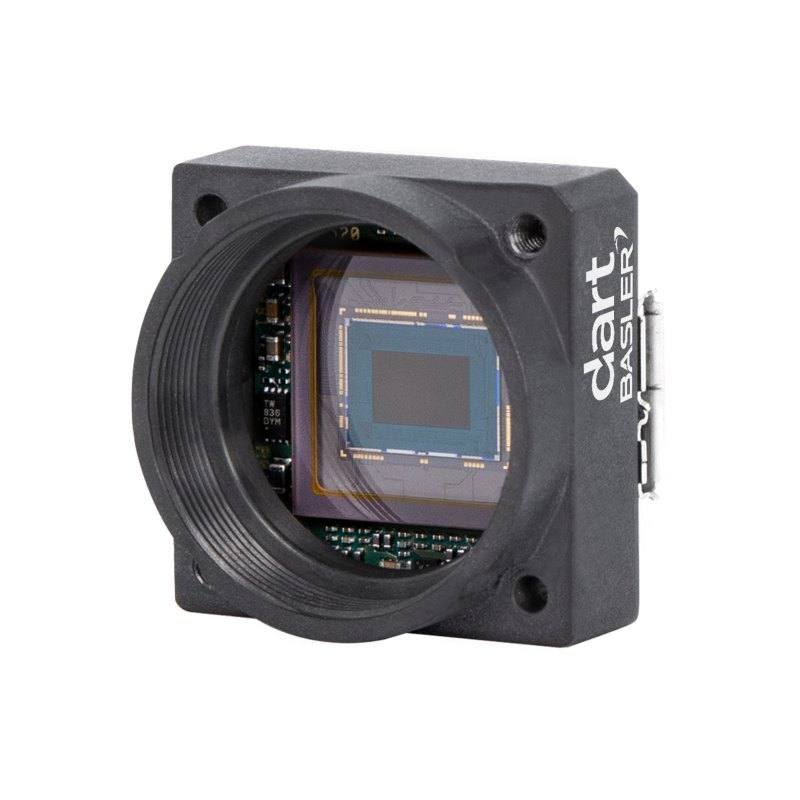
Basler daA1920-160um machine vision camera
  • Rosepetal compatible
  • Recommended by AIS Vision

Basler dart daA1920-160um

daA1920-160um

The daA1920-160um is part of Basler's dart board-level camera family and uses a 1/2.3" Sony IMX392 CMOS sensor with global shutter, a native resolution of 1920 x 1200 px (2.3 MP) and a 3.45 µm square pixel pitch. It connects over USB 3.0 (SuperSpeed, nominal max 5 Gbit/s) using the USB3 Vision standard, supports 8-bit and 12-bit pixel formats, and reaches up to 164 fps when the Device Link Throughput Limit is disabled. The compact module is powered directly from the USB interface (~1.9 W typical at 5 VDC), weighs under 15 g in the S/CS-mount versions, and is offered with S-mount, CS-mount or no mount (bare board). It provides hardware and software triggering plus GPIO I/O lines and conforms to GenICam, USB3 Vision, CE/RoHS, FCC, UL and UKCA standards.

Brand
Basler
Camera type
Area scan
Interface
USB 3.0 (USB3 Vision, nominal max. 5 Gbit/s SuperSpeed)
Resolution
2.3 MP
Horizontal resolution
1920 x 1200 px (default); 1936 x 1216 px full
Mono / color
Mono
Sensor manufacturer
Sony
Sensor model
Sony IMX392LLR-C
Shutter
Global shutter
FPS
67 fps (default); up to 164 fps (Device Link Throughput Limit disabled)
Mount
S-mount, CS-mount, or no mount (bare board)
Sensor size
1/2.3" (6.6 mm x 4.1 mm)

Technical overview

The Basler dart daA1920-160um pairs a 1/2.3" Sony IMX392 CMOS sensor (6.6 mm x 4.1 mm) with a true global shutter, which is the defining characteristic that shapes everything this camera is good at. Global shutter exposes every pixel of the 1920 x 1200 px array (2.3 MP default; 1936 x 1216 px full) simultaneously, so fast-moving parts on a conveyor or in front of a robot are captured without the slanting and smearing that a rolling shutter introduces. The 3.45 µm square pixel pitch is a balanced size for this sensor class: it gives enough sensitivity to keep exposures short under industrial lighting while still resolving the fine features needed for code reading and small-defect detection. Because the sensor is monochrome, all of the photosite area is devoted to luminance rather than being split under a color filter array, which makes it the right choice for grayscale tasks such as OCR/OCV, 1D/2D code grading, and contrast-based defect inspection where color carries no information.

On the data side the camera uses USB 3.0 (USB3 Vision, nominal max 5 Gbit/s SuperSpeed) and conforms to GenICam, so it drops into standard machine-vision software stacks via Basler's pylon SDK without proprietary glue. The headline speed figure is staged: it runs 67 fps in its default configuration and climbs to as high as 164 fps once the Device Link Throughput Limit is disabled, which is how you trade off the fixed USB3 bandwidth budget against frame rate, region of interest, and pixel format. Both 8-bit and 12-bit output are supported, so you can keep payloads small and fast for high-throughput sorting, or step up to 12-bit when you need the extra tonal headroom for grading and measurement. A single USB3 cable carries both data and power (~1.9 W typical at 5 VDC), which removes the need for a separate supply and simplifies single-camera cells, though it also means cable length and host port quality directly bound your achievable throughput.

Mechanically this is a dart board-level module measuring 20 x 29 x 29 mm and weighing about 15 g, available with S-mount, CS-mount, or as a bare board with no mount. That form factor is built for embedded and space-constrained integration: handheld units, multi-camera arrays, robot end-effectors, and OEM instruments where a boxed industrial camera will not fit. The lens decision follows directly from the small 1/2.3" optical format and 3.45 µm pixels, so you should select an S-mount or CS-mount lens rated for at least 2.3 MP on that sensor size to actually resolve down to the pixel. Hardware and software triggering plus GPIO I/O lines let you synchronize each global-shutter exposure to an encoder, photoeye, or strobe so motion is frozen consistently, and the 0–50 °C operating range with CE/RoHS, FCC, UL, and UKCA conformity covers typical indoor production environments.

Best for

  • High-speed defect inspection on moving product, where the global shutter freezes motion without distortion and up to 164 fps (Device Link Throughput Limit disabled) keeps up with fast conveyors
  • Industrial OCR/OCV and 1D/2D code reading on labels and parts, using the monochrome 2.3 MP sensor and 12-bit output for clean, high-contrast grading
  • Embedded and OEM vision in tight spaces, leveraging the 20 x 29 x 29 mm board-level form factor and ~15 g weight on robot end-effectors or inside instruments
  • Dimensional measurement and gauging of parts in motion, where simultaneous full-frame exposure prevents the geometric error a rolling shutter would add
  • Robot guidance and pick cells, where USB3 Vision plus hardware/software triggering and GPIO synchronize capture to motion and lighting

Selection notes

  • Budget your USB3 bandwidth deliberately: the camera is 67 fps by default and only reaches up to 164 fps when the Device Link Throughput Limit is disabled, so cropping the ROI, choosing 8-bit over 12-bit, and using a quality USB3 host controller are the levers that actually unlock the top frame rate
  • Match the lens to the optics: with a 1/2.3" (6.6 x 4.1 mm) sensor and 3.45 µm pixels, pick an S-mount or CS-mount lens resolving 2.3 MP on that format, and confirm the back focal distance fits the mount variant you order (S-mount, CS-mount, or bare board)
  • This is a monochrome camera by design, so it suits grayscale defect, OCR, and code tasks; if your inspection depends on distinguishing colors, this model is not the right fit
  • Plan single-cable power and data: it draws ~1.9 W typical at 5 VDC over the USB3 link, which simplifies wiring but makes cable quality and length a real constraint on sustained throughput
  • Use the hardware trigger and GPIO lines to lock each global-shutter exposure to an encoder or photoeye and to fire strobe lighting, ensuring repeatable freeze-frame capture across the 0–50 °C operating range

Specifications: General
BrandBasler
Camera typeArea scan

Specifications: Sensor
Resolution2.3 MP
Horizontal resolution1920 x 1200 px (default); 1936 x 1216 px full
Mono / colorMono
Sensor manufacturerSony
Sensor modelSony IMX392LLR-C
ShutterGlobal shutter
Sensor size1/2.3" (6.6 mm x 4.1 mm)
Pixel size3.45 x 3.45 µm

Specifications: Performance
FPS67 fps (default); up to 164 fps (Device Link Throughput Limit disabled)

Specifications: Interface
InterfaceUSB 3.0 (USB3 Vision, nominal max. 5 Gbit/s SuperSpeed)
ProtocolsUSB3 Vision, GenICam

Specifications: Optics
MountS-mount, CS-mount, or no mount (bare board)

Specifications: Electrical
PowerPowered via USB 3.0 (~1.9 W typical @ 5 VDC)
Power consumption1.9 W

Specifications: Environment
Operating temperature0–50 (32–122 °F) °C

Specifications: Mechanical
Dimensions20 x 29 x 29 mm
Weight15 g
Housing materialBoard level

Frequently asked questions

Related technical guides

Rosepetal · AI

Test this camera with Rosepetal

Validate your visual inspection with AI: send us sample images and we evaluate the case on your hardware.

AIS Vision · Integration

We validate camera + lens + lighting

AIS Vision defines and tests the optimal combination of camera, optics and lighting for your application before you buy.