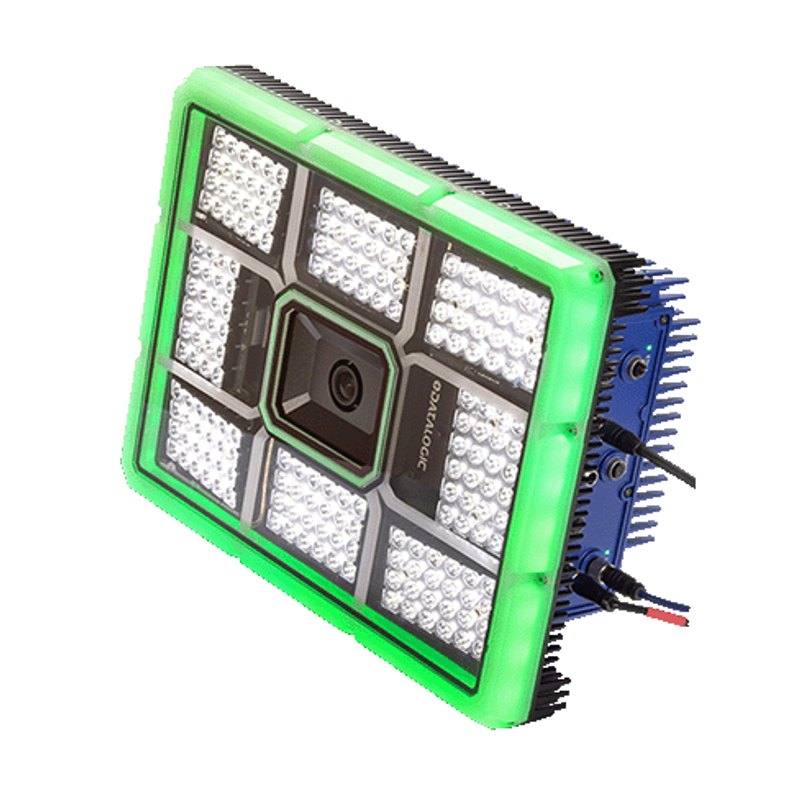
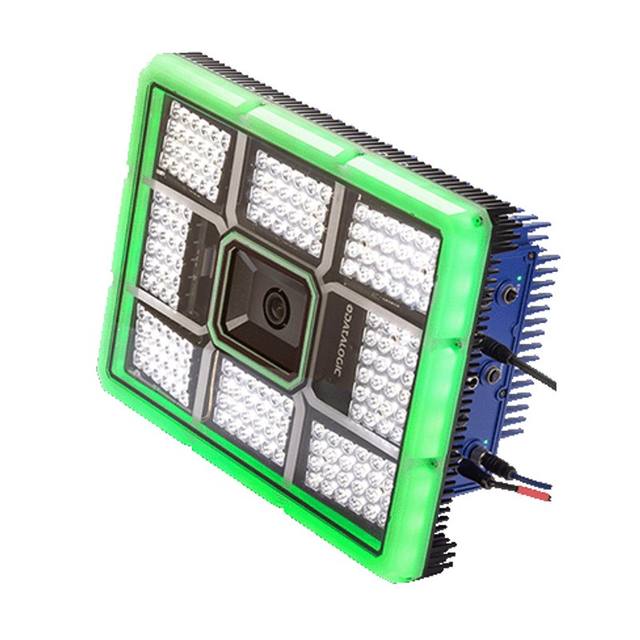
One reader covers a belt up to 1.2 m wide, and with an 8000 px wide imager the pixel pitch is simply belt width ÷ 8000: a full 1.2 m belt gives 1200 mm ÷ 8000 = 0.15 mm per pixel and an example 800 mm belt gives 0.10 mm. At an example 3 px per module the smallest 2D module on the full belt is about 0.45 mm. The lens does not change that pitch; it decides how high the reader must stand. The 16 mm f/4 lens is the widest of the 16, 25 and 35 mm optics in the Matrix 830/930 range, so it needs the lowest mount: the 25 mm version must stand about 25 ÷ 16 ≈ 1.6 times higher for the same belt and the 35 mm about 35 ÷ 16 ≈ 2.2 times.
Belts run up to 3.5 m/s and PackTrack follows parcels separated by gaps as small as 100 mm. Motion sets the exposure: to hold blur to one pixel at 3.5 m/s, exposure must stay under 0.15 mm ÷ 3500 mm/s ≈ 43 µs on a full 1.2 m belt and under 0.10 mm ÷ 3500 mm/s ≈ 29 µs on an 800 mm belt, so plan strong, short illumination.
Best for
Belts up to 1.2 m wide that should be covered by one imager rather than several narrow-field readers side by side.
Low-headroom sorters, since the 16 mm needs the least height of the three optics to cover a given belt width.
Fast lines up to 3.5 m/s that must still track parcels separated by gaps down to 100 mm with PackTrack.
Selection notes
Dynamic focus works through an optional integrated range sensor, so say whether you need it if parcel heights vary; the reader also offers adjustable software focus and sequential focus.
At 3.5 m/s the exposure limit makes lighting part of the design, and AIS Vision can run a lighting study for your belt.
At a low mount the 16 mm sees tall parcels at the lane edges more obliquely than a longer lens from higher up, so check the tallest parcel against the edge of the lane.
Specifications: General
Brand
Datalogic
Reader type
Code reader
Form factor
Fixed-mount (mirror-free) high-resolution 2D imager for conveyors
Specifications: Sensor
Resolution
16 MP
Specifications: Interface
Communication
Two Ethernet TCP/IP + two serial interfaces; PROFINET or EtherNet/IP PLC integration; SyncNet high-speed camera network
Specifications: Optical
Focus
Patented dynamic focus via optional integrated range sensor; adjustable software focus; patented sequential focus
Field of view
Covers belts up to 1.2 m wide with a single device
Focal length
16 mm, f/4 (order code)
Specifications: Environment
Operating temperature
0 – 50 °C
IP rating
IP65
Specifications: Reading
Scan technology
2D image-based reader
This product groups every purchasable order code that shares the same sensing method, range and output. Cable length, connector type and operation mode (Light-ON/Dark-ON, NO/NC) vary by order code below.
Family variants with highlighted differences
Model
Availability
MATRIX830-164WSN0,16Mp,16MM,F/4,W Base
On request
MATRIX830-164WSR0,16Mp,16MM,F/4,W,RS
On request
Applications this product is commonly selected for. Open one to see the full recommended hardware and approach.
1. Install the IMPACT Software Suite and connect the camera
Install the IMPACT Software Suite on your PC, which provides both the configuration/viewer tools and the SDK. For a GigE Vision model (E100, M or U series), connect it to a dedicated NIC and, for USB3 models, use a certified USB3 cable and port. Power the camera and confirm it enumerates.
2. Bring the camera online and verify the link
For GigE Vision, put the camera and the host NIC on the same subnet (a static IP on the camera matching the NIC range is the most reliable starting point); for USB3, confirm the device is recognized. Open the IMPACT viewer/device tool, discover the camera, and verify a stable connection before streaming. Enabling jumbo frames on the NIC helps GigE throughput.
3. Set exposure, gain and trigger, then grab a first image
In the IMPACT tools, start a live stream and adjust exposure and gain until the image is well-lit without saturation; set white balance on color models. Begin in free-run (continuous) mode to confirm imaging, then switch to hardware or software trigger as your application requires. Capture and save a reference image once the scene looks correct.
4. Build a vision tool or move to the SDK/API
Use the IMPACT point-and-click vision tools to assemble an inspection, or use the IMPACT SDK to access the camera and results programmatically and feed them into your HMI/PLC application. As these are GenICam/GenTL-compliant devices, you can alternatively drive them from any GenICam-compliant third-party vision library if your pipeline standardizes on one.
5. Route the stable feed to deep-learning inspection (optional)
Once you have a stable, repeatable image, the feed can be sent to a deep-learning inspection platform such as Rosepetal for defect detection or classification tasks that go beyond rule-based tooling. Keep lighting, optics and trigger timing fixed so the images reaching the model stay consistent.
Frequently asked questions
If the sensor is 8000 px wide, 16 MP implies about 2000 rows (16,000,000 ÷ 8000). At the 0.15 mm pitch of a full 1.2 m field that is a view of about 2000 × 0.15 mm = 300 mm along the belt; the 28 MP Matrix 930 would give about 3500 rows.
Two Ethernet TCP/IP ports and two serial interfaces, with PROFINET or EtherNet/IP for the PLC, so say which protocol your controller uses. SyncNet links several readers, for example across a belt wider than 1.2 m.
Camera Housing: Basler Camera housing ace 2 GigE, Basler Camera housing ace 2 USB / CXP / GMSL, Basler Camera housing ace USB, Basler Camera housing ace GigE