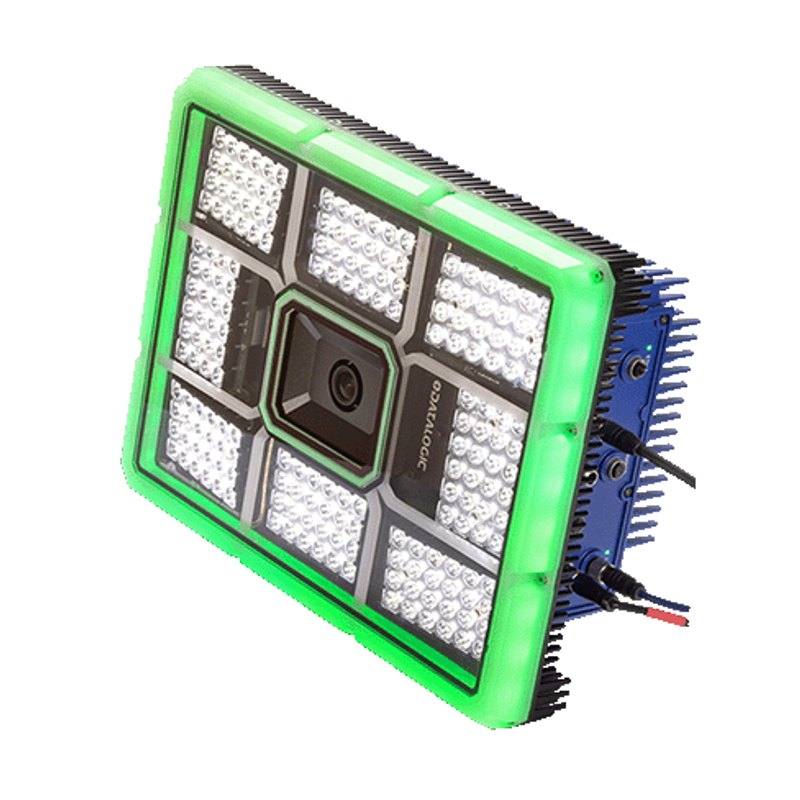
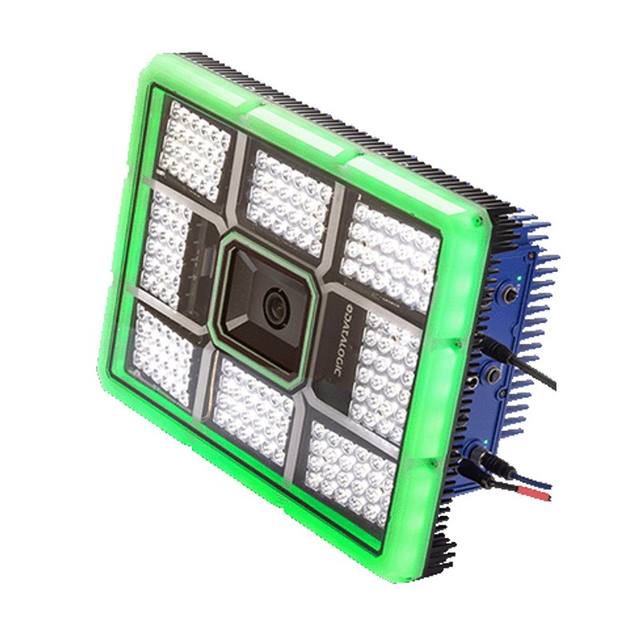
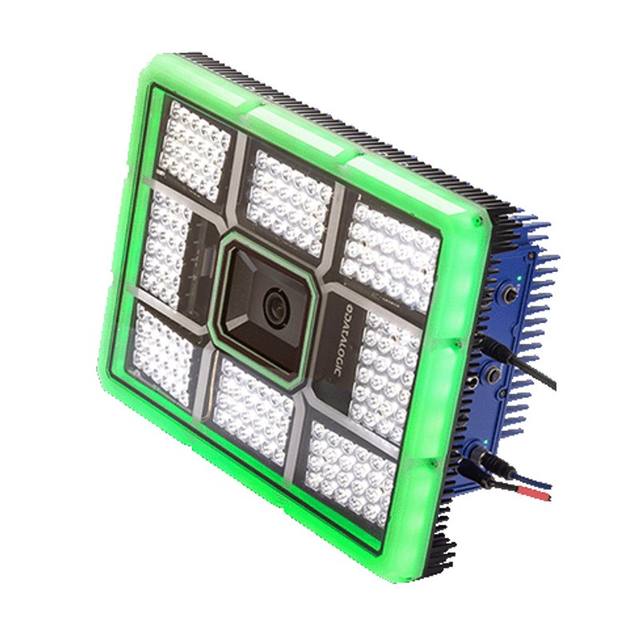
The 28 MP of the Matrix 930 do not make pixels finer across the belt: both the 830 and the 930 are 8000 px wide, so at the 1.2 m limit the pitch is the same 1200 mm ÷ 8000 = 0.15 mm. On those figures the extra megapixels are rows: 28,000,000 ÷ 8000 = 3500 rows, against 2000 on the 16 MP Matrix 830, which gives a view along the belt of about 3500 × 0.15 mm = 525 mm instead of 300 mm.
That longer view matters at speed: at 3.5 m/s a point on the belt crosses 525 mm in 525 mm ÷ 3500 mm/s = 150 ms, against ≈ 86 ms for 300 mm, so parcels stay in view longer for focus and decoding. The f/4 25 mm lens covers belts up to 1.2 m with one device, and PackTrack follows parcels with gaps as small as 100 mm.
Best for
Long labels or large codes that must fit entirely in one image: about 3500 × 0.15 mm ≈ 525 mm of belt is visible at the 1.2 m field.
Fast sorters running up to 3.5 m/s, where each parcel should stay in view long enough for focus and decoding.
Single-device coverage of belts up to 1.2 m wide with parcels separated by gaps as small as 100 mm.
Selection notes
If only the pitch across the belt matters, the 16 MP Matrix 830 25 mm gives the same 1200 ÷ 8000 = 0.15 mm at the 1.2 m field: the 930 buys view length and timing, not finer pixels.
The Matrix 930 35 mm covers 25 ÷ 35 ≈ 0.71 of this width at the same distance, and for the same belt it needs 35 ÷ 25 = 1.4 times the mounting height; the pitch across the belt depends on the field, not the lens.
Dynamic focus needs the optional integrated range sensor, so specify it when parcel heights vary.
Specifications: General
Brand
Datalogic
Reader type
Code reader
Form factor
Fixed-mount (mirror-free) high-resolution 2D imager for conveyors
Specifications: Sensor
Resolution
28 MP
Specifications: Interface
Communication
Two Ethernet TCP/IP + two serial interfaces; PROFINET or EtherNet/IP PLC integration; SyncNet high-speed camera network
Specifications: Optical
Focus
Patented dynamic focus via optional integrated range sensor; adjustable software focus; patented sequential focus
Field of view
Covers belts up to 1.2 m wide with a single device
Focal length
25 mm, f/4 (order code)
Specifications: Environment
Operating temperature
0 – 50 °C
IP rating
IP65
Specifications: Reading
Scan technology
2D image-based reader
This product groups every purchasable order code that shares the same sensing method, range and output. Cable length, connector type and operation mode (Light-ON/Dark-ON, NO/NC) vary by order code below.
Family variants with highlighted differences
Model
Availability
MATRIX930-254WPN0,28Mp,25MM,F/4,W Base
On request
MATRIX930-254WPR0,28Mp,25MM,F/4,W,RS
On request
MATRIX930-254WSN0,28Mp,25MM,F/4,W
On request
MATRIX930-254WSR0,28Mp,25MM,F/4,W,RS
On request
Applications this product is commonly selected for. Open one to see the full recommended hardware and approach.
1. Install the IMPACT Software Suite and connect the camera
Install the IMPACT Software Suite on your PC, which provides both the configuration/viewer tools and the SDK. For a GigE Vision model (E100, M or U series), connect it to a dedicated NIC and, for USB3 models, use a certified USB3 cable and port. Power the camera and confirm it enumerates.
2. Bring the camera online and verify the link
For GigE Vision, put the camera and the host NIC on the same subnet (a static IP on the camera matching the NIC range is the most reliable starting point); for USB3, confirm the device is recognized. Open the IMPACT viewer/device tool, discover the camera, and verify a stable connection before streaming. Enabling jumbo frames on the NIC helps GigE throughput.
3. Set exposure, gain and trigger, then grab a first image
In the IMPACT tools, start a live stream and adjust exposure and gain until the image is well-lit without saturation; set white balance on color models. Begin in free-run (continuous) mode to confirm imaging, then switch to hardware or software trigger as your application requires. Capture and save a reference image once the scene looks correct.
4. Build a vision tool or move to the SDK/API
Use the IMPACT point-and-click vision tools to assemble an inspection, or use the IMPACT SDK to access the camera and results programmatically and feed them into your HMI/PLC application. As these are GenICam/GenTL-compliant devices, you can alternatively drive them from any GenICam-compliant third-party vision library if your pipeline standardizes on one.
5. Route the stable feed to deep-learning inspection (optional)
Once you have a stable, repeatable image, the feed can be sent to a deep-learning inspection platform such as Rosepetal for defect detection or classification tasks that go beyond rule-based tooling. Keep lighting, optics and trigger timing fixed so the images reaching the model stay consistent.
Frequently asked questions
Yes, the family covers belts up to 1.2 m wide with a single device. At that field the pitch is 0.15 mm, so 2D modules need about 0.30 mm to get 2 px and 3 × 0.15 = 0.45 mm to get 3 px.
PROFINET or EtherNet/IP for the PLC, plus two Ethernet TCP/IP ports, two serial interfaces and SyncNet.
Camera Housing: Basler Camera housing ace 2 GigE, Basler Camera housing ace 2 USB / CXP / GMSL, Basler Camera housing ace USB, Basler Camera housing ace GigE