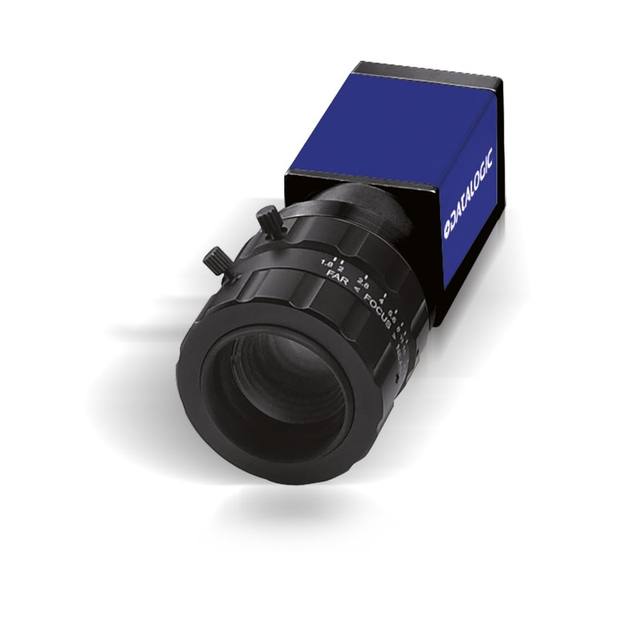
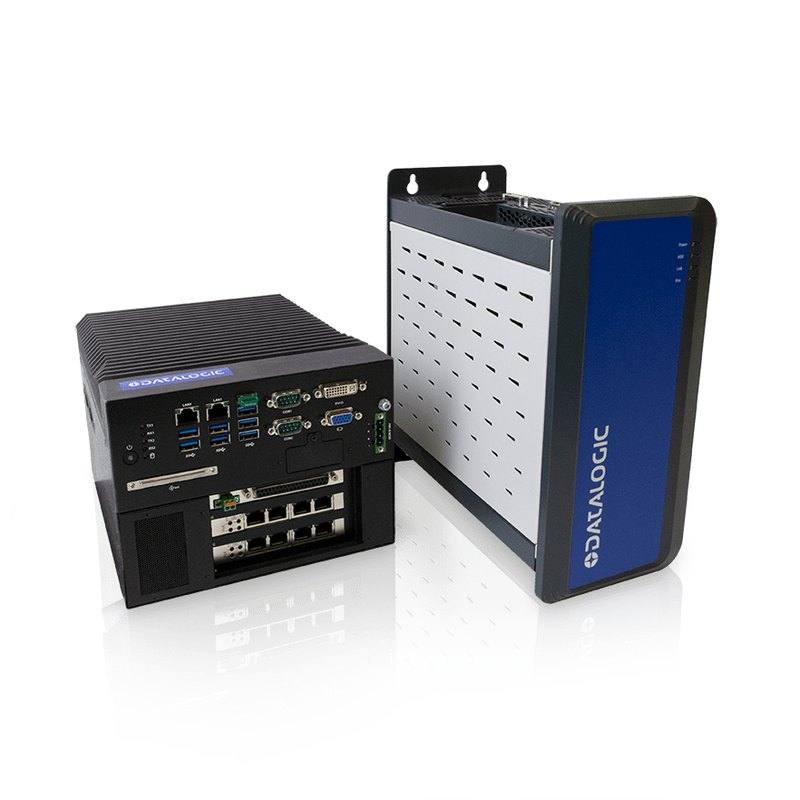
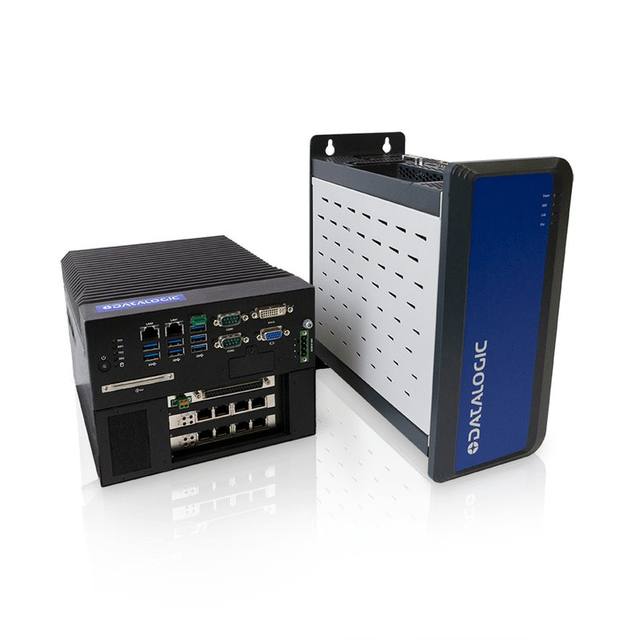
Datalogic MX-E90-8 — MX-E Series high-end vision processor: Intel® Core i7-7700T up to 3.80 Ghz - quad core, 32 GB system memory, 128 GB storage; 8 × 1000 Mbps Base-T PoE camera ports (PoE camera ports, up to 7 W per channel); 16 IN / 16 OUT, PNP or NPN, 200 µs response time; 2x LAN ports - 10/100/1000 Mbps Base-T; EtherNet/IP, Profinet, Modbus TCP and OPC; 2x RS-232 serial port; 16 IN / 16 OUT digital I/O; Windows 10 IoT Enterprise LTSC 2021; 24 ± 25% VDC; IP20. 1 order code.
Brand
Datalogic
On-board processing
Intel® Core i7-7700T up to 3.80 Ghz - quad core
On-board memory
32 GB system memory
Storage
128 GB
Camera ports
8 × 1000 Mbps Base-T PoE camera ports
Interface
GigE (1000 Mbps Base-T) camera ports with PoE
Trigger / GPIO
16 IN / 16 OUT, PNP or NPN, 200 µs response time
Communication
2x LAN ports - 10/100/1000 Mbps Base-T; EtherNet/IP, Profinet, Modbus TCP and OPC; 2x RS-232 serial port; 16 IN / 16 OUT digital I/O
Operating systems
Windows 10 IoT Enterprise LTSC 2021
Software / API
Configured with Datalogic IMPACT software (advanced algorithms); IMPACT Vision SDK
Eight camera ports make this the multi-camera version of MX-E90-2 and MX-E90-4: one controller for up to eight GigE cameras, each on its own 1000 Mbps link, with the same quad-core Core i7-7700T (up to 3.80 GHz) and 32 GB. The extra ports add no processing power, so eight cameras share four cores and the cycle time is set by the tools rather than the ports.
Plan power and bandwidth. Each port supplies up to 7 W, but do not assume all eight deliver that at once: check the unit's total PoE budget and each camera's PoE class against the cameras you plan to connect. At link speed the cameras would send up to 8 × 110 MB/s ≈ 880 MB/s of payload (typical), so keep them triggered rather than free-running.
Best for
Multi-station machines, such as a rotary table with several inspection positions, that put all cameras in one project.
Large objects covered by several cameras, where the images are judged together in one program.
Retrofit lines that replace several single-camera controllers with one unit and one network connection.
Selection notes
Check whether eight simultaneous analyses fit the cycle: if the tools are heavy, split the cameras across two controllers rather than loading one.
The I/O is shared: 16 inputs and 16 outputs for eight cameras, so count triggers and strobes before you commit.
Choose MX-E90-4 if four ports are enough; it has the same processor in the same size of housing.
Specifications: General
Brand
Datalogic
Specifications: Performance
On-board processing
Intel® Core i7-7700T up to 3.80 Ghz - quad core
On-board memory
32 GB system memory
Storage
128 GB
Specifications: Interface
Camera ports
8 × 1000 Mbps Base-T PoE camera ports
Interface
GigE (1000 Mbps Base-T) camera ports with PoE
Trigger / GPIO
16 IN / 16 OUT, PNP or NPN, 200 µs response time
Communication
2x LAN ports - 10/100/1000 Mbps Base-T; EtherNet/IP, Profinet, Modbus TCP and OPC; 2x RS-232 serial port; 16 IN / 16 OUT digital I/O
Specifications: Electrical
Power over cable (PoE / PoCXP / PoCL)
PoE camera ports, up to 7 W per channel
Supply voltage
24 ± 25% VDC
Specifications: Environment
IP rating
IP20
Specifications: Software
Operating systems
Windows 10 IoT Enterprise LTSC 2021
Software / API
Configured with Datalogic IMPACT software (advanced algorithms); IMPACT Vision SDK
Specifications: Mechanical
Dimensions
145 (H) x 192 (W) x 230 (D) mm / 5.7 (H) x 7.56 (W) x 9.05 (D) in
This product groups every purchasable order code that shares the same sensing method, range and output. Cable length, connector type and operation mode (Light-ON/Dark-ON, NO/NC) vary by order code below.
Family variants with highlighted differences
Model
Camera ports
Trigger / GPIO
Availability
Vision Processor, MX-E90, 8 ports, PNP/NPN, WIN10 Base
1. Install the IMPACT Software Suite and connect the camera
Install the IMPACT Software Suite on your PC, which provides both the configuration/viewer tools and the SDK. For a GigE Vision model (E100, M or U series), connect it to a dedicated NIC and, for USB3 models, use a certified USB3 cable and port. Power the camera and confirm it enumerates.
2. Bring the camera online and verify the link
For GigE Vision, put the camera and the host NIC on the same subnet (a static IP on the camera matching the NIC range is the most reliable starting point); for USB3, confirm the device is recognized. Open the IMPACT viewer/device tool, discover the camera, and verify a stable connection before streaming. Enabling jumbo frames on the NIC helps GigE throughput.
3. Set exposure, gain and trigger, then grab a first image
In the IMPACT tools, start a live stream and adjust exposure and gain until the image is well-lit without saturation; set white balance on color models. Begin in free-run (continuous) mode to confirm imaging, then switch to hardware or software trigger as your application requires. Capture and save a reference image once the scene looks correct.
4. Build a vision tool or move to the SDK/API
Use the IMPACT point-and-click vision tools to assemble an inspection, or use the IMPACT SDK to access the camera and results programmatically and feed them into your HMI/PLC application. As these are GenICam/GenTL-compliant devices, you can alternatively drive them from any GenICam-compliant third-party vision library if your pipeline standardizes on one.
5. Route the stable feed to deep-learning inspection (optional)
Once you have a stable, repeatable image, the feed can be sent to a deep-learning inspection platform such as Rosepetal for defect detection or classification tasks that go beyond rule-based tooling. Keep lighting, optics and trigger timing fixed so the images reaching the model stay consistent.
Frequently asked questions
The ports are independent, but the quad-core processor is shared. If each camera needs the same analysis, expect the total time to grow with the camera count.
Two LAN ports at 10/100/1000 Mbps for EtherNet/IP, Profinet, Modbus TCP and OPC, plus two RS-232 ports. They are separate from the camera ports, so control traffic does not compete with image traffic.