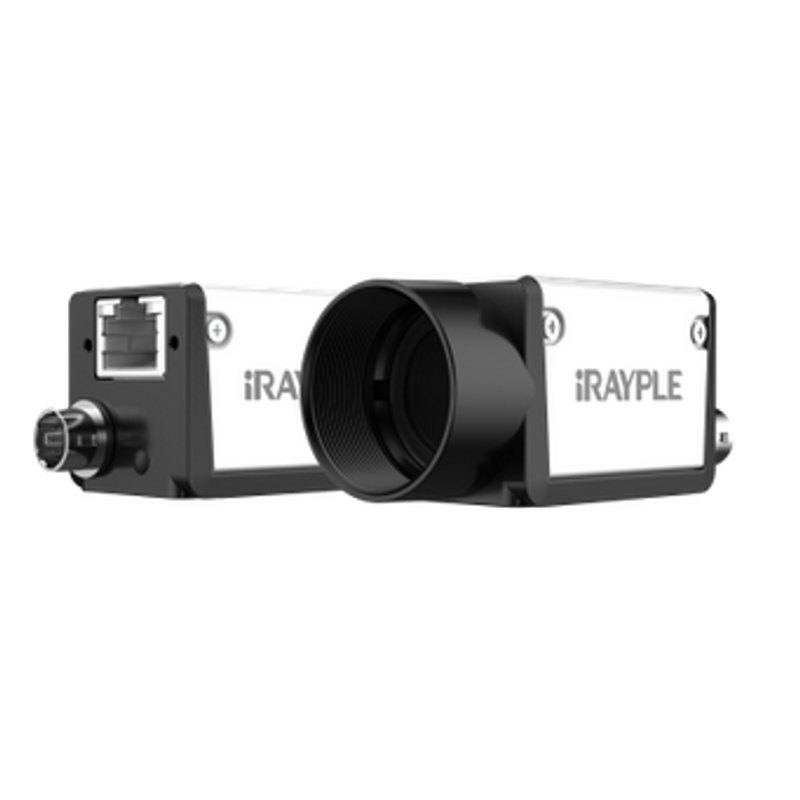
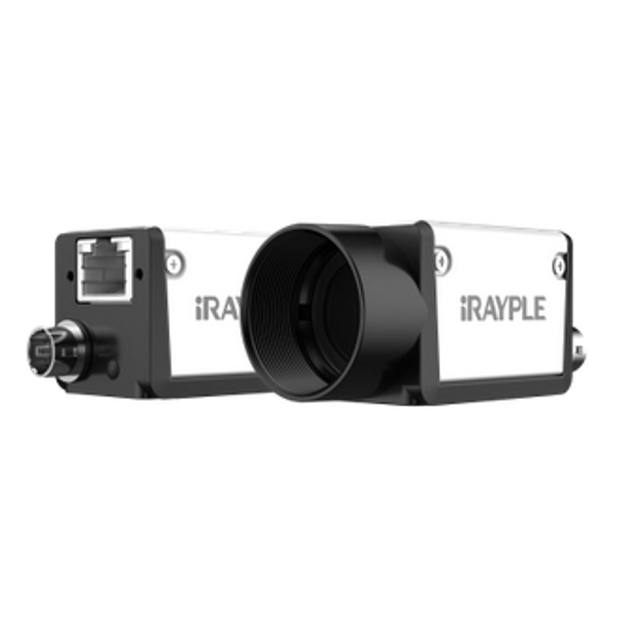
Area scan camera with a 2/3-inch Sony Pregius IMX264 global shutter CMOS sensor (3.45 um pixel). Outputs 2448 x 2048 (5.01 MP) at up to 20 fps over Gigabit Ethernet, conforming to GigE Vision V2.0 and GenICam. C-mount, PoE or DC 9-24V power, 256MB on-board cache.
The iRAYPLE A7500MG20E is a 5.01 MP monochrome area scan camera built around a 2/3-inch Sony Pregius IMX264 sensor with a 3.45 um pixel and a global shutter. The area scan format captures the full 2448 px-wide frame in a single exposure, making it suited to inspecting discrete parts and stationary or intermittently indexed scenes rather than continuous web material. The global shutter is the defining characteristic for moving subjects: every pixel starts and stops integrating light simultaneously, so fast-moving objects are recorded without the geometric skew or smear that a rolling shutter introduces. This keeps edges, printed characters and feature geometry faithful even when parts move past the field of view on a conveyor or indexing stage.
Being monochrome, the sensor dedicates every photosite to luminance rather than splitting incoming light across a colour filter array. This yields higher effective spatial resolution and better light sensitivity for a given pixel, which benefits contrast-driven tasks such as defect detection, character reading and edge measurement, where colour information is not required. The 2/3-inch optical format with a 3.45 um pixel sets the sensor's physical dimensions and informs lens selection, since the imaging circle and pixel pitch together determine the resolving power the optics must support.
Connectivity is over GigE Vision with GenICam, a widely adopted standard pairing that gives a long cable reach on standard Ethernet infrastructure and a uniform, vendor-neutral control interface that most machine-vision software can address. The 20 fps frame rate provides steady throughput for inline inspection at this resolution. Power-over-Ethernet support means a single Ethernet cable can carry both data and power, simplifying cabling and reducing the number of connectors at the camera. The C-mount provides a common, compact lens interface. The camera is also flagged as Rosepetal-ready, indicating compatibility with the Rosepetal vision platform for deployment of AI-based inspection workflows.
Best for
AI-based defect inspection of discrete parts, where high contrast monochrome capture and distortion-free global-shutter imaging feed deep-learning models reliably
Industrial OCR and OCV, reading and verifying printed, laser-marked or embossed codes and characters on moving or indexed parts
Packaging inspection, checking label presence, print quality, seal integrity and fill-level features on production lines
General automated optical inspection where 5.01 MP resolution captures fine detail across a moderately sized field of view
Inline inspection on conveyors and indexing stages, where global shutter prevents motion-induced distortion at moderate part speeds
Selection notes
Choose a C-mount lens whose image circle covers the 2/3-inch format and whose resolving power matches the 3.45 um pixel pitch; an under-specified lens will limit effective resolution regardless of sensor capability.
For a monochrome inspection of surface defects or print, plan lighting around contrast generation (e.g. directional, dome or backlight) rather than colour; monochrome benefits strongly from controlled, application-tuned illumination.
GigE Vision allows long cable runs on standard Ethernet, but use shielded industrial-grade cabling and a NIC or switch that supports the required bandwidth; if PoE is used, confirm the switch or injector supplies adequate power and the run length stays within Ethernet limits.
The global shutter makes this camera appropriate for moving parts; if the application images only stationary subjects with relaxed throughput, a rolling-shutter model may suffice and reduce cost.
If the inspection requires colour discrimination, a much higher pixel count, or a faster frame rate than this model provides, evaluate an alternative camera, since this is a monochrome 5.01 MP sensor running at 20 fps over GigE.
Specifications: General
Camera type
Area scan
Specifications: Sensor
Resolution
5.01 MP
Horizontal resolution
2448 px
Mono / color
Monochrome
Sensor manufacturer
Sony Pregius
Sensor model
IMX264
Shutter
Global shutter
Sensor size
2/3"
Pixel size
3.45 µm
Specifications: Performance
FPS
20 fps
Specifications: Interface
Interface
GigE Vision, PoE
Protocols
GigE Vision, GenICam
Specifications: Optics
Mount
C-mount
Specifications: Electrical
Power
PoE
Specifications: Commercial
Rosepetal-ready
Yes
This product groups every purchasable order code that shares the same sensing method, range and output. Cable length, connector type and operation mode (Light-ON/Dark-ON, NO/NC) vary by order code below.
Family variants with highlighted differences
Model
Mono / color
Interface
Availability
5.01 MP Monochrome GigE Vision Base
Monochrome
GigE Vision
On request
Applications this camera is commonly selected for. Open one to see the full recommended hardware and approach.
Follow these steps to bring up your iRAYPLE camera, capture a first image, and move from the viewer to your own application. The flow is the same across the A, AE, AX and L series; only the physical interface differs.
Download and install the iRAYPLE machine-vision SDK together with its viewer client for your operating system. The installer provides the camera drivers, the GenTL producer, and the viewer you will use for first light. For GigE Vision models, also install or enable the bundled filter/performance driver on the network adapter to maximize throughput.
2. Connect the camera to the correct interface
Wire the camera to its matching host interface: a dedicated Gigabit (or 10 GigE) NIC for GigE Vision models, a USB3 Vision port with a quality cable for USB3 models, or a frame grabber for CoaXPress models. Power the camera (PoE, USB bus power, or PoCXP / external supply as applicable). For GigE Vision, put the NIC and camera on the same subnet and, where supported, enable jumbo frames.
3. Detect and open the camera in the viewer
Launch the iRAYPLE viewer, run device enumeration, and select your camera from the discovered list. Open it to load the device feature tree (GenICam node map). If a GigE camera is found but cannot be opened, correct the IP configuration so the camera and NIC are in the same address range.
4. Set exposure, gain and trigger, then grab a first image
Start with continuous (free-run) acquisition under stable lighting. Adjust exposure time and gain for a well-exposed, low-noise image, set the pixel format (e.g. Mono8 or a Bayer/RGB format), and tune white balance on color models. Once the live image looks correct, switch trigger mode to hardware or software trigger to synchronize capture with your process, and verify a single triggered frame.
5. Move from the viewer to the SDK or a GenICam library
With imaging confirmed, reproduce the same settings in code using the SDK's C/C++ or Python API: enumerate, open, configure the relevant GenICam features, register a frame callback or grab loop, and convert frames to your pipeline's buffer format. Since the cameras are GenICam/GenTL-compliant, you can alternatively drive them from a third-party GenICam vision library. From here a stable image stream can feed a deep-learning inspection step such as Rosepetal for automated quality control.
Frequently asked questions
Yes. It uses a Sony Pregius IMX264 global shutter sensor, so all pixels are exposed simultaneously. This captures fast-moving objects without the skew or smear associated with rolling shutters, which is important for parts moving on conveyors or indexing stages.
It connects over GigE Vision (Gigabit Ethernet) and follows the GenICam standard for control. It also supports Power-over-Ethernet, so a single standard Ethernet cable can carry both image data and power, which simplifies wiring. Use shielded industrial Ethernet cabling and a PoE-capable switch or injector if powering over the network.
The camera delivers 5.01 MP at a horizontal resolution of 2448 px, running at up to 20 fps. This provides fine detail for inspection tasks while maintaining steady throughput on an inline production setup.
It is a monochrome camera. Every pixel captures luminance directly with no colour filter array, giving higher effective resolution and better light sensitivity for contrast-based tasks such as defect detection, character reading and edge measurement. It is not suited to applications that require colour discrimination.
It uses a C-mount and a 2/3-inch sensor with a 3.45 um pixel. Select a C-mount lens whose image circle covers the 2/3-inch format and whose resolution matches the pixel pitch to achieve the sensor's full resolving capability.