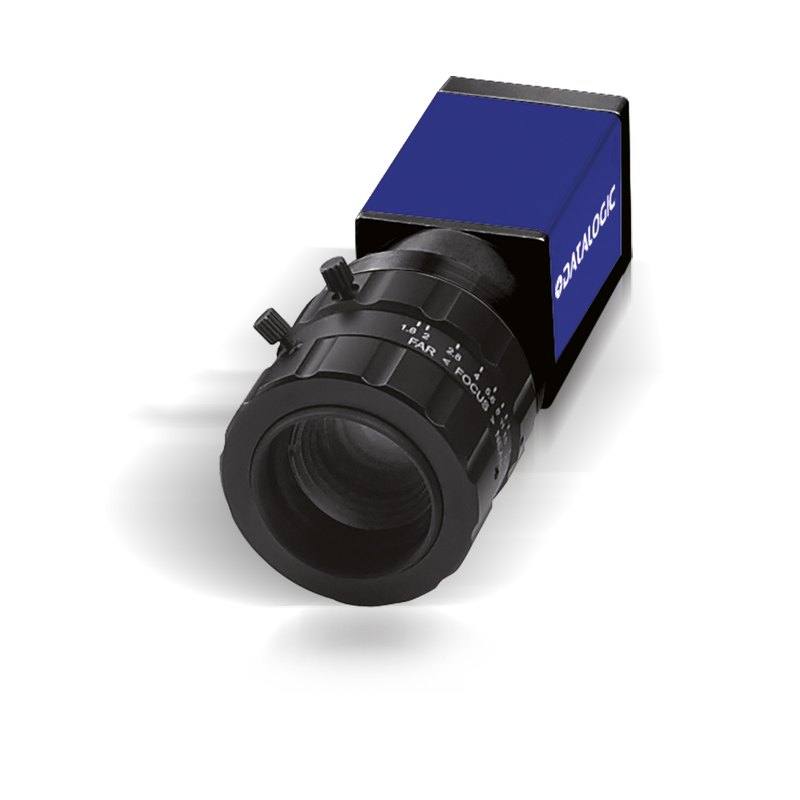
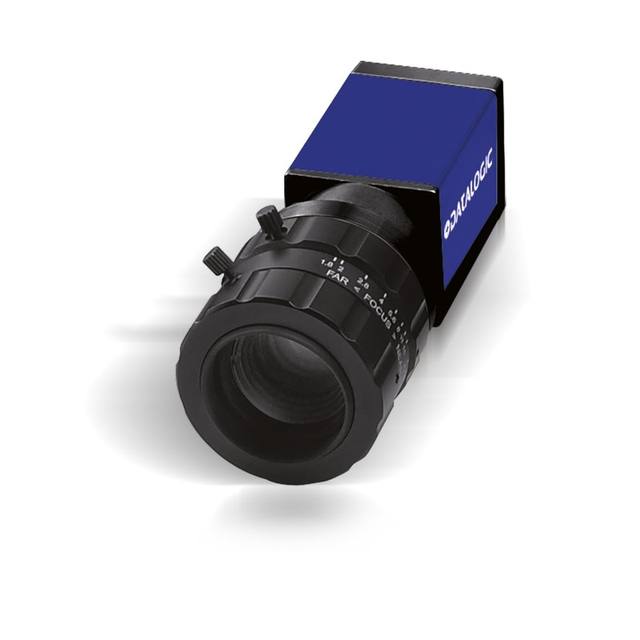
Compact GigE Vision area scan camera with 659 x 480 (0.3 MP) resolution, global shutter 1/4" CMOS sensor and 300 fps. C-mount, Power over Ethernet or 12-24 VDC supply, with trigger and strobe I/O. Part of the Datasensing E100 Series for use with MX-E vision processors.
The Datasensing E101 (CAM-E101-GE) is a compact monochrome area scan camera built around a 1/4-inch sensor with a 0.3 MP (659 px horizontal) resolution and a global shutter. As an area scan device, it captures a full two-dimensional frame in a single exposure, which makes it suited to inspecting discrete parts and fields of view rather than continuous web material. The global shutter is the defining characteristic here: every pixel starts and stops integrating light at the same instant, so moving objects are captured without the geometric skew or smear that a rolling shutter would introduce. Combined with a 300 fps frame rate, this lets the camera freeze fast-moving parts cleanly and sustain high inspection throughput.
Image data is delivered over a GigE Vision interface, with GenICam for standardised feature access, meaning the camera presents itself to any GigE Vision / GenICam-compliant software stack in a consistent, discoverable way. The Gigabit Ethernet link supports long cable runs on standard infrastructure, and Power over Ethernet allows image data and power to share a single cable, simplifying wiring on the line. The C-mount optical interface is a widely supported standard, giving access to a broad range of lenses appropriate for the small 1/4-inch sensor format and its 4.8 µm pixels.
Being monochrome, the sensor dedicates every pixel to luminance rather than splitting resolution across a colour filter array, which generally yields better light sensitivity and edge contrast for tasks where colour is not the discriminating feature. The modest 0.3 MP resolution keeps data volumes and processing load low, favouring speed and deterministic, low-latency capture over fine spatial detail. The camera is listed as Rosepetal-ready, indicating compatibility with that AI vision tooling.
Best for
High-speed presence/absence and defect checks on fast-moving production lines, where the 300 fps global shutter freezes motion without distortion
AI-based defect inspection on small parts or localised regions where a compact field of view at 0.3 MP is sufficient
Industrial OCR/OCV for reading codes, date/lot marks and printed text on moving products
Packaging inspection tasks such as label presence, fill-level and seal checks at line speed
Applications requiring monochrome contrast (surface flaws, edges, printed marks) rather than colour discrimination
Integration with Rosepetal AI tooling
Selection notes
Match the lens to the 1/4-inch sensor format and C-mount thread; a lens with a smaller image circle than the sensor will vignette, and the 4.8 µm pixels set the resolving limit, so choose a lens whose resolution comfortably exceeds the pixel pitch.
At 0.3 MP the spatial resolution is modest. Confirm your smallest defect or character spans enough pixels at the required working distance and field of view; if you need finer detail over the same field, a higher-resolution model is the better choice.
Plan lighting around the high frame rate: short exposures at 300 fps demand bright, stable illumination, and pairing strobed lighting with the camera helps freeze motion and maintain consistent exposure.
Use the GigE Vision link to your advantage for cabling: Gigabit Ethernet supports long runs on standard Cat cabling, and PoE lets a single cable carry both power and data; verify your switch or NIC supplies PoE.
For colour-dependent inspection, continuous-material/web scanning, or applications needing higher resolution, select a colour, line scan, or higher-megapixel camera instead of this monochrome 0.3 MP area scan unit.
Specifications: General
Camera type
Area scan
Specifications: Sensor
Resolution
0.3 MP
Horizontal resolution
659 px
Mono / color
Monochrome
Shutter
Global shutter
Sensor size
1/4"
Pixel size
4.8 µm
Specifications: Performance
FPS
300 fps
Specifications: Interface
Interface
GigE Vision, PoE
Protocols
GigE Vision, GenICam
Specifications: Optics
Mount
C-mount
Specifications: Electrical
Power
PoE
Specifications: Commercial
Rosepetal-ready
Yes
This product groups every purchasable order code that shares the same sensing method, range and output. Cable length, connector type and operation mode (Light-ON/Dark-ON, NO/NC) vary by order code below.
Family variants with highlighted differences
Model
Mono / color
Interface
Availability
0.3 MP Monochrome GigE Vision Base
Monochrome
GigE Vision
On request
Applications this camera is commonly selected for. Open one to see the full recommended hardware and approach.
1. Install the IMPACT Software Suite and connect the camera
Install the IMPACT Software Suite on your PC, which provides both the configuration/viewer tools and the SDK. For a GigE Vision model (E100, M or U series), connect it to a dedicated NIC and, for USB3 models, use a certified USB3 cable and port. Power the camera and confirm it enumerates.
2. Bring the camera online and verify the link
For GigE Vision, put the camera and the host NIC on the same subnet (a static IP on the camera matching the NIC range is the most reliable starting point); for USB3, confirm the device is recognized. Open the IMPACT viewer/device tool, discover the camera, and verify a stable connection before streaming. Enabling jumbo frames on the NIC helps GigE throughput.
3. Set exposure, gain and trigger, then grab a first image
In the IMPACT tools, start a live stream and adjust exposure and gain until the image is well-lit without saturation; set white balance on color models. Begin in free-run (continuous) mode to confirm imaging, then switch to hardware or software trigger as your application requires. Capture and save a reference image once the scene looks correct.
4. Build a vision tool or move to the SDK/API
Use the IMPACT point-and-click vision tools to assemble an inspection, or use the IMPACT SDK to access the camera and results programmatically and feed them into your HMI/PLC application. As these are GenICam/GenTL-compliant devices, you can alternatively drive them from any GenICam-compliant third-party vision library if your pipeline standardizes on one.
5. Route the stable feed to deep-learning inspection (optional)
Once you have a stable, repeatable image, the feed can be sent to a deep-learning inspection platform such as Rosepetal for defect detection or classification tasks that go beyond rule-based tooling. Keep lighting, optics and trigger timing fixed so the images reaching the model stay consistent.
Frequently asked questions
Yes. It uses a global shutter, so all pixels are exposed simultaneously. This freezes fast-moving objects without the skew or smear typical of rolling-shutter sensors, which is why it works well for high-speed inspection.
It connects over GigE Vision (Gigabit Ethernet) using the GenICam standard for software access. It is powered by Power over Ethernet, so a single Ethernet cable can carry both data and power.
It is a monochrome camera with a 0.3 MP resolution (659 px horizontal) on a 1/4-inch sensor with 4.8 µm pixels. It is optimised for speed and motion-freezing rather than fine spatial detail.
It runs at up to 300 fps, making it suitable for high-throughput, fast-moving applications such as AI defect inspection, industrial OCR/OCV and packaging inspection where motion must be frozen cleanly.
It uses a standard C-mount, so it accepts widely available C-mount lenses suited to the 1/4-inch format. It is listed as Rosepetal-ready.