Skip to content
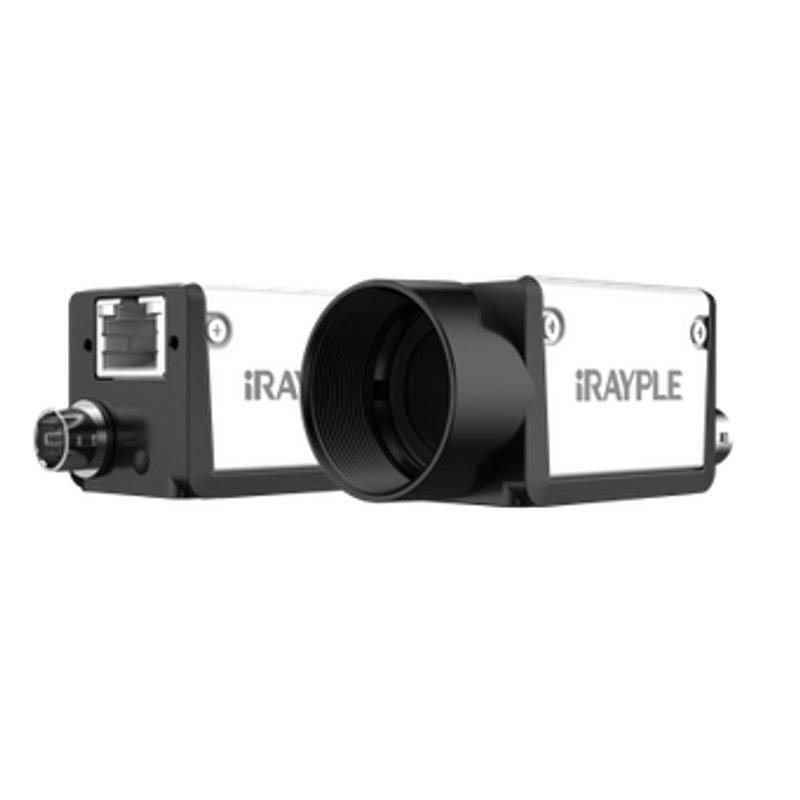
iRAYPLE A3A20MG8E / A3A20CG8E / A3A20CU24E (4000x3000, IMX226) machine vision camera
  • Rosepetal compatible
  • Recommended by AIS Vision

iRAYPLE A3A20 Series (12MP IMX226 GigE / USB3 Area Scan Camera)

A3A20MG8E

The iRAYPLE (Dahua Machine Vision) A3A20 series uses a 1/1.7" Sony IMX226 12MP CMOS rolling-shutter sensor with 1.85 µm pixels and 4000(H)x3000(V) resolution. The GigE models (A3A20MG8E mono, A3A20CG8E color) deliver 8 fps over a 1 Gbps Gigabit Ethernet interface with PoE or 6-26 V DC power via a 6-pin Hirose connector, comply with GigE Vision V2.0 and GenICam, and include a 128 MB on-board image buffer, opto-isolated GPIO, and a C-mount in a 29x29x42 mm, 88 g housing. The USB3.0 variant (A3A20CU24E) runs at 24 fps over a 5 Gbps USB3 Vision interface, is bus-powered, and ships in a compact 29x29x29 mm body. Onboard ISP functions include sharpness, denoising, gamma, LUT, black-level correction, target brightness and contrast, with software/hardware trigger and free-run modes.

Brand
iRAYPLE
Camera type
Area scan
Interface
GigE / PoE (A3A20MG8E, A3A20CG8E); USB3.0 (A3A20CU24E)
Resolution
12 MP
Horizontal resolution
4000 x 3000 px
Mono / color
Mono (A3A20MG8E) / Color (A3A20CG8E, A3A20CU24E)
Sensor manufacturer
sony_starvis (Sony IMX226, STARVIS BSI CMOS)
Sensor model
Sony IMX226
Shutter
Rolling shutter
FPS
8 fps (GigE) / 24 fps (USB3 A3A20CU24E)
Mount
C-mount
Sensor size
1/1.7 inch

Technical overview

The iRAYPLE A3A20 series is a 12-megapixel area-scan camera built on the 1/1.7-inch Sony IMX226 STARVIS BSI CMOS sensor, delivering a native 4000 x 3000 resolution with very small 1.85 µm pixels. That pixel pitch is the headline trade-off to understand: it packs 12 MP into a modest 1/1.7-inch optical format, so on the GigE/PoE models (A3A20MG8E mono, A3A20CG8E color) you get high spatial detail at 8 fps, while the USB3.0 variant (A3A20CU24E) pushes the same sensor to 24 fps over a 5 Gbps USB3 Vision link. The fine pixel size means resolving power per millimetre of field is excellent, but the small wells reward generous, controlled lighting rather than short exposures in dim conditions. With a C-mount and the 1/1.7-inch format, lens selection is straightforward, though to do the 4000 x 3000 grid justice you should pair it with a lens whose resolving power matches the fine 1.85 µm pixel pitch across the full image circle.

This is a rolling-shutter sensor, which is the single most important design-in fact. Rolling shutter is well suited to static or slow-moving scenes, web and surface inspection on indexed motion, and any setup where the part is stationary at the moment of capture. Fast lateral motion during exposure can introduce skew, so for moving lines you will want to stop the part, strobe the light, or keep object speed low relative to the exposure. The camera supports software trigger, hardware trigger, and free-run modes, and on the GigE models the opto-isolated GPIO lets you synchronise a hardware trigger to an encoder or sensor and fire a strobe controller in lockstep, which is the standard way to freeze motion and stabilise brightness on a rolling-shutter device. A 128 MB on-board image buffer on the GigE models absorbs burst acquisition and network back-pressure so frames are not dropped during transfer.

On the interface and integration side, the GigE models run over a 1 Gbps Gigabit Ethernet link with PoE or 6-26 V DC power through a 6-pin Hirose connector, comply with GigE Vision V2.0 and GenICam, and fit a 29 x 29 x 42 mm, 88 g housing drawing 3.4 W. GigE gives you long, inexpensive cable runs and single-cable PoE power, which suits distributed multi-camera cells. The USB3.0 model is bus-powered in a more compact 29 x 29 x 29 mm body and is the choice when you need the higher 24 fps frame rate at the cost of USB cable-length limits. Onboard ISP functions, sharpness, denoising, gamma, LUT, black-level correction, and target brightness and contrast, offload basic image conditioning from the host. The mono A3A20MG8E maximises sensitivity and per-pixel detail for measurement, OCR/OCV, and defect work, while the color A3A20CG8E/CU24E variants add color discrimination. The wide -30 to +50 °C operating range (under 95% RH) covers cold-store, ambient, and warm factory installations.

Best for

  • High-resolution defect and surface inspection of stationary or indexed parts in electronics, semiconductor, and printing, where the 4000 x 3000 grid resolves fine flaws
  • Dimensional measurement and metrology tasks that need many pixels across the field of view, using the mono A3A20MG8E for maximum per-pixel detail
  • Industrial OCR/OCV and printed-text or label verification where fine 1.85 µm pixels give ample sampling of small characters
  • Code and mark traceability reading on packaging and components, where the high pixel count provides margin on small or dense codes
  • Higher-throughput inspection using the USB3.0 A3A20CU24E at 24 fps where a short bus-powered cable run is acceptable

Selection notes

  • Confirm motion handling first: this is a rolling-shutter sensor, so freeze the part (stop-and-go indexing) or strobe the light for moving objects; continuous fast lateral motion can skew the image
  • Budget for light: the small 1.85 µm pixels in a 1/1.7-inch format favour generous, controlled illumination over long exposures, so plan lighting and a strobe controller to hold brightness stable
  • Choose the interface by throughput and cable length: GigE/PoE (8 fps) supports long single-cable runs and distributed cells, while USB3.0 (24 fps) is bus-powered but limited to short cable lengths
  • Match the lens to the sensor: use a C-mount lens with an image circle and resolving power adequate for the 1/1.7-inch format and 1.85 µm pixel pitch, or the camera will out-resolve the optics
  • Pick mono vs color deliberately: A3A20MG8E mono gives the best sensitivity and detail for measurement, OCR, and defect work; A3A20CG8E/CU24E color is for tasks needing color discrimination
  • Verify power and wiring on GigE: budget for PoE or 6-26 V DC via the 6-pin Hirose, the 3.4 W draw, and use the opto-isolated GPIO to tie hardware trigger and strobe to your line

Specifications: General
BrandiRAYPLE
Camera typeArea scan

Specifications: Sensor
Resolution12 MP
Horizontal resolution4000 x 3000 px
Mono / colorMono (A3A20MG8E) / Color (A3A20CG8E, A3A20CU24E)
Sensor manufacturersony_starvis (Sony IMX226, STARVIS BSI CMOS)
Sensor modelSony IMX226
ShutterRolling shutter
Sensor size1/1.7 inch
Pixel size1.85 x 1.85 µm

Specifications: Performance
FPS8 fps (GigE) / 24 fps (USB3 A3A20CU24E)

Specifications: Interface
InterfaceGigE / PoE (A3A20MG8E, A3A20CG8E); USB3.0 (A3A20CU24E)
ProtocolsGigE Vision V2.0 + GenICam (GigE); USB3 Vision + GenICam (USB3)

Specifications: Optics
MountC-mount

Specifications: Electrical
PowerPoE / 6-26 V DC via Hirose (GigE); USB bus power (USB3)
Power consumption3.4 W
Supply voltage6 ~ 26 V DC via Hirose, or PoE

Specifications: Environment
Operating temperature-30 °C ~ +50 °C, < 95% RH

Specifications: Mechanical
Dimensions29 x 29 x 42 mm (excl. lens mount and rear connectors)
Weight88 g

Frequently asked questions

Related technical guides

Rosepetal · AI

Test this camera with Rosepetal

Validate your visual inspection with AI: send us sample images and we evaluate the case on your hardware.

AIS Vision · Integration

We validate camera + lens + lighting

AIS Vision defines and tests the optimal combination of camera, optics and lighting for your application before you buy.