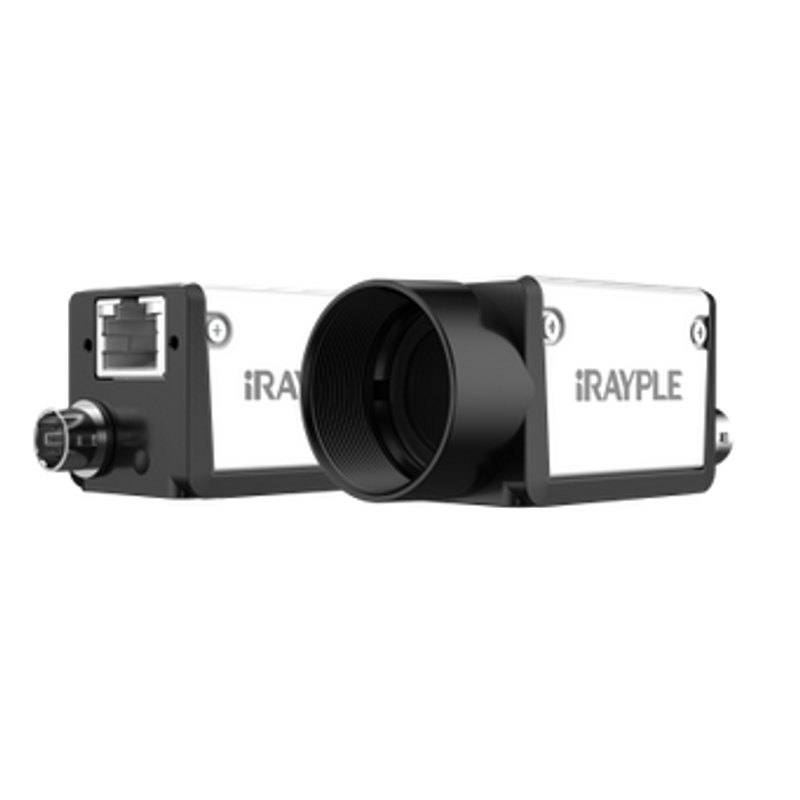
iRAYPLE A7160 Series 1.6MP Area Scan Camera (IMX273/IMX296)
A7160MG000E
The A7160 family uses a 1/2.9" Sony Pregius global-shutter CMOS sensor (IMX273 on -G000E/-CU000E, IMX296 on -G001E) at 1440x1080 (1.6MP) with 3.45um square pixels, 12-bit depth, 38 dB SNR and 70 dB dynamic range. GigE models (A7160MG000E/CG000E mono/color) run at 77 fps over Gigabit Ethernet with PoE or DC 9-24V power, while the USB3.0 model (A7160CU000E) reaches 249 fps; the IMX296 variant (A7160MG001E) runs at 65 fps. All models use a C-mount, conform to GigE Vision V2.0 / GenICam (or USB3 Vision) and CE/FCC/RoHS, and provide a 6-pin Hirose opto-isolated GPIO with on-board image buffer (64MB on the camera, up to 128MB transmission cache on GigE).
Brand
iRAYPLE
Camera type
Area scan
Interface
GigE / PoE (GigE & USB3.0 variants; A7160CU000E is USB3.0)
Resolution
1.6 MP
Horizontal resolution
1440 x 1080 px
Mono / color
Mono and Color variants (MG = mono, CG/CU = color)
Sensor manufacturer
Sony Pregius
Sensor model
Sony IMX273 (IMX296 on A7160MG001E)
Shutter
Global shutter
FPS
77 fps (GigE); up to 249 fps (USB3 A7160CU000E); 65 fps (IMX296 A7160MG001E)
The iRAYPLE A7160 is a compact 1.6 MP area scan camera built around a 1/2.9-inch Sony Pregius global-shutter CMOS sensor (IMX273 on the -MG000E/-CG000E/-CU000E variants, IMX296 on the -MG001E). At 1440 x 1080 pixels on 3.45 um square pixels, it delivers a modest resolution that is deliberately matched to fast, geometrically clean imaging rather than fine-detail capture. The defining trait here is the global shutter: every pixel is exposed simultaneously, so parts moving on a conveyor or under a moving robot arm are frozen without the skew or smear that a rolling shutter introduces. Combined with 12-bit depth, 38 dB SNR and 70 dB dynamic range, that makes the A7160 a dependable choice when image geometry has to stay trustworthy for measurement or code reading.
Interface and frame rate are where the variant you choose really matters. The mainstream GigE models (A7160MG000E mono and A7160CG000E color) run at 77 fps over Gigabit Ethernet, conform to GigE Vision V2.0 and GenICam, and can be powered over PoE or from DC 9-24 V through the Hirose connector. That single-cable PoE option keeps multi-camera cells tidy and lets installers place the controller away from the line. The USB3.0 variant (A7160CU000E) trades the GigE link for speed, reaching 249 fps over a USB3 Vision interface, while the IMX296-based A7160MG001E runs at 65 fps. An on-board 64 MB image buffer (with up to 128 MB transmission cache on the GigE models) absorbs network or host hiccups so frames are not dropped during burst acquisition.
Mechanically the camera is a 29 x 29 x 42 mm, 88 g C-mount block drawing only 3.6 W, with a wide -30 to +50 degC operating range that suits enclosed machine cabinets and cooler factory environments. The C-mount opens up the broad ecosystem of standard machine-vision lenses sized for the 1/2.9-inch format. A 6-pin Hirose opto-isolated GPIO provides the trigger-in and strobe-out lines needed to synchronize the camera with an external lighting controller, so exposure can be locked to a part-present sensor and a strobe pulse. Choosing the mono variant (MG) maximizes sensitivity and sharpness for measurement, OCR and code reading; the color variants (CG/CU) add a Bayer color filter where part color or print color is part of the inspection.
Best for
High-speed defect inspection on moving conveyors where the global shutter freezes motion without skew
Reading 1D/2D codes and DPM marks for traceability on fast-indexing lines
Industrial OCR/OCV of printed lot codes, dates and labels using the mono sensor's sharpness
Robot guidance and pick-and-place where geometrically accurate, low-latency frames are required
2D dimensional measurement of small to mid-size parts where global-shutter geometry must stay trustworthy
Selection notes
Pick the interface to match the task: GigE/PoE (A7160MG000E/CG000E) at 77 fps for distributed, single-cable cells, or USB3.0 (A7160CU000E) at 249 fps for very fast, short-cable inspection.
At 1.6 MP (1440 x 1080) this camera prioritizes speed and clean geometry over pixel count; for fine-detail or large field-of-view inspection a higher-resolution model is the better fit.
The C-mount and 1/2.9-inch sensor format dictate lens choice: size the lens for this format and the 3.45 um pixels so the optics resolve to the sensor and you get the field of view and working distance the task needs.
Use the 6-pin Hirose opto-isolated GPIO to hardware-trigger the camera from a part-present sensor and to strobe the lighting, ensuring repeatable exposure on moving parts.
Choose mono (MG) for maximum sensitivity and resolution in measurement, OCR and code reading, or color (CG/CU) only when part or print color is part of the decision; note the IMX296 variant (MG001E) runs slower at 65 fps.
Specifications: General
Brand
iRAYPLE
Camera type
Area scan
Specifications: Sensor
Resolution
1.6 MP
Horizontal resolution
1440 x 1080 px
Mono / color
Mono and Color variants (MG = mono, CG/CU = color)
Sensor manufacturer
Sony Pregius
Sensor model
Sony IMX273 (IMX296 on A7160MG001E)
Shutter
Global shutter
Sensor size
1/2.9" CMOS
Pixel size
3.45 x 3.45 um
Specifications: Performance
FPS
77 fps (GigE); up to 249 fps (USB3 A7160CU000E); 65 fps (IMX296 A7160MG001E)
Specifications: Interface
Interface
GigE / PoE (GigE & USB3.0 variants; A7160CU000E is USB3.0)
Protocols
GigE Vision V2.0, GenICam (USB3 Vision on A7160CU000E)
Specifications: Optics
Mount
C-mount
Specifications: Electrical
Power
PoE / DC 9-24V via Hirose (USB power on A7160CU000E)
Power consumption
3.6 W
Specifications: Environment
Operating temperature
-30 to +50 degC
Specifications: Mechanical
Dimensions
29 x 29 x 42 (excl. lens mount & connector) mm
Weight
88 g
Applications this camera is commonly selected for. Open one to see the full recommended hardware and approach.
Follow these steps to bring up your iRAYPLE camera, capture a first image, and move from the viewer to your own application. The flow is the same across the A, AE, AX and L series; only the physical interface differs.
Download and install the iRAYPLE machine-vision SDK together with its viewer client for your operating system. The installer provides the camera drivers, the GenTL producer, and the viewer you will use for first light. For GigE Vision models, also install or enable the bundled filter/performance driver on the network adapter to maximize throughput.
2. Connect the camera to the correct interface
Wire the camera to its matching host interface: a dedicated Gigabit (or 10 GigE) NIC for GigE Vision models, a USB3 Vision port with a quality cable for USB3 models, or a frame grabber for CoaXPress models. Power the camera (PoE, USB bus power, or PoCXP / external supply as applicable). For GigE Vision, put the NIC and camera on the same subnet and, where supported, enable jumbo frames.
3. Detect and open the camera in the viewer
Launch the iRAYPLE viewer, run device enumeration, and select your camera from the discovered list. Open it to load the device feature tree (GenICam node map). If a GigE camera is found but cannot be opened, correct the IP configuration so the camera and NIC are in the same address range.
4. Set exposure, gain and trigger, then grab a first image
Start with continuous (free-run) acquisition under stable lighting. Adjust exposure time and gain for a well-exposed, low-noise image, set the pixel format (e.g. Mono8 or a Bayer/RGB format), and tune white balance on color models. Once the live image looks correct, switch trigger mode to hardware or software trigger to synchronize capture with your process, and verify a single triggered frame.
5. Move from the viewer to the SDK or a GenICam library
With imaging confirmed, reproduce the same settings in code using the SDK's C/C++ or Python API: enumerate, open, configure the relevant GenICam features, register a frame callback or grab loop, and convert frames to your pipeline's buffer format. Since the cameras are GenICam/GenTL-compliant, you can alternatively drive them from a third-party GenICam vision library. From here a stable image stream can feed a deep-learning inspection step such as Rosepetal for automated quality control.
Frequently asked questions
It uses a global shutter. The Sony Pregius IMX273 (or IMX296) sensor exposes all pixels simultaneously, freezing moving parts without the skew or smear a rolling shutter would produce.
It is a 1.6 MP camera at 1440 x 1080 pixels on a 1/2.9-inch Sony Pregius global-shutter CMOS sensor (IMX273 on most variants, IMX296 on the A7160MG001E) with 3.45 um square pixels, 12-bit depth, 38 dB SNR and 70 dB dynamic range.
The GigE models run at 77 fps, the USB3.0 model (A7160CU000E) reaches up to 249 fps, and the IMX296-based A7160MG001E runs at 65 fps.
GigE models conform to GigE Vision V2.0 / GenICam and can be powered over PoE or DC 9-24 V via the Hirose connector. The A7160CU000E uses a USB3 Vision interface with USB power. All models provide a 6-pin Hirose opto-isolated GPIO for trigger and strobe.
It uses a standard C-mount lens interface. Mono variants (MG) suit measurement, OCR and code reading, while color variants (CG/CU) add a Bayer color filter for applications where part or print color matters.