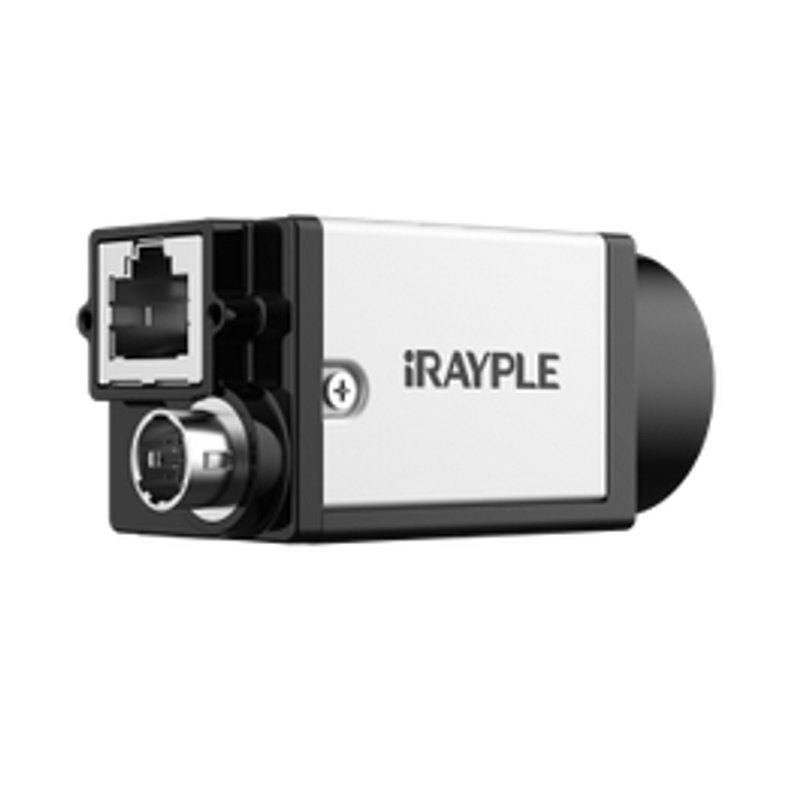
The iRAYPLE AE3A20MG010E (mono) and AE3A20CG010E (color) are AE-series area scan cameras using the Sony IMX226 1/1.7" CMOS sensor at 4000x3000 (12.0 MP), 1.85 µm pixels, delivering 10 fps over a Gigabit Ethernet interface with PoE support and up to 100 m cable runs. The camera conforms to GigE Vision V2.0 and the GenICam standard, includes a 256 MB on-board image buffer, and supports software/hardware trigger and free-run modes. It uses a C-mount, is powered via PoE or DC 9-24 V through a Hirose connector, and provides 1 optically isolated input and 1 optically isolated output on a 6-pin GPIO. The sensor offers a 12-bit ADC, ~38 dB SNR and ~60 dB dynamic range, in a 29x29x42 mm body weighing ~88 g.
Brand
iRAYPLE
Camera type
Area scan
Interface
GigE (1000 Mbps) with PoE
Resolution
12.0 MP
Horizontal resolution
4000 x 3000 px
Mono / color
Mono (MG) / Color (CG)
Sensor manufacturer
sony (Sony STARVIS/Exmor R, not Pregius); display 'Sony (IMX226 CMOS, STARVIS)'
The iRAYPLE AE3A20MG010E is a 12-megapixel area-scan camera built around the Sony IMX226, a 1/1.7-inch CMOS sensor that delivers a 4000 x 3000 pixel image through tiny 1.85 um pixels. That combination is the defining trade-off of this camera: you get a high static pixel count for resolving fine detail, but on a physically small sensor with a rolling shutter rated at 10 fps at full resolution. For an installer this means the AE3A20MG010E is squarely a high-resolution, low-motion tool. It excels when the part is stationary (or indexed and stopped) under the camera and you need to resolve small features, read dense print, or take precise dimensional measurements across a wide field. Because the shutter is rolling rather than global, fast lateral motion will smear or skew, so plan to image parts at rest or use bright strobed lighting to freeze them. The IMX226 is a back-illuminated STARVIS-class sensor, which favors light sensitivity; it pairs a 12-bit ADC with roughly 38 dB SNR and about 60 dB dynamic range, giving you headroom to hold both bright and shadowed regions in a single frame on contrast-rich surfaces.
On the connectivity side this is a GigE Vision V2.0 / GenICam camera on a Gigabit Ethernet (1000 Mbps) interface with PoE, so a single cable carries both data and power up to 100 m. That long, single-cable reach and standards compliance make it easy to drop into existing GigE Vision toolchains and to mount the camera far from the PC or PLC cabinet. The 256 MB on-board image buffer matters here: at 12 MP the per-frame payload is large for a 1 Gbps link, and the buffer absorbs bursts so frames are not dropped while the network drains them. The camera also supports software trigger, hardware trigger, and free-run, which lets you slave acquisition to an encoder, photo-eye, or PLC strobe so each capture lands on a part in position. Power can come from PoE or DC 9-24 V through a Hirose connector, and the 6-pin GPIO provides one optically isolated input and one optically isolated output for clean trigger-in and strobe/result-out wiring without ground loops.
Mechanically the camera uses a C-mount and a compact 29 x 29 x 42 mm body weighing about 88 g, drawing only 3.5 W, so it fits tight inspection stations and lightweight gantries and adds little thermal load. The C-mount and 1/1.7-inch format mean lens selection should target that sensor size and the 1.85 um pixel pitch; a lens that out-resolves the pixel (high MTF at the relevant line pairs) is needed to actually realize the 12 MP, and you should verify the lens covers the full diagonal without vignetting. The AE3A20MG010E ships in monochrome (MG) and the AE3A20CG010E in color (CG): mono gives maximum sensitivity and per-pixel sharpness for gauging, defect detection, and code reading, while color is the choice when hue or print color is the discriminating feature. Rated for 0 to +50 C operation, it suits typical factory enclosures but not high-temperature ovens or unconditioned outdoor cabinets.
Best for
High-resolution defect and surface inspection of stationary or indexed parts where the 12 MP (4000 x 3000) frame must resolve small flaws across a wide field of view
Dimensional measurement and gauging on stopped parts, using the high static pixel count and 12-bit depth for sub-pixel edge metrology
Industrial OCR/OCV reading of dense date codes, labels, and printed text where fine character detail benefits from 12 MP and monochrome sharpness
2D code and traceability mark verification on electronics, semiconductor, and battery components held still under strobed lighting
Standards-based GigE Vision installs needing a single-cable PoE run up to 100 m from a remote or hard-to-reach inspection station
Selection notes
The rolling shutter and 10 fps full-resolution rate make this a low-motion camera: image parts at rest, index-and-stop, or freeze motion with a bright strobe to avoid the skew/smear a rolling shutter produces on moving objects.
Pair with a C-mount lens rated for the 1/1.7-inch format and the 1.85 um pixel pitch; a lens with sufficient MTF at the pixel's line-pair frequency is required to actually realize 12 MP, and it must cover the full sensor diagonal without vignetting.
The 12 MP payload is large for a 1 Gbps GigE link; rely on the 256 MB on-board buffer and a quality PoE-capable switch/NIC, and budget for the long cable run (up to 100 m) when planning network topology.
Drive acquisition through the hardware trigger and route a strobe via the optically isolated GPIO (1 isolated input, 1 isolated output on the 6-pin connector) so each 12 MP frame lands on a part in position and lighting fires only during exposure.
Choose MG (mono) for maximum sensitivity and per-pixel detail in gauging, defect detection, and code reading; choose CG (color) only when hue or print color is the feature being judged. Confirm the 0 to +50 C operating range covers your enclosure and that PoE or DC 9-24 V (Hirose) power is available.
Specifications: General
Brand
iRAYPLE
Camera type
Area scan
Specifications: Sensor
Resolution
12.0 MP
Horizontal resolution
4000 x 3000 px
Mono / color
Mono (MG) / Color (CG)
Sensor manufacturer
sony (Sony STARVIS/Exmor R, not Pregius); display 'Sony (IMX226 CMOS, STARVIS)'
Sensor model
Sony IMX226
Shutter
Rolling shutter
Sensor size
1/1.7" CMOS
Pixel size
1.85 µm x 1.85 µm
Specifications: Performance
FPS
10 fps at full resolution
Specifications: Interface
Interface
GigE (1000 Mbps) with PoE
Protocols
GigE Vision V2.0, GenICam
Specifications: Optics
Mount
C-mount
Specifications: Electrical
Power
PoE or DC 9-24 V (Hirose)
Power consumption
3.5 W
Specifications: Environment
Operating temperature
0 to +50 °C
Specifications: Mechanical
Dimensions
29 x 29 x 42 mm
Weight
88 g
Applications this camera is commonly selected for. Open one to see the full recommended hardware and approach.
Follow these steps to bring up your iRAYPLE camera, capture a first image, and move from the viewer to your own application. The flow is the same across the A, AE, AX and L series; only the physical interface differs.
Download and install the iRAYPLE machine-vision SDK together with its viewer client for your operating system. The installer provides the camera drivers, the GenTL producer, and the viewer you will use for first light. For GigE Vision models, also install or enable the bundled filter/performance driver on the network adapter to maximize throughput.
2. Connect the camera to the correct interface
Wire the camera to its matching host interface: a dedicated Gigabit (or 10 GigE) NIC for GigE Vision models, a USB3 Vision port with a quality cable for USB3 models, or a frame grabber for CoaXPress models. Power the camera (PoE, USB bus power, or PoCXP / external supply as applicable). For GigE Vision, put the NIC and camera on the same subnet and, where supported, enable jumbo frames.
3. Detect and open the camera in the viewer
Launch the iRAYPLE viewer, run device enumeration, and select your camera from the discovered list. Open it to load the device feature tree (GenICam node map). If a GigE camera is found but cannot be opened, correct the IP configuration so the camera and NIC are in the same address range.
4. Set exposure, gain and trigger, then grab a first image
Start with continuous (free-run) acquisition under stable lighting. Adjust exposure time and gain for a well-exposed, low-noise image, set the pixel format (e.g. Mono8 or a Bayer/RGB format), and tune white balance on color models. Once the live image looks correct, switch trigger mode to hardware or software trigger to synchronize capture with your process, and verify a single triggered frame.
5. Move from the viewer to the SDK or a GenICam library
With imaging confirmed, reproduce the same settings in code using the SDK's C/C++ or Python API: enumerate, open, configure the relevant GenICam features, register a frame callback or grab loop, and convert frames to your pipeline's buffer format. Since the cameras are GenICam/GenTL-compliant, you can alternatively drive them from a third-party GenICam vision library. From here a stable image stream can feed a deep-learning inspection step such as Rosepetal for automated quality control.
Frequently asked questions
It uses the Sony IMX226, a 1/1.7-inch CMOS sensor with 1.85 um pixels, delivering 4000 x 3000 pixels (12.0 MP) at full resolution.
The camera runs at 10 fps at full resolution and uses a rolling shutter, so it is best suited to stationary or indexed parts, or motion frozen by strobed lighting rather than fast continuous motion.
It is a GigE Vision V2.0 / GenICam camera on a Gigabit Ethernet (1000 Mbps) interface with PoE, supporting cable runs up to 100 m. Power comes from PoE or DC 9-24 V via a Hirose connector, and it has a 256 MB on-board image buffer and draws 3.5 W.
It supports software trigger, hardware trigger, and free-run modes. The 6-pin GPIO provides 1 optically isolated input and 1 optically isolated output for clean trigger-in and strobe/result-out wiring.
Yes; the AE3A20MG010E is monochrome (MG) and the AE3A20CG010E is the color (CG) variant. Both use a C-mount in a 29 x 29 x 42 mm, ~88 g body rated for 0 to +50 C operation.