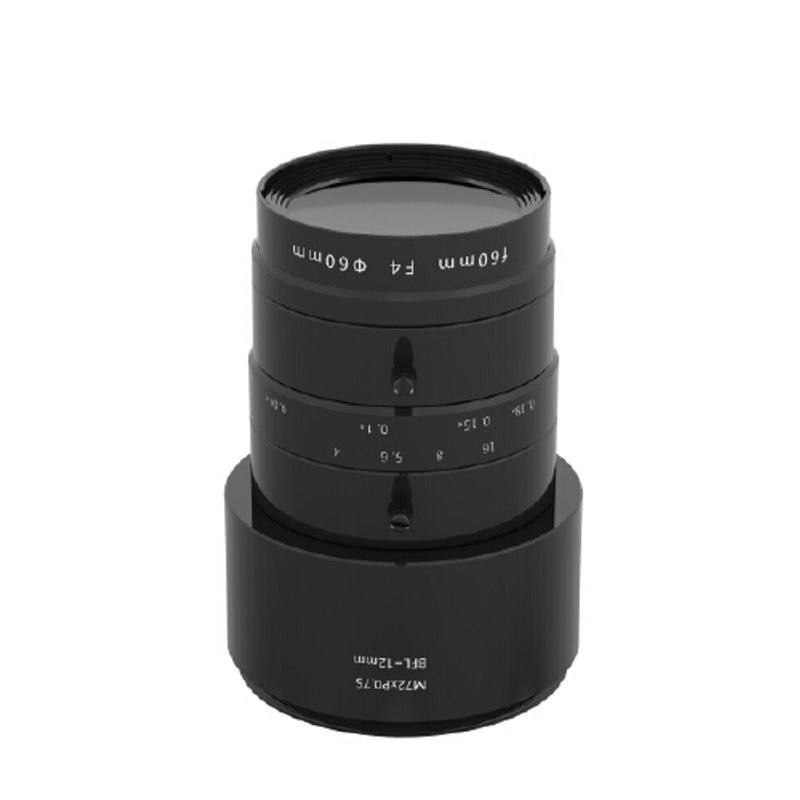
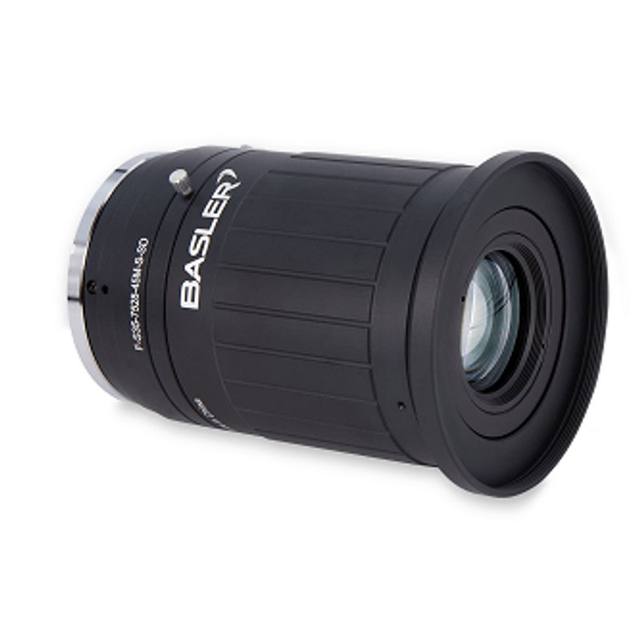
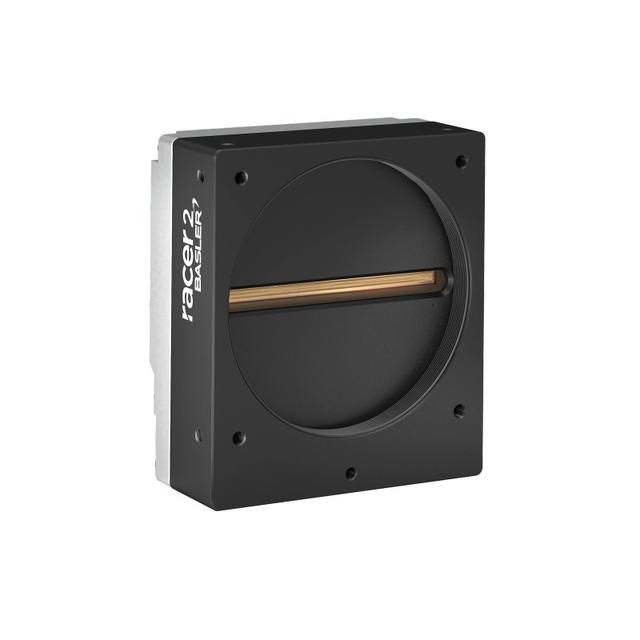
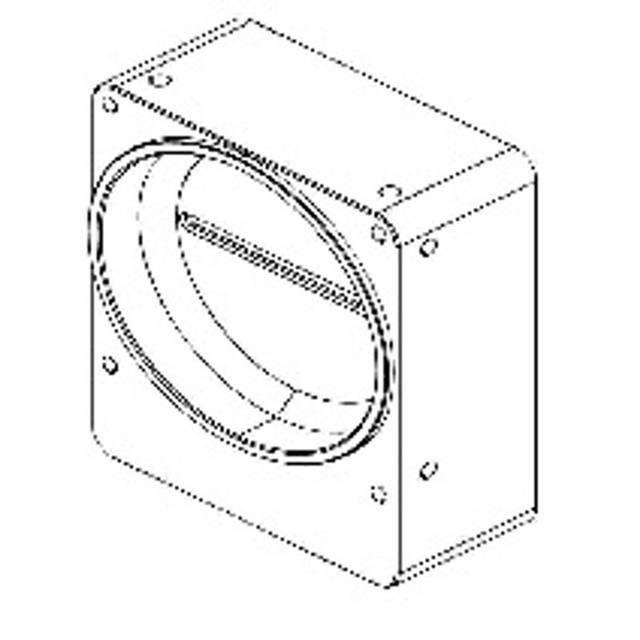
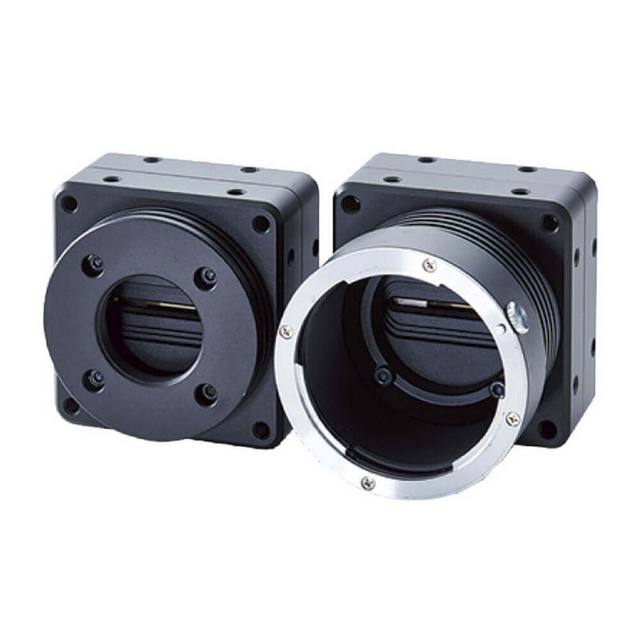
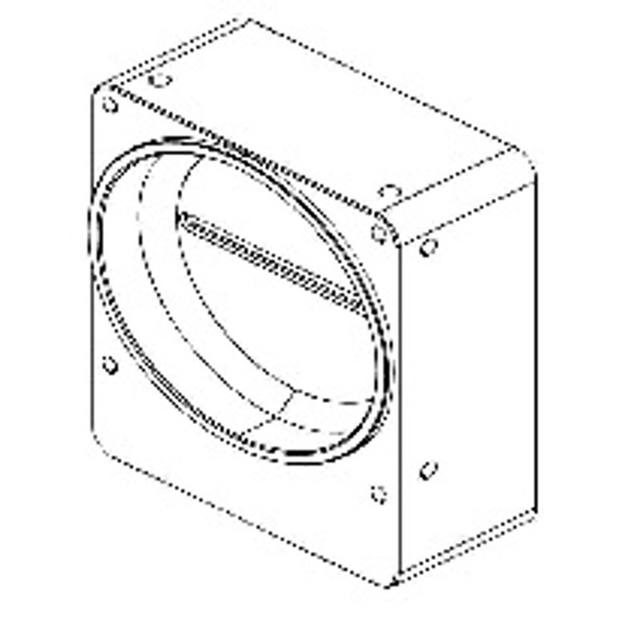
The F60-6040B-M72 is part of iRAYPLE's 8K Line Scan Lens series, supporting a maximum image circle of Ф60mm and matched to 8K line scan cameras with 7 µm pixel size. It offers an M72×P0.75 thread mount, an aperture range of F4.0 to F16 with manual iris control, and a working distance of 0.205m to 0.425m. Optical distortion is rated below 0.2%, with a 41.3° field of view and spectral coverage from 435nm to 700nm.
The iRAYPLE F60-6040B-M72 is a 60mm fixed focal length line scan lens engineered specifically for 8K resolution line scan cameras equipped with 7 µm pixel pitch sensors. Its M72×P0.75 thread mount and Φ60mm image circle are sized to cover the full linear sensor length of an 8K array, which at 7 µm pitch spans approximately 57.3mm — leaving sufficient margin for corner illumination without vignetting. The aperture range of F4.0 to F16 with manual iris control gives integrators meaningful control over depth of field and exposure: F4.0 delivers maximum light throughput for fast-moving webs or low-reflectance surfaces, while stopping down to F11–F16 can tighten depth of field on curved or uneven substrates. Optical distortion is rated below 0.2%, which at 8K resolution (where one pixel represents a very small physical increment at typical working distances) is essential for dimensional measurement accuracy and for stitching inspection zones on wide panels.
Working distance is adjustable between 205mm and 425mm, giving installers flexibility to set the camera standoff to match conveyor guarding, enclosure depth, or field of view requirements without changing lenses. At these distances, a 41.3° field of view provides a practical scan width of approximately 155mm at the minimum standoff to approximately 320mm at the maximum standoff, suited to inspecting panels, films, and sheets across that range. Spectral coverage from 435nm to 700nm spans the full visible range used by most machine vision monochrome and color line scan cameras, and the coating is compatible with standard broadband or structured illumination without a dedicated filter requirement. At 637g and 102.85mm body length with a 76mm barrel diameter, the lens is substantial but well within the handling envelope of standard line scan mounting stages.
For installers planning a complete optical chain, the non-telecentric design means that lateral magnification will shift slightly as working distance changes, so rigid mechanical fixturing is necessary to maintain consistent pixel-to-millimeter mapping across the scan. This is the expected trade-off for a non-telecentric lens in this class, and is straightforward to manage with a locked Z-axis stage. The -20°C to +50°C operating range covers most factory floor environments including cold rooms and printing presses. The M72 mount thread is a large-format industrial standard and integrators should verify that their chosen camera's M72 female thread accepts P0.75 pitch, as some cameras ship with M72×P1.0; the F60-6040B-M72's P0.75 pitch must be matched exactly to avoid damage or focus error.
Best for
8K line scan inspection of flat continuous materials such as battery electrode foil, solar cell wafers, or display glass, where the full 60mm image circle is needed to cover the approximately 57.3mm active sensor length with no vignetting and sub-0.2% distortion supports accurate defect localization
Wide-web print and packaging inspection where a 41.3° field of view at 205–425mm standoff provides scan widths of approximately 155–320mm and the F4.0 maximum aperture supports the line rates demanded by high-speed web presses
Semiconductor wafer and PCB surface inspection in line scan configurations where the 7 µm pixel pitch compatibility and low distortion combine to resolve fine surface features and measure pitch or width with repeatable accuracy
Electronics and battery electrode surface defect detection using AI-based vision systems where 8K resolution feeds high-fidelity image data to deep learning inference, and consistent optical geometry across the working distance range ensures training and inference images share the same spatial characteristics
Film and sheet dimensional measurement on production lines operating in ambient factory temperatures, leveraging the -20°C to +50°C operating range and repeatable manual iris setting to maintain stable magnification throughout a production run
Selection notes
Verify M72 pitch before ordering: the F60-6040B-M72 uses M72×P0.75. Cameras with M72×P1.0 female threads are not compatible and attempting to mate them will damage threads. Confirm camera mount specification in the camera datasheet before purchasing.
This lens is matched to 7 µm pixel pitch 8K sensors. Using it on a camera with a different pixel pitch or a shorter sensor will not fill the image circle, but the lens will underperform its optical resolution specification — the MTF is optimized for 7 µm sampling. For 5 µm or 3.5 µm pixel pitch 8K sensors, select a lens from iRAYPLE's corresponding series.
Because the lens is non-telecentric, the pixel-to-millimeter scale changes with working distance. For dimensional measurement applications, fix the working distance mechanically and calibrate at that exact standoff. Do not rely on re-focusing alone to maintain scale accuracy.
The maximum aperture is F4.0. For very high line rates on dark or matte surfaces, evaluate whether the combination of lens aperture, light source intensity, and camera sensitivity achieves the required exposure within the line period. A co-axial or on-axis bar light matched to the 435–700nm spectral band will work well with this lens coating.
At 637g, the lens mass should be included in the cantilever load calculation for the camera/lens assembly when mounted on a linear stage or gantry. Use a lens support bracket if the camera mount does not have a rated moment load specification that accommodates this weight at the camera's working overhang distance.
Specifications: General
Brand
iRAYPLE
Specifications: Optical
Focal length
60 mm
Lens mount
M72 (M72×P0.75)
Aperture (f-number)
F4.0–F16
Image circle / max sensor
Ф60 mm
Telecentric
No
Working distance
205–425 mm
Specifications: Environment
Operating temperature
-20°C to +50°C
Specifications: Mechanical
Dimensions
102.85×Ø76 mm
Weight
637 g
Applications this camera is commonly selected for. Open one to see the full recommended hardware and approach.
Matched automatically by: camera mount fits the lens mount · camera sensor is covered by the lens image circle — this lens: M72 (M72×P0.75) · Ф60 mm image circle.
Follow these steps to bring up your iRAYPLE camera, capture a first image, and move from the viewer to your own application. The flow is the same across the A, AE, AX and L series; only the physical interface differs.
Download and install the iRAYPLE machine-vision SDK together with its viewer client for your operating system. The installer provides the camera drivers, the GenTL producer, and the viewer you will use for first light. For GigE Vision models, also install or enable the bundled filter/performance driver on the network adapter to maximize throughput.
2. Connect the camera to the correct interface
Wire the camera to its matching host interface: a dedicated Gigabit (or 10 GigE) NIC for GigE Vision models, a USB3 Vision port with a quality cable for USB3 models, or a frame grabber for CoaXPress models. Power the camera (PoE, USB bus power, or PoCXP / external supply as applicable). For GigE Vision, put the NIC and camera on the same subnet and, where supported, enable jumbo frames.
3. Detect and open the camera in the viewer
Launch the iRAYPLE viewer, run device enumeration, and select your camera from the discovered list. Open it to load the device feature tree (GenICam node map). If a GigE camera is found but cannot be opened, correct the IP configuration so the camera and NIC are in the same address range.
4. Set exposure, gain and trigger, then grab a first image
Start with continuous (free-run) acquisition under stable lighting. Adjust exposure time and gain for a well-exposed, low-noise image, set the pixel format (e.g. Mono8 or a Bayer/RGB format), and tune white balance on color models. Once the live image looks correct, switch trigger mode to hardware or software trigger to synchronize capture with your process, and verify a single triggered frame.
5. Move from the viewer to the SDK or a GenICam library
With imaging confirmed, reproduce the same settings in code using the SDK's C/C++ or Python API: enumerate, open, configure the relevant GenICam features, register a frame callback or grab loop, and convert frames to your pipeline's buffer format. Since the cameras are GenICam/GenTL-compliant, you can alternatively drive them from a third-party GenICam vision library. From here a stable image stream can feed a deep-learning inspection step such as Rosepetal for automated quality control.
Frequently asked questions
The lens has a Φ60mm image circle, which fully covers an 8K line scan sensor with 7 µm pixel pitch (approximately 57.3mm active length) with margin. Do not use this lens on sensors with an active length exceeding 60mm as corner vignetting will occur.
The working distance range is 205mm to 425mm, adjusted by focusing the lens body. Because this is a non-telecentric lens, changing the working distance shifts the magnification, altering the pixel-to-physical-unit scale. The working distance must be fixed and re-calibrated if changed.
Start at or near F4.0 (maximum aperture) to maximize light throughput and minimize exposure time at high web speeds. Stop down toward F8–F11 only if depth of field on a curved or textured surface requires it and your lighting system has sufficient intensity to compensate.
Yes. The 435–700nm spectral range covers the full visible spectrum used by tri-linear or multi-line color line scan cameras. No additional filter is required for standard broadband visible illumination. Verify that the color camera's sensor length and pixel pitch match the 8K/7 µm specification this lens is optimized for.
The mount uses M72×P0.75 (72mm diameter, 0.75mm thread pitch). Some large-format industrial cameras use M72×P1.0. These are not interchangeable — forcing mismatched pitches will strip or cross-thread the mount. Always confirm the camera's thread pitch before mounting.