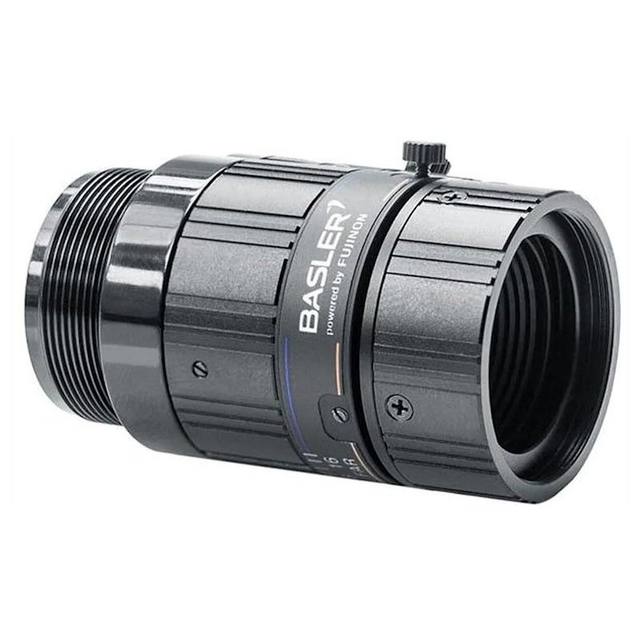
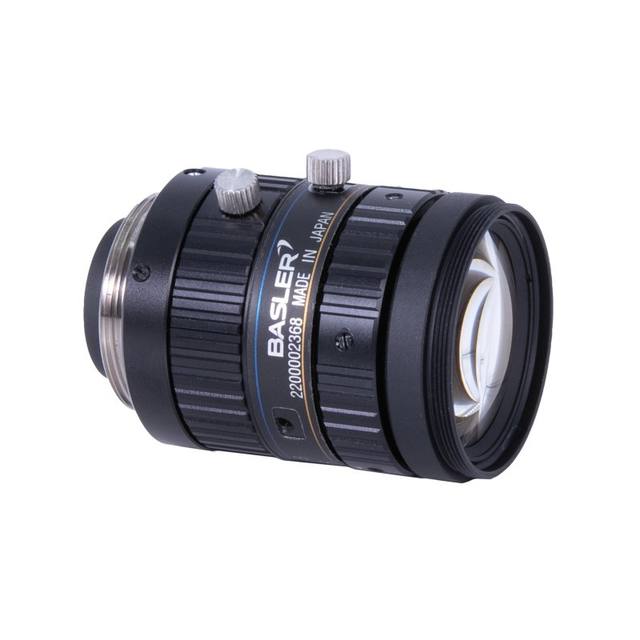
The VS-MC50H1 is part of VS Technology's VS-MCH1 series — a ruggedized, high-resolution fixed focal length lens line for 1" format C-mount cameras, marketed by Omron under part number 3Z4S-LE. The 50mm model provides a 12.8° × 12.8° angle of view and supports sensors up to 1" (approx. 16mm image circle). Minimum object distance is 500mm. A threaded iris plate system locks the selected aperture (F1.8, F5.6, or F8.0) in place to prevent dust generation from vibration, making it suitable for food, pharmaceutical, drone, and robotics applications. The manual-focus torque body enables precise, controlled focusing.
Brand
VS Technology
Focal length
50 mm
Lens mount
C-Mount
Aperture (f-number)
F1.8 / F5.6 / F8.0 (correct for 50mm model; series uses F1.4 for shorter focal lengths)
The VS-MC50H1 is a 50 mm fixed focal-length C-mount lens rated for 5-megapixel sensors, covering image circles up to the full 1" (16 mm diagonal) format. At 50 mm this is the longest focal length in the VS-MCH1 series, delivering a narrow 12.8° × 12.8° angle of view that naturally compresses perspective and yields fine angular magnification at distance. The maximum aperture of F1.8 gives installers enough light-gathering headroom to keep exposure times short under moderate ambient or continuous illumination, while the narrower locked positions — F5.6 and F8.0 — sit in the sharpest part of the aperture range for diffraction-limited performance across the full 5 MP sensor. All three positions (F1.8, F5.6, F8.0) are locked by the threaded iris plate system. The minimum working distance of 500 mm means this lens is designed for stand-off inspection stations rather than close-in macro work; at that distance a 1" sensor captures a field of view in the low hundreds of millimetres, appropriate for part-level dimensional checks, label reads, or surface scans on a conveyor.
The defining mechanical feature of the VS-MCH1 series is its ruggedisation package, which directly addresses two failure modes common in factory and mobile deployments. The iris plate is secured by a threaded locking mechanism rather than a friction-detent ring, so aperture cannot drift when the assembly is subjected to continuous vibration; critically, the threaded plate design does not generate abrasive particles that would contaminate a clean-room, food-processing, or pharmaceutical environment. The manual-focus torque body adds controlled damping to focus adjustment, preventing creep after the integrator sets focus during commissioning. Together these features make the lens compatible with drone-mounted imaging heads, robot end-effectors, and conveyor-mounted housings that see sustained vibration spectra which would cause a standard C-mount lens to drift out of focus or shift aperture over weeks of operation.
Because the lens is not telecentric, perspective error scales with the ratio of object depth to working distance — at 500 mm standoff this effect is modest and acceptable for most inspection and guidance tasks, but it rules the lens out for high-accuracy gauging of tall features where telecentricity would be required. The 5 MP optical resolution rating means it is matched to sensors such as 2/3" and 1" sensors up to 5 MP without introducing lens-limited blur; pairing it with a higher-resolution sensor is possible but the lens becomes the limiting element. The C-mount flange back of 17.526 mm is fully standard, so it seats on any C-mount camera body without adapters. For lighting, the 12.8° field and 500 mm+ standoff favour coaxial or on-axis ring illumination to minimise shadows on the narrow scene footprint, and the F1.8 maximum aperture means even LED ring lights with modest output can support microsecond-range strobe pulses for motion freeze.
Best for
Conveyor-mounted label and barcode inspection at 500 mm–1 m standoff on lines subject to vibration from adjacent machinery, where aperture drift and particle contamination are genuine failure risks.
Robot-arm or end-effector vision where the camera head is in constant motion and the locked iris prevents focus or aperture change between cycles.
Pharmaceutical and food-processing inspection cells where contamination rules prohibit debris generation from friction-based mechanical components inside the optical path.
Dimensional verification of medium-sized components (sub-200 mm field at 500 mm working distance) on 2/3" or 1" area-scan cameras up to 5 MP resolution.
Drone-mounted or mobile inspection platforms where mechanical shock and vibration during transit must not alter the calibrated optical setup between inspection runs.
Selection notes
Sensor format ceiling is 1" (16 mm diagonal): cameras with larger sensors — 4/3", 35 mm — will see hard vignetting at the corners. For sub-1" sensors the lens is fully compatible and the effective field of view narrows proportionally with the sensor's crop factor.
The lens is not telecentric, so it is unsuitable for high-accuracy dimensional gauging of objects with significant Z-height variation. For gauging tasks requiring better than ~0.1% dimensional accuracy across a 10 mm depth range at 500 mm, a telecentric lens should be specified instead.
Only three aperture positions are available: F1.8, F5.6, and F8.0. Installers cannot set intermediate stops, so depth-of-field and exposure must be engineered around these discrete values. Verify that the required depth of field is achievable at one of these three apertures before specifying.
Minimum working distance is 500 mm. If the inspection station geometry forces a shorter standoff, this lens cannot focus and a shorter-focal-length or macro-capable lens is required.
The C-mount thread is standard but the torque-body design means focus is set manually at installation and is not motorised. Applications requiring autofocus or remote focus adjustment must add a separate motorised focus stage or select a different lens family.
Specifications: General
Brand
VS Technology
Specifications: Optical
Focal length
50 mm
Lens mount
C-Mount
Aperture (f-number)
F1.8 / F5.6 / F8.0 (correct for 50mm model; series uses F1.4 for shorter focal lengths)
Image circle / max sensor
1" (16 mm diagonal, max sensor size)
Optical resolution
5 MP rated
Working distance
500 mm ~ ∞
Telecentric
No
Applications this camera is commonly selected for. Open one to see the full recommended hardware and approach.
Matched automatically by: camera mount fits the lens mount · camera sensor is covered by the lens image circle — this lens: C-Mount · 1" (16 mm diagonal, max sensor size) image circle.
These steps take an Omron Sentech (STC) camera from the box to a stable first image and on to your own application. They apply across the GigE Vision, USB3 Vision and CoaXPress STC families; the interface only changes how you cable and power the camera.
Download and install the Sentech SDK on the host PC. The package provides StViewer, the viewing and configuration software you use to bring the camera up, and StApi, the programming SDK you integrate later. Because the cameras are GenICam/GenTL-compliant, StApi also registers a GenTL producer, so any GenICam-compliant third-party vision software can discover and drive the camera as an alternative front end.
2. Cable, power and connect the camera
Connect according to the interface. GigE Vision: link to a Gigabit NIC (use PoE or the separate power input) and put the camera and host on the same subnet; for USB3 Vision use a USB 3.x port and a certified cable; for CoaXPress (STC) connect to a CoaXPress frame grabber, which also supplies Power-over-Coax. Then open StViewer and let it enumerate the camera. If a GigE camera does not appear, check the IP configuration and firewall, and on USB3 confirm the host bandwidth and driver.
3. Configure exposure, gain and white balance
Open the device in StViewer and start a live stream. Set exposure and gain for a well-exposed, low-noise image: raise exposure first and only add gain when more light or a faster shutter is not an option, keeping exposure short enough to freeze motion on global-shutter models. On colour cameras, run white balance under your actual production lighting. Adjust the lens aperture and focus on a representative target before tuning anything else.
4. Set the trigger and grab a first image
Start in free-run (continuous) acquisition to confirm a clean, stable image. For inline inspection switch to hardware or software triggering: select the trigger source, set the active edge and any delay, and wire the strobe or illumination to the camera's I/O so lighting fires with each exposure. Acquire and save a frame in StViewer; this saved image is your reference for the SDK stage and for downstream inspection.
5. Move to the StApi SDK (or any GenICam software)
Once the image is stable, reproduce the same settings in code. Use StApi to open the device, apply the GenICam features you validated in StViewer (exposure, gain, trigger, pixel format) and grab frames into your application via the bundled C++, C, C#/.NET or Python interfaces; the included samples are the fastest starting point. Prefer a different stack? The same GenICam/GenTL camera works with third-party vision libraries. With a reliable feed, you can route it into a deep-learning inspection such as Rosepetal for AI-based defect detection.
Frequently asked questions
The image circle is specified as 1" (16 mm diagonal). Any sensor at or below the 1" format — including 2/3", 1/1.8", and 1/1.2" — will be fully covered. Sensors larger than 1" will vignette.
500 mm is the specified minimum object distance. Below this the lens cannot achieve sharp focus. If your application requires a shorter standoff, a different focal length or close-focus lens is needed.
The VS-MCH1 series uses a threaded iris plate system that physically locks the aperture at F1.8, F5.6, or F8.0. This prevents vibration from shifting the aperture and eliminates particulate generation from friction-based iris mechanisms — both critical in pharmaceutical, food, and mobile deployments.
The lens is rated at 5 MP optical resolution and will support dimensional measurement tasks at moderate accuracy. However, it is not telecentric, so perspective-induced error is present for objects with depth variation. For sub-pixel gauging of features with significant Z-height, a telecentric lens is the correct choice.
The VS-MC50H1 uses a standard C-mount (17.526 mm flange back). It is compatible with any C-mount camera body regardless of interface (GigE, USB3, CoaXPress, Camera Link). No adapter is required for C-mount cameras.