Skip to content
Omron / Sentech STC-BBS2041POE-BC / STC-BCS2041POE-BC machine vision camera
  • Rosepetal compatible
  • Recommended by AIS Vision

Omron / Sentech Sentech STC-BBS2041POE-BC / STC-BCS2041POE-BC (20MP GigE Board Camera)

STC-BBS2041POE-BC

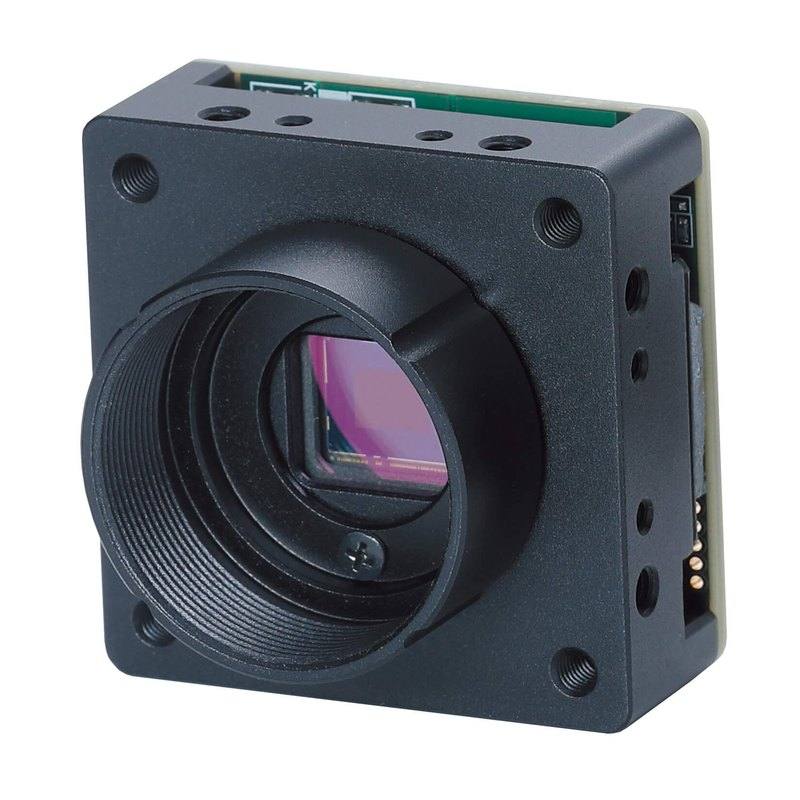
The STC-BBS2041POE-BC (monochrome) and STC-BCS2041POE-BC (color) are part of Omron Sentech's B-series GigE Vision CMOS board-level camera family, packaged in a compact ~38 mm square board form factor for OEM integration. Both use the 1-inch Sony IMX183 rolling-shutter CMOS sensor at 20 MP (5472 x 3648) with 2.4 µm pixels, delivering up to 5.5 fps at full resolution over a 1 Gbps GigE Vision / GenICam interface. The camera accepts a C-mount lens and is PoE-compatible (IEEE 802.3af), simplifying single-cable power and data, and can also run from an external DC supply.

Brand
Omron / Sentech
Camera type
Area scan
Interface
GigE Vision (1000BASE-T, 1 Gbps), PoE
Resolution
20 MP
Horizontal resolution
5472 x 3648 px
Mono / color
Mono (BBS) / Color (BCS)
Sensor manufacturer
sony_exmor (or sony_exmor_r); display 'Sony Exmor R' is correct
Sensor model
Sony IMX183
Shutter
Rolling shutter
FPS
5.5 fps at 20 MP
Mount
C-mount
Sensor size
1" optical format

Technical overview

This is a 20 MP area-scan camera built on the 1-inch Sony IMX183 CMOS sensor, resolving 5472 x 3648 pixels on a 2.4 micron pixel pitch. That pixel count is the headline reason to reach for this camera: across a single field of view it captures roughly 20 million sample points, which means you can frame a larger part and still hold enough pixels on each feature to resolve fine defects, small characters, or tight dimensional tolerances without tiling multiple exposures. The trade-off lives in the small 2.4 micron pixels - they keep the optical format at a manageable 1 inch but gather less light per pixel than a larger-pixel sensor, so it rewards generous, controlled illumination and a lens that can actually deliver detail at that pitch. The camera ships in monochrome (the BBS variant, this part number) and a color sibling (BCS); monochrome gives you the full per-pixel resolution and the best light sensitivity, which is usually what high-detail inspection wants unless color itself is the feature being judged.

The sensor uses a rolling shutter and runs at up to 5.5 fps at full 20 MP resolution. Rolling shutter reads the sensor line by line rather than exposing every pixel simultaneously, so this camera is squarely a still-scene or slow-motion tool: parts that are stationary at the moment of capture, indexed under the camera, or moving slowly enough that line-to-line skew is negligible. It is not the camera for fast continuous web motion or freezing parts flying past on a conveyor - for that you would want a global-shutter sensor. Pair it instead with an indexing stage or a stop-and-shoot station, and use a hardware trigger plus strobed lighting timed to the settle point so the whole frame is captured against a steady scene. At 20 MP each frame is large, so 5.5 fps is a sensible ceiling; cycle-time budgets should be planned around that full-frame rate.

Connectivity is GigE Vision over 1000BASE-T at 1 Gbps, speaking GenICam, with Power over Ethernet to the IEEE 802.3af standard (or an external DC supply). GigE Vision is the practical workhorse interface here: standard Cat cabling, the long cable reach that 1000BASE-T allows, and GenICam compliance means it drops into essentially any major machine-vision software stack without proprietary drivers. PoE is the integration win - a single Ethernet cable carries both data and power from an 802.3af-rated PoE switch or injector, which cuts cabling, simplifies cabinet wiring, and is well suited to the OEM and embedded role this camera is designed for. Physically it is a board-level camera in a compact roughly 38 mm square footprint with a C-mount, so it is meant to be built into an enclosure or instrument rather than used as a standalone boxed unit. The C-mount opens up a broad, inexpensive lens ecosystem, but note that driving 5472 horizontal pixels at 2.4 microns demands a genuinely high-resolution C-mount lens with the right image circle for the 1-inch format - the lens, not the sensor, will usually be the limit on real-world sharpness.

Best for

  • High-resolution surface and defect inspection on electronics, semiconductor wafers, and printed material, where 20 MP lets one frame cover a large area while still resolving small flaws
  • Dimensional measurement and metrology on stationary or indexed parts, using the full 5472 x 3648 pixel grid for sub-pixel gauging across a wide field of view
  • Industrial OCR/OCV and reading or verifying printed codes and characters, where high pixel density yields clean character edges for reliable decoding
  • OEM and embedded vision instruments that need a compact board-level camera (~38 mm square) integrated into an enclosure with single-cable PoE wiring
  • Stop-and-shoot or slow-indexed inspection stations where the rolling-shutter sensor captures a settled, stationary scene at up to 5.5 fps

Selection notes

  • Confirm the application is slow or stationary at capture: the rolling shutter and 5.5 fps full-frame rate make this a still-scene camera, not a choice for fast continuous motion - design in an indexing stage, hardware trigger, and strobe timed to the settle point
  • Budget for a true high-resolution C-mount lens with a 1-inch image circle; at 2.4 micron pixels the lens, not the sensor, typically sets the achievable detail, and an under-spec lens wastes the 20 MP
  • Plan illumination generously: small 2.4 micron pixels collect less light per pixel, so high-detail inspection benefits from bright, controlled, ideally strobed lighting to keep exposure short and noise low
  • Choose monochrome (this BBS part) for maximum per-pixel resolution and sensitivity, or the BCS color variant only when color is the feature being inspected - a color Bayer mask trades spatial detail and light for color information
  • Provision the network: GigE Vision at 1 Gbps fills the link with 20 MP frames, so allocate dedicated NICs or switch ports, and use an 802.3af-rated PoE switch or injector if you rely on single-cable PoE power
  • Treat the ~38 mm board-level form factor as an integration component - it needs mounting, thermal contact, and protection inside an enclosure rather than standalone deployment

Specifications: General
BrandOmron / Sentech
Camera typeArea scan

Specifications: Sensor
Resolution20 MP
Horizontal resolution5472 x 3648 px
Mono / colorMono (BBS) / Color (BCS)
Sensor manufacturersony_exmor (or sony_exmor_r); display 'Sony Exmor R' is correct
Sensor modelSony IMX183
ShutterRolling shutter
Sensor size1" optical format
Pixel size2.4 µm x 2.4 µm

Specifications: Performance
FPS5.5 fps at 20 MP

Specifications: Interface
InterfaceGigE Vision (1000BASE-T, 1 Gbps), PoE
ProtocolsGigE Vision, GenICam

Specifications: Optics
MountC-mount

Specifications: Electrical
PowerPoE (IEEE 802.3af) or external DC

Frequently asked questions

Related technical guides

Rosepetal · AI

Test this camera with Rosepetal

Validate your visual inspection with AI: send us sample images and we evaluate the case on your hardware.

AIS Vision · Integration

We validate camera + lens + lighting

AIS Vision defines and tests the optimal combination of camera, optics and lighting for your application before you buy.